Ganita Manjari Class 9 Maths Chapter 1: Orienting Yourself: The Use of Coordinates — NCERT Solutions
Chapter 1 of the new NCERT Class 9 Maths textbook Ganita Manjari (2026-27) — Orienting Yourself: The Use of Coordinates. Below are 14 questions from this chapter with answers and step-by-step explanations, including 8 diagram-based questions with their figures. Try each one before revealing the answer — and if a concept doesn't click, Vidya ma'am teaches this exact chapter live in the EduLevel app.
What Chapter 1 covers
Introduction
Settling In
The 2-D Cartesian Coordinate System
Distance Between Two Points in the 2-D Plane
Ganita Manjari Chapter 1 — solved questions
Attempt each question first, then open the answer to compare your method.
Q1Distance Between Two Points in the 2-D Planemedium3 marks
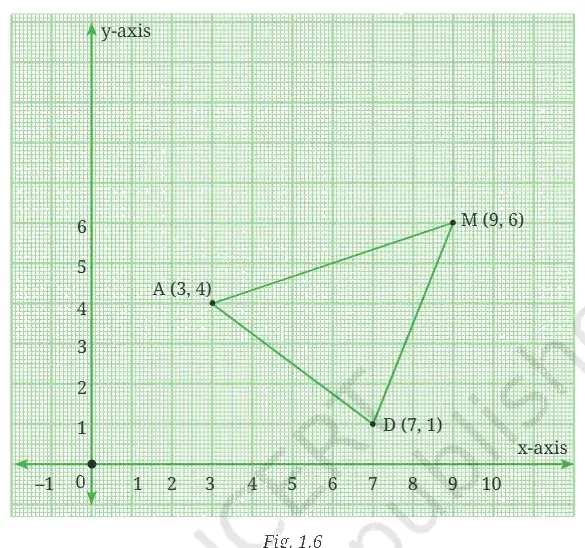
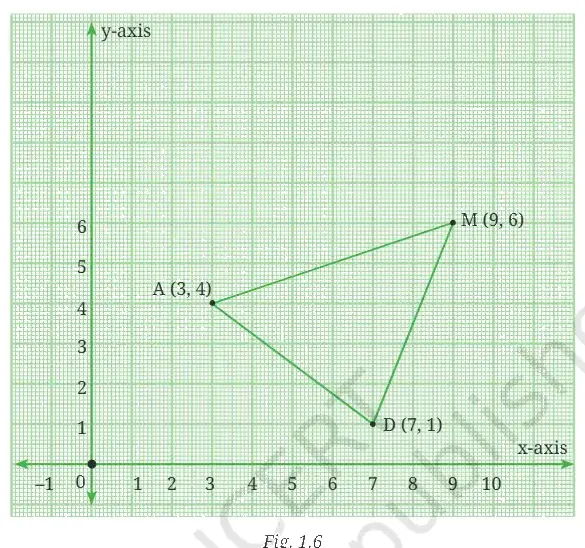
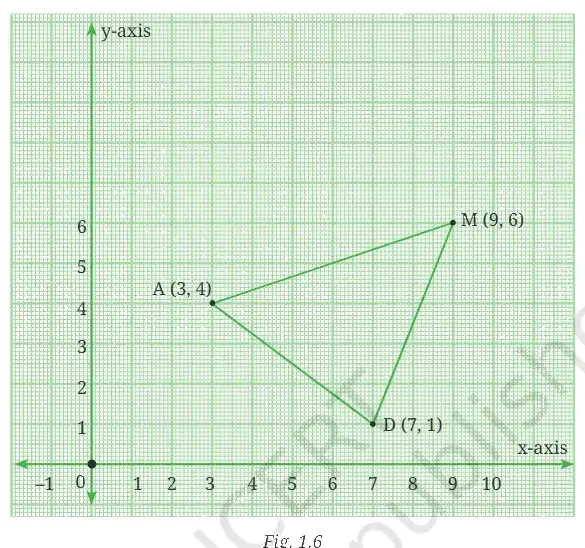
Consider the acute-angled triangle ADM located in the first quadrant as shown in the provided figure. How can the lengths of the sides AD, DM, and MA be determined?
Show answer & explanation
Answer: By the distance formula (Pythagoras on axis-parallel legs): AD = 5 units, DM = sqrt(29) = 5.39 units approx, MA = sqrt(40) = 2 sqrt(10) = 6.32 units approx.
Explanation: From the figure, A(3, 4), D(7, 1) and M(9, 6). For each side, form a right triangle whose legs are parallel to the axes: the horizontal leg is the difference of x-coordinates and the vertical leg is the difference of y-coordinates, and then apply the Pythagorean theorem, i.e. the distance formula sqrt((x2 - x1)2 + (y2 - y1)2). AD: legs 7 - 3 = 4 and 4 - 1 = 3, so AD = sqrt(42 + 32) = sqrt(25) = 5 units. DM: legs 9 - 7 = 2 and 6 - 1 = 5, so DM = sqrt(22 + 52) = sqrt(29), about 5.39 units. MA: legs 9 - 3 = 6 and 6 - 4 = 2, so MA = sqrt(62 + 22) = sqrt(40) = 2 sqrt(10), about 6.32 units.
Q2Settling Ineasy2 marks
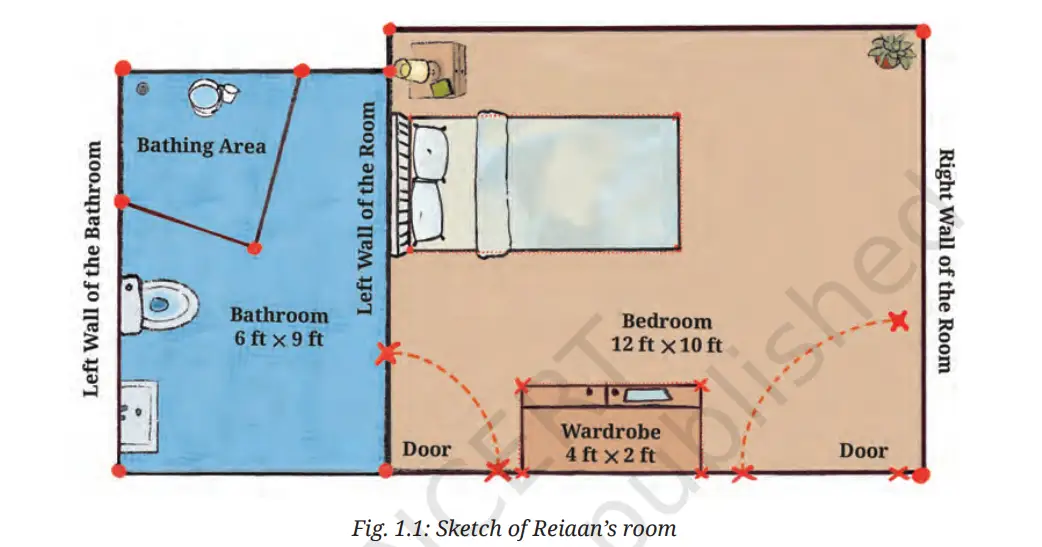
Referring to the sketch of Reiaan's room in Fig. 1.1, which depicts a floor plan, provide a reason why the positions of the windows cannot be represented on this particular map.
Show answer & explanation
Answer: Because the map is a 2-D top view of the floor; windows lie on the walls at a height above the floor, and this third dimension (height) cannot be shown on the floor plan.
Explanation: The sketch of Reiaan's room is a floor plan, i.e. the room seen from directly above, so it can record only two measurements: positions along the length and the breadth of the floor. Doors can be shown because their openings start at floor level, but windows are fixed on the vertical walls at some height above the floor. Specifying a window's position needs a third coordinate, its height above the floor, which a 2-D floor map has no way to represent, so the windows' positions cannot be marked on it.
Q3Distance Between Two Points in the 2-D Planeeasy2 marks
When moving from point A(3, 4) to point D(7, 1), calculate the horizontal distance covered parallel to the x-axis and the vertical distance covered parallel to the y-axis.
Show answer & explanation
Answer: Horizontal distance (parallel to x-axis) = 4 units; vertical distance (parallel to y-axis) = 3 units.
Explanation: The horizontal distance is the difference of the x-coordinates: 7 - 3 = 4 units, moved parallel to the x-axis. The vertical distance is the difference of the y-coordinates: 4 - 1 = 3 units, moved parallel to the y-axis (downwards, since D is lower than A). So going from A(3, 4) to D(7, 1) means 4 units across and 3 units down.
Q4Settling Ineasy2 marks
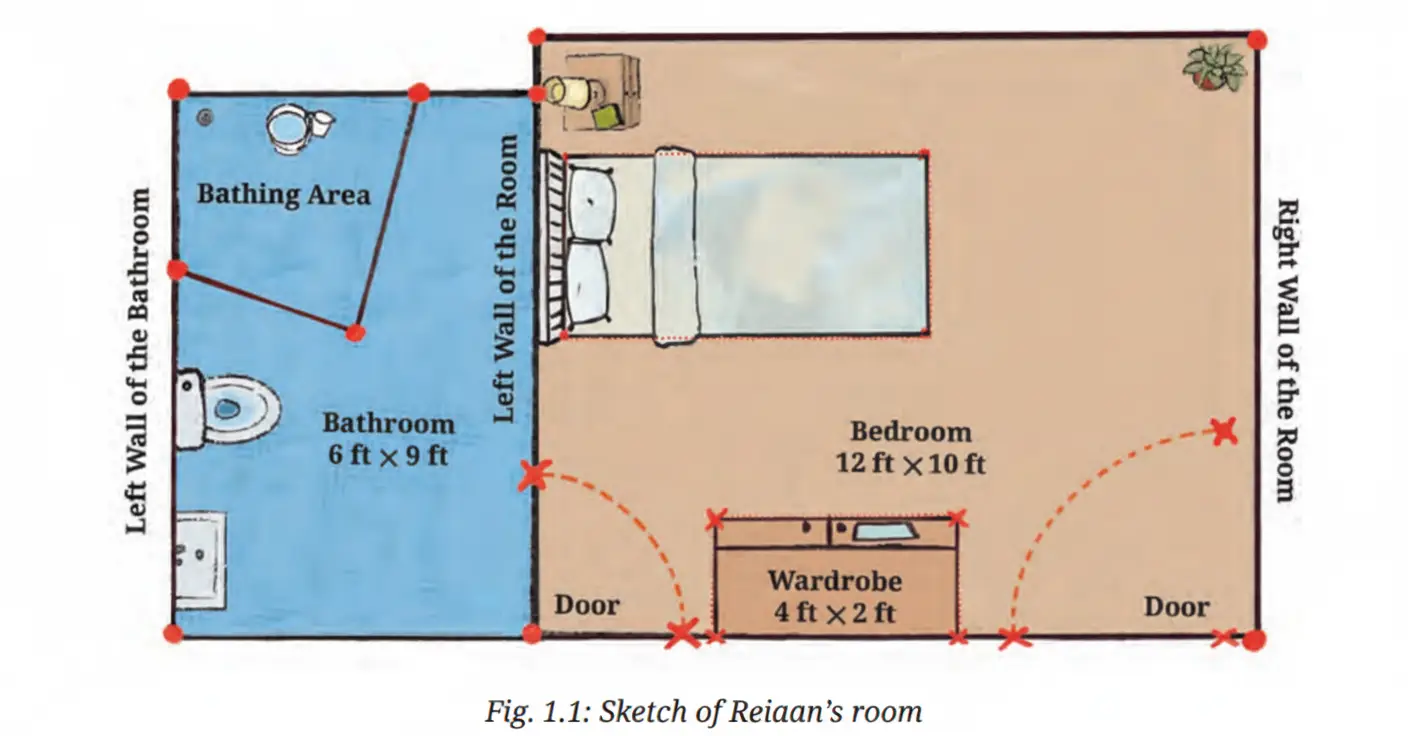
Referring to the floor plan of a room depicted in Fig. 1.1, provide a reason why the positions of the windows cannot be indicated on this type of map.
Show answer & explanation
Answer: Because the floor plan is a 2-D top view showing only positions on the floor; windows are on the walls at a height above the floor, and height (the third dimension) cannot be represented on such a map.
Explanation: A floor plan shows the room as seen from above, so every object is located using only two measurements, along the length and the breadth of the floor. A window sits on a vertical wall at some height above the floor, so fixing its position needs a third measurement, the height. Since a 2-D map cannot show this third dimension, the positions of the windows cannot be indicated on it.
Q5Distance Between Two Points in the 2-D Planeeasy2 marks
Can the horizontal and vertical distances calculated between points A and D be used to determine the direct distance AD?
Show answer & explanation
Answer: Yes. The horizontal and vertical distances are the two legs of a right triangle with AD as hypotenuse, so AD = sqrt(42 + 32) = sqrt(25) = 5 units.
Explanation: Complete the right triangle by taking the point C(3, 1): AC is vertical with length 4 - 1 = 3 units and CD is horizontal with length 7 - 3 = 4 units, and the angle at C is 90 degrees since the segments are parallel to the axes. By the Pythagorean theorem, AD2 = AC2 + CD2 = 32 + 42 = 9 + 16 = 25. Therefore AD = sqrt(25) = 5 units, so the two axis-parallel distances do determine the direct distance.
Q6Distance Between Two Points in the 2-D Planemedium3 marks
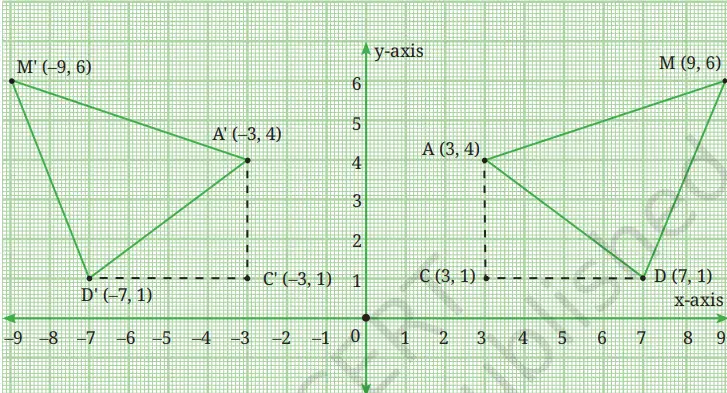
Referring to the reflection of triangle ADM to A'D'M' across the y-axis as shown in the figure, identify which properties have remained the same and which have changed.
Show answer & explanation
Answer: Same: shape, size, side lengths (AD = A'D' = 5, DM = D'M' = sqrt(29), MA = M'A' = sqrt(40)), angles, area, y-coordinates, and each point's distance from the y-axis. Changed: the signs of the x-coordinates (position moves from the first quadrant to the second) and the orientation, since the image is a mirror image.
Explanation: Reflection in the y-axis maps A(3, 4) to A'(-3, 4), D(7, 1) to D'(-7, 1) and M(9, 6) to M'(-9, 6): each y-coordinate is unchanged while each x-coordinate changes sign. Applying the distance formula to the image gives A'D' = sqrt(42 + 32) = 5, D'M' = sqrt(22 + 52) = sqrt(29) and M'A' = sqrt(62 + 22) = sqrt(40), exactly the lengths of AD, DM and MA, so the size, shape, angles and area are preserved. What changes is the position of the triangle (it now lies in the second quadrant) and its orientation: going round A' to D' to M' is the reverse sense of going round A to D to M, as expected for a mirror image.
Q7The 2-D Cartesian Coordinate Systemhard3 marks
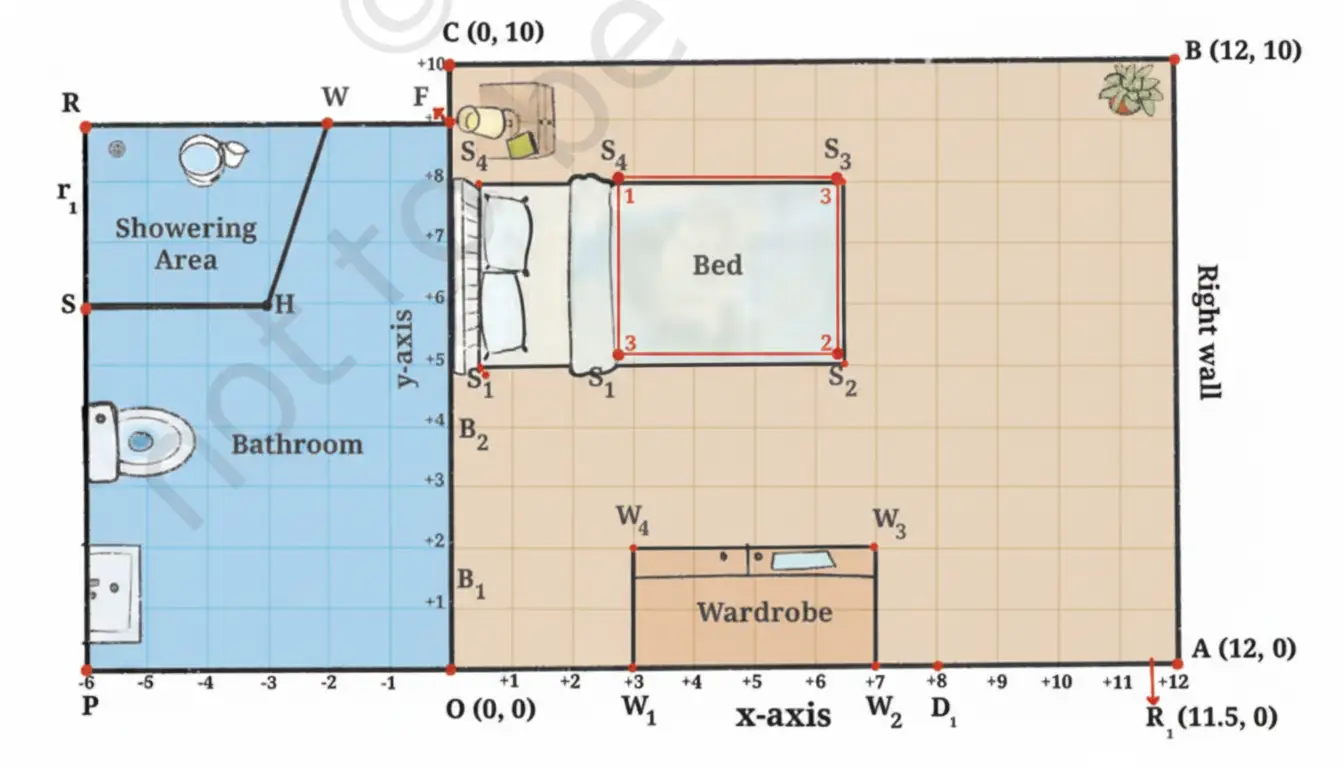
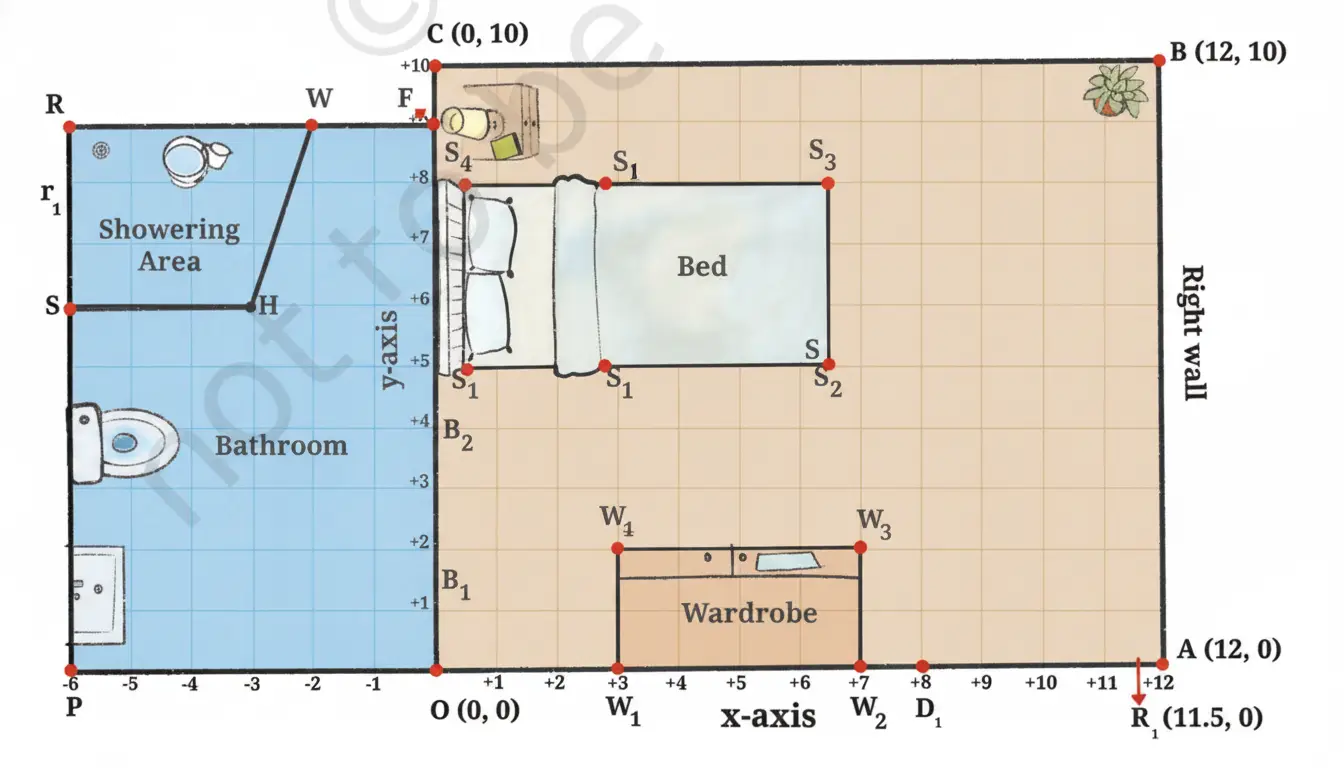
Based on a provided diagram of a house layout, if a bathroom door hinged at point B opens into a bedroom, will it collide with a wardrobe? Suggest any modifications that would be needed if the door's width were increased.
Show answer & explanation
Answer: No, it will not hit the wardrobe — it clears it by half a foot. The door runs from B1(0, 1.5) to B2(0, 4), so it is 2.5 ft wide, and its free edge sweeps an arc of radius 2.5 ft about the hinge (0, 1.5). The nearest wardrobe point is (3, 1.5), 3 ft away. The door could be widened up to 3 ft before it first touches.
Explanation: Read the hinge points off the plan: B1(0, 1.5) and B2(0, 4), so the door width is 4 - 1.5 = 2.5 ft. Hinged at B1 and swinging into the bedroom, every point of the door stays within 2.5 ft of (0, 1.5). The wardrobe occupies x from 3 to 7 and y from 0 to 2, so its closest point to the hinge is (3, 1.5), at a distance of 3 - 0 = 3 ft. Since the swing radius 2.5 ft is less than 3 ft, the door stops 0.5 ft short and never reaches the wardrobe. Widening the door only matters past 3 ft; beyond that the wardrobe must move further from the y-axis, or the door be re-hinged at B2, opened into the bathroom, or made a sliding door.
Q8The 2-D Cartesian Coordinate Systemhard3 marks
Referring to the layout of Reiaan's bathroom: (i) Identify the coordinates for the four corners labeled O, F, R, and P. (ii) Describe the geometric shape of the showering area SHWR and state the coordinates of its four corners. (iii) Designate a 3 ft by 2 ft area for a washbasin and a 2 ft by 3 ft area for a toilet, and provide the coordinates for the corners of these two spaces.
Show answer & explanation
Answer: (i) O(0, 0), F(0, 9), R(-6, 9), P(-6, 0). (ii) SHWR is a trapezium (SH parallel to RW) with S(-6, 6), H(-3, 6), W(-2, 9), R(-6, 9). (iii) One possible design: washbasin (3 ft x 2 ft) at (-4, 0), (-1, 0), (-1, 2), (-4, 2); toilet (2 ft x 3 ft) at (-6, 2), (-4, 2), (-4, 5), (-6, 5).
Explanation: (i) The bathroom is 6 ft x 9 ft and lies to the left of the y-axis, so its corners are O(0, 0), F(0, 9), R(-6, 9) and P(-6, 0). (ii) The showering area has corners S(-6, 6), H(-3, 6), W(-2, 9) and R(-6, 9); SH and RW are both horizontal, hence parallel, while HW is slanted, so exactly one pair of opposite sides is parallel and SHWR is a trapezium. (iii) Any placement inside the bathroom that avoids the showering area and the door B1B2 works: for example a 3 ft x 2 ft washbasin along the bottom wall with corners (-4, 0), (-1, 0), (-1, 2), (-4, 2), and a 2 ft x 3 ft toilet along the left wall with corners (-6, 2), (-4, 2), (-4, 5), (-6, 5); these regions do not overlap each other or the showering area.
Q9The 2-D Cartesian Coordinate Systemeasy1 mark
Investigate and state the typical widths for doors in a room. You can measure doors in your own home or at school to gather data.
Show answer & explanation
Answer: Typical room doors are about 2.5 ft to 3.5 ft (about 75 cm to 105 cm) wide: bedroom/classroom doors about 3 ft, bathroom doors about 2.5 ft, and main entrance doors about 3.5 ft to 4 ft.
Explanation: This is a measurement activity: measure the clear width of several doors at home and at school with a measuring tape and tabulate the results. Typical findings are that interior doors of living rooms and bedrooms are around 3 ft (about 90 cm) wide, bathroom and toilet doors are slightly narrower at about 2.5 ft (75 cm), and main doors are wider, about 3.5 ft to 4 ft, so that furniture and people can pass easily. So most room doors fall in the range of roughly 2.5 ft to 3.5 ft.
Q10Distance Between Two Points in the 2-D Planemedium2 marks
If triangle ADM were reflected across the x-axis instead of the y-axis, would the observations about the properties that change and remain the same still hold true?
Show answer & explanation
Answer: Yes. Reflecting across the x-axis (A(3, 4) to (3, -4), D(7, 1) to (7, -1), M(9, 6) to (9, -6)) again keeps all side lengths, angles, size and shape the same and reverses the orientation; the only difference is that now the y-coordinates change sign while the x-coordinates stay the same, and the image lies in the fourth quadrant.
Explanation: Under reflection in the x-axis, each point (x, y) maps to (x, -y), so A(3, 4), D(7, 1), M(9, 6) go to (3, -4), (7, -1), (9, -6). The differences of coordinates between any two vertices keep the same absolute values, so by the distance formula every side length is unchanged (AD = 5, DM = sqrt(29), MA = sqrt(40)), and hence the angles, shape, size and area are all preserved, while the figure is again a mirror image with reversed orientation. The observations therefore still hold, with the roles of x and y swapped: previously the x-coordinates changed sign and the triangle moved to the second quadrant; now the y-coordinates change sign and the triangle moves to the fourth quadrant.
Q11The 2-D Cartesian Coordinate Systemeasy1 mark
Assess whether the doors at your school are wide enough to accommodate individuals in wheelchairs.
Show answer & explanation
Answer: A standard wheelchair is about 60 cm to 70 cm (2 ft to 2.25 ft) wide, so a door needs a clear width of at least about 90 cm (3 ft) for comfortable wheelchair access; measure the school doors and compare, since doors of 3 ft or more are adequate while narrower ones (for example 2.5 ft toilet doors) are not.
Explanation: This is a measurement-and-comparison activity. A typical wheelchair is about 60 cm to 70 cm wide, and accessibility guidelines recommend a clear doorway width of at least about 90 cm (roughly 3 ft) so that the chair can pass with room for the user's hands on the wheels. Measure the clear width of classroom, laboratory and toilet doors at school with a tape: doors of 3 ft (90 cm) or more can accommodate wheelchairs comfortably, while doors of about 2.5 ft (75 cm) or less are too narrow and would need widening.
Q12Distance Between Two Points in the 2-D Planemedium3 marks
Plot the point Z(5, -6) on a Cartesian plane. Form a right-angled triangle IZN and determine the lengths of its three sides.
Show answer & explanation
Answer: With N(5, 0) the foot of the perpendicular from Z to the x-axis and I(0, -6) the foot on the y-axis, triangle IZN is right-angled at Z with IZ = 5 units, ZN = 6 units and IN = sqrt(61) = 7.81 units approx.
Explanation: Plot Z(5, -6), which lies in the fourth quadrant, 5 units right of the y-axis and 6 units below the x-axis. Drop a perpendicular from Z to the x-axis to meet it at N(5, 0), and a perpendicular to the y-axis to meet it at I(0, -6); since IZ is horizontal and ZN is vertical, the angle at Z is 90 degrees, giving right triangle IZN. Then IZ = 5 - 0 = 5 units and ZN = 0 - (-6) = 6 units, and by the Pythagorean theorem the hypotenuse IN = sqrt(52 + 62) = sqrt(25 + 36) = sqrt(61), about 7.81 units.
Q13The 2-D Cartesian Coordinate Systemeasy1 mark
Determine the value of the x-coordinate for any point that lies on the y-axis.
Show answer & explanation
Answer: The x-coordinate of any point on the y-axis is 0.
Explanation: The x-coordinate of a point measures its perpendicular distance from the y-axis (positive to the right, negative to the left). A point lying on the y-axis is at zero distance from it, so its x-coordinate must be 0. Hence every point on the y-axis has coordinates of the form (0, y).
Q14Distance Between Two Points in the 2-D Planemedium3 marks
Determine if the points M(-3, -4), A(0, 0), and G(6, 8) lie on the same straight line. Propose a method to verify this without plotting the points.
Show answer & explanation
Answer: Yes, M, A and G are collinear: MA = 5, AG = 10 and MG = 15, and since MA + AG = MG the three points lie on one straight line; the check uses only the distance formula, with no plotting.
Explanation: Method: compute the three pairwise distances with the distance formula; the points are collinear exactly when the sum of the two smaller distances equals the largest. MA = sqrt((0 - (-3))2 + (0 - (-4))2) = sqrt(9 + 16) = sqrt(25) = 5 units; AG = sqrt(62 + 82) = sqrt(36 + 64) = sqrt(100) = 10 units; MG = sqrt((6 - (-3))2 + (8 - (-4))2) = sqrt(81 + 144) = sqrt(225) = 15 units. Since MA + AG = 5 + 10 = 15 = MG, the point A lies on the segment MG, so the three points are on the same straight line. (Equivalently, for both M and G the ratio y/x equals 4/3, so both lie on the same line through the origin A.)
Stuck anywhere in Chapter 1 (Orienting Yourself: The Use of Coordinates)? Vidya ma'am — EduLevel's AI teacher — teaches this chapter live, by voice, and solves your doubts till they click.