Ganita Manjari Class 9 Maths Chapter 5: I'm Up and Down, and Round and Round — NCERT Solutions
Chapter 5 of the new NCERT Class 9 Maths textbook Ganita Manjari (2026-27) — I'm Up and Down, and Round and Round. Below are 14 questions from this chapter with answers and step-by-step explanations, including 8 diagram-based questions with their figures. Try each one before revealing the answer — and if a concept doesn't click, Vidya ma'am teaches this exact chapter live in the EduLevel app.
What Chapter 5 covers
Shapes in Nature
Definitions
Symmetries
How Many Circles?
Chords & Angles
Midpoints of Chords
Distance from Centre
Angles Subtended by Arc
Concyclicity of Points
Ganita Manjari Chapter 5 — solved questions
Attempt each question first, then open the answer to compare your method.
Q1Distance from Centremedium3 marks
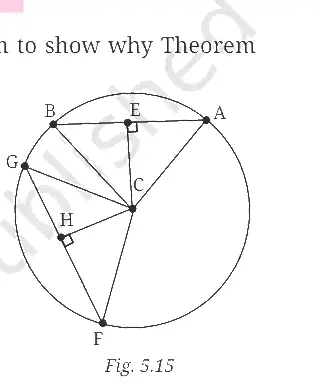
Referring to the provided diagram (Fig. 5.15), given that CE is perpendicular to chord AB and CH is perpendicular to chord GH, and that the lengths of these perpendiculars are equal (CE = CH), prove that the chords are also equal in length (AB = GF).
Show answer & explanation
Answer: Proved: AB = GF, since chords equidistant from the centre are equal.
Explanation: Join the radii CA and CG. In right triangles CEA and CHG, angle CEA = angle CHG = 90°, the hypotenuses CA and CG are equal (radii of the same circle), and CE = CH (given). By the RHS congruence rule, triangle CEA is congruent to triangle CHG, so AE = GH. Since the perpendicular from the centre bisects a chord, AB = 2AE and GF = 2GH. Therefore AB = 2AE = 2GH = GF, which proves that chords equidistant from the centre are equal in length.
Q2Angles Subtended by Arceasy2 marks
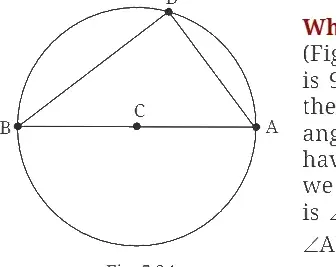
Explain why the angle subtended by a diameter at any point on the circumference of a circle is always 90 degrees, as illustrated in the figure.
Show answer & explanation
Answer: Because a diameter subtends a straight angle (180°) at the centre, the angle at any point on the circle is half of it, i.e. 180°/2 = 90°.
Explanation: In the figure, BA is a diameter passing through the centre C, and D is a point on the circle. The angle subtended by BA at the centre is angle BCA = 180°, since B, C and A lie on one straight line. By the central angle theorem, the angle subtended by an arc at the centre is twice the angle subtended by it at any point on the remaining part of the circle. Hence angle BDA = (1/2) x angle BCA = (1/2) x 180° = 90°, so a diameter always subtends a right angle at any point on the circumference.
Q3Midpoints of Chordseasy2 marks
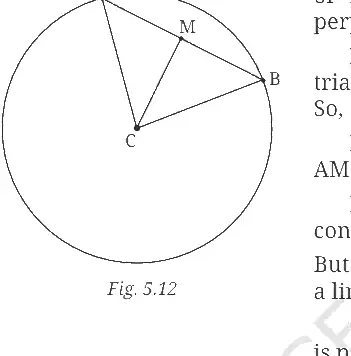
Justify the converse of Theorem 4 by explaining why a perpendicular line drawn from a circle's center to a chord must bisect that chord. Use the provided hint which suggests using Fig. 5.12, given that ∠CMA = ∠CMB = 90°, to prove that AM = BM.
Show answer & explanation
Answer: Proved: AM = BM, so the perpendicular from the centre to a chord bisects the chord.
Explanation: Join the radii CA and CB. In triangles CMA and CMB, angle CMA = angle CMB = 90° (given, since CM is perpendicular to chord AB), the hypotenuses CA and CB are equal (radii of the same circle), and side CM is common to both triangles. By the RHS congruence rule, triangle CMA is congruent to triangle CMB. Therefore AM = BM by CPCT, which shows that the perpendicular drawn from the centre to a chord must bisect the chord.
Q4Concyclicity of Pointshard3 marks
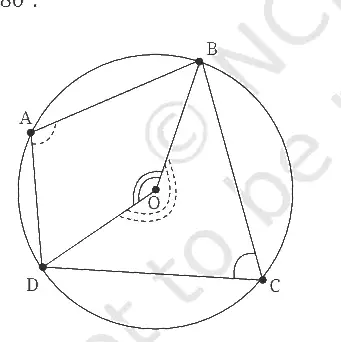
Prove that the sum of the opposite angles of a quadrilateral inscribed in a circle (a cyclic quadrilateral) is 180 degrees.
Show answer & explanation
Answer: Proved: in a cyclic quadrilateral ABCD, angle A + angle C = 180° and angle B + angle D = 180°.
Explanation: Let ABCD be a quadrilateral inscribed in a circle with centre O; join OB and OD. Arc BCD subtends angle BOD at the centre and angle BAD at point A on the remaining part of the circle, so angle BOD = 2 x angle A. Similarly, arc BAD subtends the reflex angle BOD at the centre and angle BCD at C, so reflex angle BOD = 2 x angle C. Adding these, angle BOD + reflex angle BOD = 360° gives 2(angle A + angle C) = 360°, so angle A + angle C = 180°. Since all four angles of a quadrilateral sum to 360°, the other pair also satisfies angle B + angle D = 360° - 180° = 180°.
Q5Angles Subtended by Arceasy2 marks
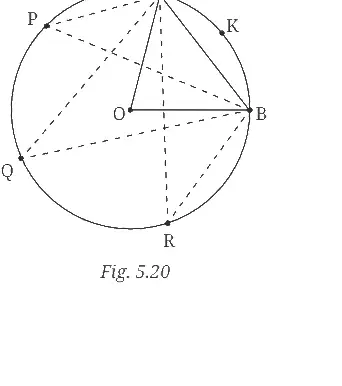
As an activity, consider the provided figure of a circle. First, measure the central angle subtended by the arc AKB. Then, measure the angles subtended by the same arc at points P, Q, and R, which lie on the remaining part of the circle. State the observation you make about the angles at P, Q, and R. Further, what relationship can you establish between the central angle and the angle at any point on the remaining part of the circle? You are encouraged to repeat this process with a different arc to confirm your findings.
Show answer & explanation
Answer: Observation: angle APB = angle AQB = angle ARB (all equal); relationship: angle AOB = 2 x the angle subtended by arc AKB at any point on the remaining part of the circle.
Explanation: On measuring with a protractor, the angles subtended by arc AKB at P, Q and R come out equal: angle APB = angle AQB = angle ARB. This is the observation — an arc subtends equal angles at all points on the remaining part of the circle (angles in the same segment are equal). Comparing with the central angle, each of these angles measures exactly half of angle AOB, so the relationship is angle AOB = 2 x angle APB. Repeating the activity with a different arc (including a major arc, where the central angle is reflex) gives the same two results, confirming the central angle theorem.
Q6How Many Circles?medium3 marks
Provide a justification for Theorem 1, which states that there is a unique circle passing through any three non-collinear points.
Show answer & explanation
Answer: The perpendicular bisectors of AB and BC intersect at exactly one point O with OA = OB = OC, so the circle with centre O and radius OA is the one and only circle through A, B and C.
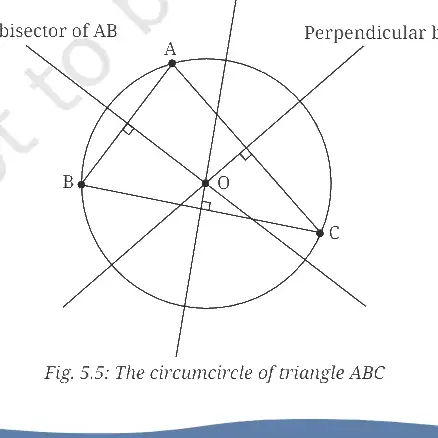
Explanation: Let A, B, C be three non-collinear points. Every point equidistant from A and B lies on the perpendicular bisector of AB, and every point equidistant from B and C lies on the perpendicular bisector of BC. Since A, B, C are not collinear, AB and BC are not parallel, so their perpendicular bisectors are also not parallel and intersect at exactly one point O; this point satisfies OA = OB = OC. The circle with centre O and radius OA therefore passes through all three points. For uniqueness, the centre of any circle through A, B and C must be equidistant from all three, so it must lie on both perpendicular bisectors and hence coincide with O, with radius OA — so exactly one such circle exists.
Q7Angles Subtended by Arceasy2 marks
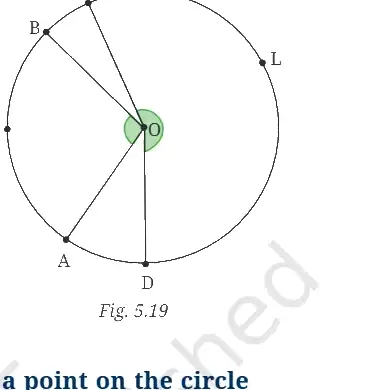
For the given circle with center O and points A, B, C, D on its circumference as shown in the figure, use a protractor to measure the central angles corresponding to arc AKB and arc CLD. Using these measurements, classify each arc as either a minor arc or a major arc.
Show answer & explanation
Answer: Arc AKB: central angle AOB is about 100° (less than 180°), so it is a minor arc; arc CLD: its central angle is the reflex angle at O, about 200° (more than 180°), so it is a major arc.
Explanation: Place the protractor at the centre O. The central angle AOB corresponding to arc AKB measures about 100°; since this is less than 180°, arc AKB is a minor arc. The central angle corresponding to arc CLD is the reflex angle COD (shown shaded at O in the figure), which measures about 200°; since this is more than 180°, arc CLD is a major arc. The rule used is: an arc is minor when its central angle is less than 180° and major when its central angle is a reflex angle, i.e. greater than 180°.
Q8Angles Subtended by Arceasy1 mark
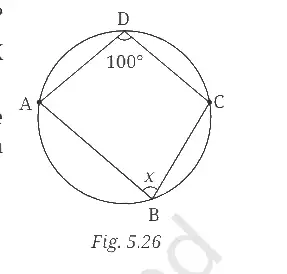
Using the provided diagram (Fig. 5.26), determine the value of angle x.
Show answer & explanation
Answer: x = 80°
Explanation: Points A, D, C and B all lie on the circle, so ADCB is a cyclic quadrilateral in which angle ADC = 100° and angle ABC = x are a pair of opposite angles. Opposite angles of a cyclic quadrilateral are supplementary, so angle ADC + angle ABC = 180°. Therefore x = 180° - 100° = 80°. Equivalently, angles ADC and ABC lie in opposite segments of the chord AC, so they must add up to 180°.
Q9How Many Circles?easy1 mark
As the center of a circle passing through points A and B is moved along the perpendicular bisector, does the curvature of the circle appear to increase or decrease?
Show answer & explanation
Answer: The curvature decreases as the centre moves farther from AB (the circle grows larger and flatter); it increases as the centre moves closer to AB.
Explanation: Every circle through A and B has its centre on the perpendicular bisector of AB. As the centre moves farther away from AB along this bisector, the radius OA keeps increasing, so the circle becomes larger. Curvature is inversely related to the radius (a bigger circle bends less sharply), so the curvature decreases and the arc through A and B looks flatter and flatter, approaching a straight line. Conversely, moving the centre towards the midpoint of AB makes the radius smaller and the curvature greater.
Q10Shapes in Natureeasy1 mark
Provide a list of various objects found in nature that have a circular shape.
Show answer & explanation
Answer: Examples: the discs of the Sun and the full Moon, ripples on still water, the iris and pupil of the eye, growth rings of a tree trunk, a rainbow, water droplets and bubbles, cross-sections of fruits like oranges, and round flower heads like sunflowers.
Explanation: Circles appear widely in nature because many natural processes act equally in all directions from a central point. Common examples include the discs of the Sun and the full Moon, circular ripples spreading on still water, the iris and pupil of the human eye, and the annual growth rings seen in a cut tree trunk. Other examples are a rainbow (a full circle when seen from high above), water droplets and soap bubbles seen face-on, the cross-sections of fruits such as oranges and lemons, and round flower heads such as sunflowers. Any such set of naturally round objects is an acceptable answer.
Q11Midpoints of Chordsmedium3 marks
In a circle with a 5 cm radius, there are two parallel chords measuring 6 cm and 8 cm in length. These chords are situated on opposite sides of the circle's center. Determine the perpendicular distance between these two chords.
Show answer & explanation
Answer: 7 cm
Explanation: The perpendicular from the centre bisects a chord, so the half-lengths of the chords are 3 cm and 4 cm. For the 6 cm chord, its distance from the centre is sqrt(52 - 32) = sqrt(25 - 9) = sqrt(16) = 4 cm, using Pythagoras with the radius as hypotenuse. For the 8 cm chord, the distance is sqrt(52 - 42) = sqrt(25 - 16) = sqrt(9) = 3 cm. Since the chords are parallel and on opposite sides of the centre, the distance between them is the sum 4 + 3 = 7 cm.
Q12Chords & Angleseasy2 marks
Consider two isosceles triangles formed by joining the endpoints of two different chords to the center of the same circle. If the lengths of the chords (the bases of the triangles) are equal, demonstrate that the two triangles are congruent to each other.
Show answer & explanation
Answer: Proved: triangle OAB is congruent to triangle OCD by the SSS rule (OA = OC, OB = OD as radii, AB = CD given).
Explanation: Let the chords be AB and CD in a circle with centre O, so the two triangles are OAB and OCD. Here OA = OC and OB = OD, because all four are radii of the same circle (this is also why each triangle is isosceles). The bases are equal, AB = CD, since the chords are given to be equal. By the SSS congruence rule, triangle OAB is congruent to triangle OCD. In particular, by CPCT angle AOB = angle COD, showing that equal chords subtend equal angles at the centre.
Q13Angles Subtended by Archard3 marks
Consider two points, A and B, on a circle centered at O.
(i) Can two distinct points, X and Y, exist on the circle and on the same side of line AB, for which the angle ∠AXB is not equal to ∠AYB?
(ii) If ∠AXB equals ∠AYB, does this imply that points X and Y are on the same side of the circle?
(iii) If ∠AXB is equal to ∠AYB, but X and Y are not on the circle, is it necessary that the circle passing through points A, B, and X must also pass through point Y?
Show answer & explanation
Answer: (i) No, such points cannot exist; (ii) not necessarily — if AB is a diameter, points on opposite sides also give equal (90°) angles, otherwise yes; (iii) yes, provided X and Y are on the same side of line AB, the circle through A, B, X must also pass through Y.
Explanation: (i) No. Points on the circle on the same side of AB lie in the same segment, and angles in the same segment of a circle are equal, so angle AXB = angle AYB always holds. (ii) Not necessarily: if X and Y lie on opposite sides of AB, the angles lie in opposite segments and are supplementary, so they can still be equal when each is 90°, which happens exactly when AB is a diameter; for any chord that is not a diameter, equal angles do force X and Y to the same side. (iii) Yes, when X and Y lie on the same side of line AB: by the converse of the angles-in-the-same-segment theorem, two points on the same side of AB subtending equal angles at AB must be concyclic with A and B, so the circle through A, B and X necessarily passes through Y as well.
Q14Symmetriesmedium2 marks
In a circle with a radius of 5 units, what is the length of the longest possible chord? Additionally, discuss whether a 'smallest chord' exists and explain your reasoning.
Show answer & explanation
Answer: Longest chord = the diameter = 10 units; no smallest chord exists — chords can be made arbitrarily short but never of zero length.
Explanation: The longest chord of a circle is its diameter. For any chord AB, joining its endpoints to the centre O gives AB <= OA + OB = 2r by the triangle inequality, with equality exactly when the chord passes through the centre. So the longest chord has length 2 x 5 = 10 units. A smallest chord does not exist: a chord must meet the circle at two distinct points, so its length is always greater than 0, yet by taking the two points closer and closer together the chord can be made shorter than any given positive length. Since no positive length can be the minimum, there is no smallest chord.
Stuck anywhere in Chapter 5 (I'm Up and Down, and Round and Round)? Vidya ma'am — EduLevel's AI teacher — teaches this chapter live, by voice, and solves your doubts till they click.