Ganita Manjari Class 9 Maths Chapter 2: Introduction to Linear Polynomials — NCERT Solutions
Chapter 2 of the new NCERT Class 9 Maths textbook Ganita Manjari (2026-27) — Introduction to Linear Polynomials. Below are 14 questions from this chapter with answers and step-by-step explanations, including 8 diagram-based questions with their figures. Try each one before revealing the answer — and if a concept doesn't click, Vidya ma'am teaches this exact chapter live in the EduLevel app.
What Chapter 2 covers
Introduction
Linear Polynomials
Exploring linear patterns
Linear growth
Linear Relationships
Visualizing linear relationships
Ganita Manjari Chapter 2 — solved questions
Attempt each question first, then open the answer to compare your method.
Q1Linear growtheasy2 marks
The cost of a journey, C, is defined by the linear function C(d) = 100 + 60d, where d is the distance in kilometers. Construct a table to show how the cost changes for distances from 0 to 10 km.
Show answer & explanation
Answer: d (km): 0,1,2,3,4,5,6,7,8,9,10 gives C (Rs): 100, 160, 220, 280, 340, 400, 460, 520, 580, 640, 700
Explanation: Substitute each value of d from 0 to 10 into C(d) = 100 + 60d. For example, C(0) = 100 + 60 x 0 = 100, C(1) = 100 + 60 = 160, C(2) = 100 + 120 = 220, and so on up to C(10) = 100 + 600 = 700. Each time d increases by 1 km, the cost increases by a fixed amount of Rs 60, which is the mark of a linear relationship.
Q2Exploring linear patternseasy2 marks
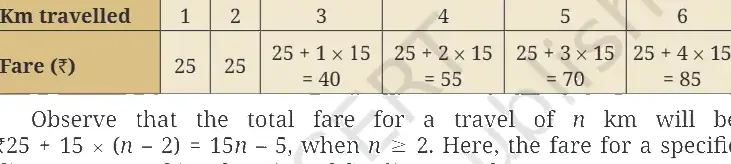
An auto-rickshaw has a fixed fare of ₹25 for the first 2 km. After that, the fare increases by ₹15 for each additional kilometer. What will be the total fare for a journey of 10 km?
Show answer & explanation
Answer: Total fare for 10 km = Rs 145
Explanation: The first 2 km cost a fixed Rs 25, so only the distance beyond 2 km is charged extra. Additional distance = 10 - 2 = 8 km, charged at Rs 15 per km, giving 8 x 15 = Rs 120. Total fare = 25 + 120 = Rs 145. This matches the pattern in the table (fare for n km = 25 + 15(n - 2) for n >= 2).
Q3Visualizing linear relationshipseasy2 marks
For the line represented by the equation y = 2x + 1, identify additional points on the line by completing the provided table.
Show answer & explanation
Answer: For x = 1, 2, 5, 7, 9, 12, 20 the values of y are 3, 5, 11, 15, 19, 25, 41; the missing entries are y = 5, 11, 19, 25, 41
Explanation: Every point on the line satisfies y = 2x + 1, so substitute each given x-value into the equation. For x = 2: y = 2 x 2 + 1 = 5; for x = 5: y = 11; for x = 9: y = 19; for x = 12: y = 25; for x = 20: y = 41. The given entries check out too: x = 1 gives y = 3 and x = 7 gives y = 15, confirming the rule.
Q4Exploring linear patternsmedium3 marks
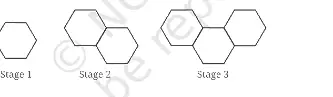
The image shows the first three stages of a pattern constructed with matchsticks, where each new stage adds a hexagon sharing one side with the previous one.
(i) Sketch the next two stages of this pattern and state the number of matchsticks needed for each.
(ii) Complete the provided table for the number of matchsticks.
(iii) Formulate a general rule for the number of matchsticks required for the nth stage.
(iv) Calculate the number of matchsticks needed for the 15th stage.
(v) Determine if a stage can be built with exactly 200 matchsticks, and provide a justification for your answer.
Show answer & explanation
Answer: (i) Stage 4 = 21, Stage 5 = 26 matchsticks; (ii) 6, 11, 16, 21, 26; (iii) 5n + 1; (iv) 76 matchsticks; (v) No, since 5n + 1 = 200 gives n = 39.8, not a natural number
Explanation: Stage 1 (one hexagon) uses 6 matchsticks; each new hexagon shares one side, so every later stage adds only 5 matchsticks. This gives the sequence 6, 11, 16, 21, 26, ... so Stage 4 needs 21 and Stage 5 needs 26. The nth stage needs 6 + 5(n - 1) = 5n + 1 matchsticks; for n = 15 this is 5 x 15 + 1 = 76. Setting 5n + 1 = 200 gives 5n = 199, so n = 39.8, which is not a natural number; hence no stage uses exactly 200 matchsticks.
Q5Linear Relationshipseasy2 marks
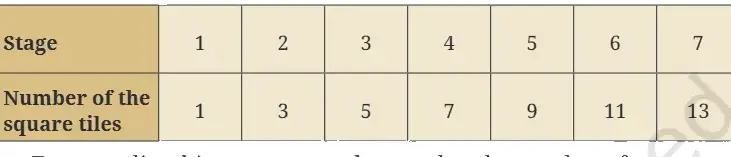
A pattern of square tiles is described in the provided table. Predict the number of squares for the next three stages of the pattern and list the number of tiles for the first seven stages.
Show answer & explanation
Answer: Next three stages have 9, 11 and 13 tiles; first seven stages: 1, 3, 5, 7, 9, 11, 13
Explanation: The table starts 1, 3, 5, 7, so each stage has 2 more tiles than the previous one — a constant increase of 2. Continuing the pattern, Stage 5 = 7 + 2 = 9, Stage 6 = 11 and Stage 7 = 13. The number of tiles in the nth stage follows the rule 2n - 1, which confirms the full list 1, 3, 5, 7, 9, 11, 13 for the first seven stages.
Q6Linear Polynomialseasy2 marks
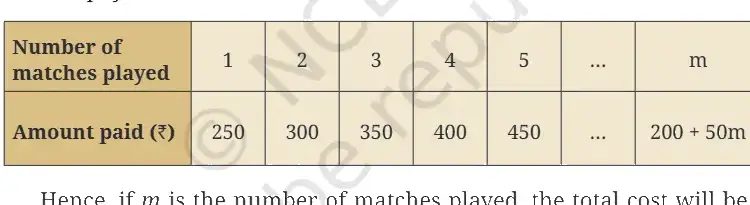
A chess club requires a joining fee of ₹200 and charges ₹50 for each match played. If a player paid a total of ₹750, how many matches did they play?
Show answer & explanation
Answer: 11 matches
Explanation: If m matches are played, the total amount paid is 200 + 50m (joining fee plus Rs 50 per match), as shown in the table. Set 200 + 50m = 750, so 50m = 550, giving m = 11. Check: 200 + 50 x 11 = 200 + 550 = Rs 750.
Q7Linear growtheasy1 mark
Based on the provided table showing the height of water, h (in meters), over time, t (in months), predict the height of the water at the end of 5 months.
Show answer & explanation
Answer: Height at the end of 5 months = 0.5 m
Explanation: From the table, the height falls from 3 m at t = 0 to 2.5, 2, 1.5 and 1 m at t = 1, 2, 3, 4 — a constant decrease of 0.5 m per month, so the relation is linear: h = 3 - 0.5t. At t = 5, h = 3 - 0.5 x 5 = 3 - 2.5 = 0.5 m.
Q8Linear Relationshipseasy2 marks
The fare for an auto-rickshaw is ₹25 for the initial 2 km and then increases by ₹15 per km for the subsequent distance. Calculate the total fare for a 10 km journey.
Show answer & explanation
Answer: Total fare for 10 km = Rs 145
Explanation: For n km (n >= 2) the fare is 25 + 15(n - 2), which simplifies to 15n - 5 as shown below the table. For a 10 km journey the chargeable extra distance is 10 - 2 = 8 km, costing 8 x 15 = Rs 120. Total fare = 25 + 120 = Rs 145; the formula check 15 x 10 - 5 = 145 agrees.
Q9Linear Polynomialseasy2 marks
The sum of two numbers is 64. One number is 10 more than the other. Determine the two numbers.
Show answer & explanation
Answer: The two numbers are 27 and 37
Explanation: Let the smaller number be x; then the other number is x + 10. Their sum gives the linear equation x + (x + 10) = 64, so 2x + 10 = 64 and 2x = 54, giving x = 27. The numbers are 27 and 37; check: 27 + 37 = 64 and 37 - 27 = 10.
Q10Visualizing linear relationshipsmedium3 marks
Plot the following points on a coordinate plane: (–3, 6), (–2, 4), (0, 0), (1, –2), (2, –4), and (3, –6). Connect them using a ruler and confirm they lie on a straight line. Determine the equation of this line by examining the relationship between the x and y coordinates.
Show answer & explanation
Answer: All the points lie on a straight line through the origin; its equation is y = -2x
Explanation: Plot each point on graph paper and join them; they all fall on one straight line passing through the origin, sloping downwards from left to right. Comparing coordinates, in every pair the y-coordinate is -2 times the x-coordinate: 6 = -2 x (-3), 4 = -2 x (-2), 0 = -2 x 0, -2 = -2 x 1, -4 = -2 x 2, -6 = -2 x 3. Hence the relationship is y = -2x, which is the equation of the line.
Q11Linear Relationshipsmedium2 marks
Given the expression 2n - 1 for a tile pattern, calculate the number of tiles in the 15th and 26th stages. Additionally, determine which stage of the pattern will contain 21 tiles and which will contain 47 tiles.
Explanation: Substitute the stage number into 2n - 1: for n = 15, tiles = 2 x 15 - 1 = 29; for n = 26, tiles = 2 x 26 - 1 = 51. For the reverse questions, solve 2n - 1 = 21, giving 2n = 22 and n = 11; and 2n - 1 = 47, giving 2n = 48 and n = 24. So stage 11 has 21 tiles and stage 24 has 47 tiles.
Q12Introductioneasy2 marks
A store sells red boxes containing 4 pens each and blue boxes containing 5 pencils each. If a person purchases 'x' red boxes and 'y' blue boxes, formulate an algebraic expression for the total number of items they have. Furthermore, if they receive 3 extra pens for free, what is the new expression for the total number of items?
Show answer & explanation
Answer: Total items = 4x + 5y; with 3 free pens the total becomes 4x + 5y + 3
Explanation: Each red box has 4 pens, so x red boxes contain 4x pens; each blue box has 5 pencils, so y blue boxes contain 5y pencils. Adding these gives the total number of items as 4x + 5y. Receiving 3 extra pens adds a constant 3 to this, so the new expression is 4x + 5y + 3, a linear polynomial in x and y.
Q13Linear growtheasy2 marks
Using the cost function C(d) = 100 + 60d, calculate the cost for a 15 km journey. Also, find out how many kilometers can be travelled for a total cost of ₹700.
Show answer & explanation
Answer: Cost for 15 km = Rs 1000; for Rs 700 one can travel 10 km
Explanation: For the cost, substitute d = 15 into C(d) = 100 + 60d: C(15) = 100 + 60 x 15 = 100 + 900 = Rs 1000. For the distance, set 100 + 60d = 700, so 60d = 600 and d = 10. Hence a 15 km journey costs Rs 1000, and Rs 700 allows a journey of 10 km.
Q14Exploring linear patternsmedium2 marks
Based on the auto-rickshaw fare structure previously described, for how many kilometers of travel will the total fare be ₹130?
Show answer & explanation
Answer: The fare is Rs 130 for a journey of 9 km
Explanation: The fare structure is Rs 25 for the first 2 km and Rs 15 for each km after that, so for n km (n >= 2) the fare is 25 + 15(n - 2) = 15n - 5. Set 15n - 5 = 130, so 15n = 135 and n = 9. Check: 25 + 15 x (9 - 2) = 25 + 105 = Rs 130, so the journey is 9 km.
Stuck anywhere in Chapter 2 (Introduction to Linear Polynomials)? Vidya ma'am — EduLevel's AI teacher — teaches this chapter live, by voice, and solves your doubts till they click.