14 questions with answersGanita Manjari · 2026-27

Ganita Manjari Class 9 Maths Chapter 8: Predicting What Comes Next: Exploring Sequences and Progressions — NCERT Solutions

Chapter 8 of the new NCERT Class 9 Maths textbook Ganita Manjari (2026-27) — Predicting What Comes Next: Exploring Sequences and Progressions. Below are 14 questions from this chapter with answers and step-by-step explanations, including 5 diagram-based questions with their figures. Try each one before revealing the answer — and if a concept doesn't click, Vidya ma'am teaches this exact chapter live in the EduLevel app.

What Chapter 8 covers

  • Introduction to Sequences
  • Explicit Rule
  • Recursive Rule
  • Arithmetic Progressions
  • Sum of Natural Numbers
  • Geometric Progressions

Ganita Manjari Chapter 8 — solved questions

Attempt each question first, then open the answer to compare your method.

Q1Geometric Progressionsmedium3 marks

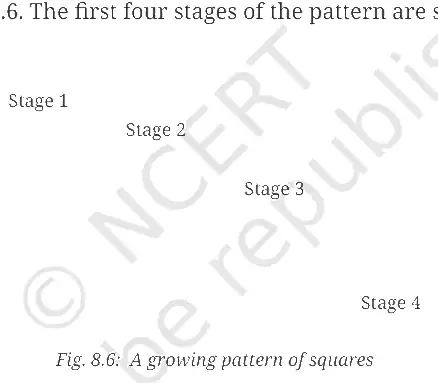
Consider the pattern of growing squares shown in the figure, where the number of green squares in the first four stages are 3, 6, 12, 24. Can you determine the number of squares for stages 5 and 6? What about for stages 10, 11, 12, and 20? At any stage? Describe how this pattern's growth differs from the one in Fig. 8.3 (not shown).
Ganita Manjari Class 9 Maths, Predicting What Comes Next: Exploring Sequences and Progressions — diagram for this question
Show answer & explanation
Answer: Stage 5 = 48, Stage 6 = 96; Stage 10 = 1536, Stage 11 = 3072, Stage 12 = 6144; Stage 20 = 1572864; Stage n = 3 x 2^(n-1). Unlike Fig. 8.3, which adds a fixed 4 squares each stage (linear growth), this pattern doubles each stage (exponential growth).

Explanation: The counts 3, 6, 12, 24 double at every stage, so the pattern is a geometric progression with first term 3 and common ratio 2, giving Stage n = 3 x 2^(n-1). So Stage 5 = 24 x 2 = 48 and Stage 6 = 96. Stage 10 = 3 x 29 = 1536, Stage 11 = 3072, Stage 12 = 6144, and Stage 20 = 3 x 219 = 3 x 524288 = 1572864. In Fig. 8.3 the number of squares grows by adding the same number (4) at each stage, which is slow linear growth, whereas here each stage multiplies by 2, so the count grows far faster (exponential growth).
Q2Introduction to Sequenceseasy2 marks

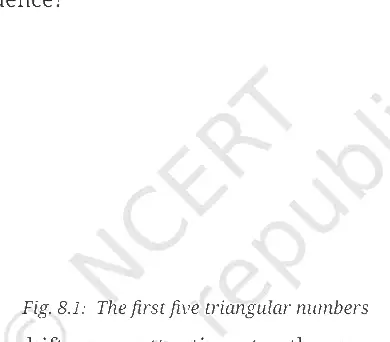
The sequence of triangular numbers is represented by a triangular arrangement of dots as shown in Fig. 8.1. Sketch the dot patterns that represent the next two terms in this sequence.

Ganita Manjari Class 9 Maths, Predicting What Comes Next: Exploring Sequences and Progressions — diagram for this question
Show answer & explanation
Answer: The next two terms are 21 and 28: a triangle of dots with rows of 1, 2, 3, 4, 5, 6 dots (21 dots) and a triangle with rows of 1, 2, 3, 4, 5, 6, 7 dots (28 dots).

Explanation: Fig. 8.1 shows the first five triangular numbers 1, 3, 6, 10, 15, where the nth pattern is a triangle of dots with rows containing 1, 2, 3, ..., n dots. Each new term adds one more row with one extra dot, so the differences are 2, 3, 4, 5, and the next differences are 6 and 7. Hence the 6th pattern is a triangle with rows of 1 to 6 dots, giving 15 + 6 = 21 dots, and the 7th pattern has rows of 1 to 7 dots, giving 21 + 7 = 28 dots.

Q3Arithmetic Progressionsmedium3 marks

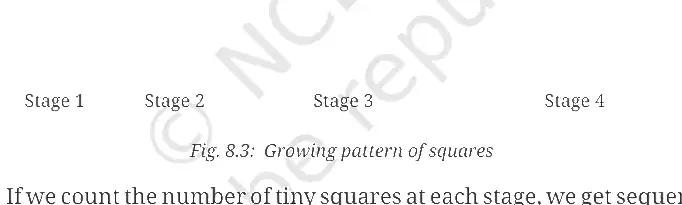
Referring to the sequence of patterns of squares shown in Fig. 8.3, which generates the number sequence 1, 5, 9, 13, ..., predict the number of squares that will be present in the following stages: (a) Stage 5 and Stage 6, (b) Stage 10, Stage 11, and Stage 12, (c) Stage 20. Can you find a general rule for any stage?

Ganita Manjari Class 9 Maths, Predicting What Comes Next: Exploring Sequences and Progressions — diagram for this question
Show answer & explanation
Answer: (a) Stage 5 = 17, Stage 6 = 21; (b) Stage 10 = 37, Stage 11 = 41, Stage 12 = 45; (c) Stage 20 = 77; general rule: Stage n has 4n - 3 squares.

Explanation: The sequence 1, 5, 9, 13 increases by 4 at every stage, so it is an arithmetic progression with first term 1 and common difference 4. The rule is Stage n = 1 + 4(n - 1) = 4n - 3. Substituting: Stage 5 = 17, Stage 6 = 21, Stage 10 = 37, Stage 11 = 41, Stage 12 = 45, and Stage 20 = 4 x 20 - 3 = 77. The rule makes sense because each new stage adds one square to each of the four arms of the figure.

Q4Introduction to Sequencesmedium3 marks

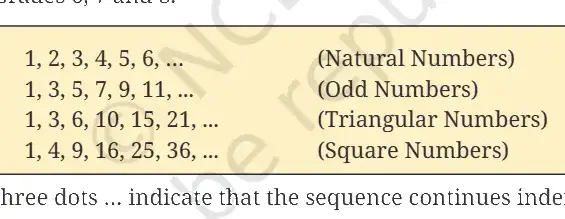
Examine the sequences presented in the accompanying list. For each sequence, identify and describe the pattern, and then predict the subsequent few terms.

Ganita Manjari Class 9 Maths, Predicting What Comes Next: Exploring Sequences and Progressions — diagram for this question
Show answer & explanation
Answer: Natural numbers (add 1 each time): next terms 7, 8, 9; Odd numbers (add 2 each time): next terms 13, 15, 17; Triangular numbers (differences increase by 1; nth term n(n+1)/2): next terms 28, 36, 45; Square numbers (nth term n2): next terms 49, 64, 81.

Explanation: The list shows four sequences. Natural numbers 1, 2, 3, 4, 5, 6, ... grow by adding 1 each time, so the next terms are 7, 8, 9. Odd numbers 1, 3, 5, 7, 9, 11, ... grow by adding 2, giving 13, 15, 17. Triangular numbers 1, 3, 6, 10, 15, 21, ... have differences that increase by 1 each time (2, 3, 4, 5, 6), so the next differences are 7, 8, 9, giving 28, 36, 45; the nth term is n(n+1)/2. Square numbers 1, 4, 9, 16, 25, 36, ... are the perfect squares n2 (their differences are the odd numbers 3, 5, 7, ...), so the next terms are 72 = 49, 82 = 64, 92 = 81.

Q5Introduction to Sequencesmedium2 marks

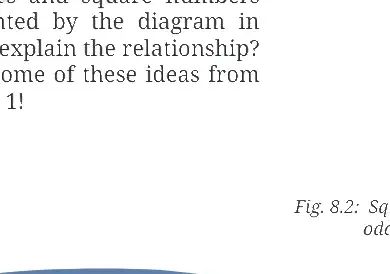
Figure 8.2 illustrates a relationship between the sequence of odd numbers and the sequence of square numbers. Based on the diagram, explain this relationship.

Ganita Manjari Class 9 Maths, Predicting What Comes Next: Exploring Sequences and Progressions — diagram for this question
Show answer & explanation
Answer: The sum of the first n odd numbers equals the nth square number: 1 = 12, 1 + 3 = 22, 1 + 3 + 5 = 32, 1 + 3 + 5 + 7 = 42; in general 1 + 3 + 5 + ... + (2n - 1) = n2.

Explanation: In Fig. 8.2 each square number is drawn as an n x n array of dots, and the array is split into L-shaped borders. The innermost corner has 1 dot, and each successive L-shaped border contains the next odd number of dots: 3, 5, 7, and so on. Adding an L-shaped border of the next odd number of dots to an n x n square turns it into an (n+1) x (n+1) square. So 1 = 12, 1 + 3 = 4 = 22, 1 + 3 + 5 = 9 = 32, 1 + 3 + 5 + 7 = 16 = 42, showing that the sum of the first n odd numbers is exactly n2.

Q6Recursive Rulemedium3 marks

A sequence is defined by the recursive rule u_1 = 1 and u_n = 2u_{n-1} + 3 for n ≥ 2. Find the first four terms of this sequence. Additionally, determine if 133 is a term of this sequence.

Show answer & explanation
Answer: First four terms: 1, 5, 13, 29; 133 is not a term of the sequence (the terms continue 61, 125, 253, jumping over 133).

Explanation: Using u_n = 2u_(n-1) + 3 with u_1 = 1: u_2 = 2(1) + 3 = 5, u_3 = 2(5) + 3 = 13, u_4 = 2(13) + 3 = 29. Continuing the same rule, u_5 = 2(29) + 3 = 61, u_6 = 2(61) + 3 = 125, u_7 = 2(125) + 3 = 253. The terms are strictly increasing and the sequence jumps from 125 directly to 253, so no term can equal 133. Hence 133 is not a term of the sequence.

Q7Sum of Natural Numberseasy2 marks

The sequence of triangular numbers is 1, 3, 6, 10, 15, ..., where the nᵗʰ term is given by tₙ = n(n+1)/2. Calculate the 10ᵗʰ, 17ᵗʰ, and 80ᵗʰ triangular numbers using this formula.

Show answer & explanation
Answer: t_10 = 55, t_17 = 153, t_80 = 3240.

Explanation: Substitute each value of n into t_n = n(n+1)/2. For n = 10: t_10 = (10 x 11)/2 = 110/2 = 55. For n = 17: t_17 = (17 x 18)/2 = 306/2 = 153. For n = 80: t_80 = (80 x 81)/2 = 6480/2 = 3240.

Q8Geometric Progressionseasy1 mark

Determine if the sequence 1, 2, 4, 8, 16, ... constitutes a geometric progression. If it does, state its common ratio.

Show answer & explanation
Answer: Yes, it is a geometric progression with common ratio 2.

Explanation: A sequence is a geometric progression when the ratio of every term to the previous term is the same constant. Here 2/1 = 4/2 = 8/4 = 16/8 = 2, so the ratio is constant throughout. Hence the sequence is a GP with first term 1 and common ratio 2; each term is obtained by multiplying the previous term by 2.

Q9Arithmetic Progressionsmedium3 marks

Review all the sequences presented in the chapter up to this point. Identify which of these sequences qualify as arithmetic progressions and which do not. Provide a justification for each classification.

Show answer & explanation
Answer: APs: natural numbers 1, 2, 3, ... (d = 1), odd numbers 1, 3, 5, ... (d = 2), and the squares pattern 1, 5, 9, 13, ... (d = 4). Not APs: triangular numbers 1, 3, 6, 10, ... (differences 2, 3, 4, ... keep increasing), square numbers 1, 4, 9, 16, ... (differences 3, 5, 7, ... keep increasing), and the doubling/tripling sequences 3, 6, 12, 24, ...; 1, 2, 4, 8, ...; 1, 3, 9, 27, ... (constant ratio, not constant difference — these are GPs).

Explanation: An arithmetic progression must have the same difference between every pair of consecutive terms. Natural numbers (difference 1), odd numbers (difference 2), and the pattern 1, 5, 9, 13, ... from Fig. 8.3 (difference 4) all satisfy this, so they are APs. Triangular numbers 1, 3, 6, 10, 15, ... are not, because their differences 2, 3, 4, 5, ... keep increasing; square numbers 1, 4, 9, 16, ... are not, because their differences 3, 5, 7, ... also increase. Sequences such as 3, 6, 12, 24, ... and 1, 2, 4, 8, 16, ... and 1, 3, 9, 27, 81, ... are not APs either, since their differences keep doubling or tripling; they instead have a constant ratio between terms, which makes them geometric progressions.

Q10Explicit Ruleeasy2 marks

A sequence is generated by the explicit formula s_n = 5n - 2. Determine the first 6 terms of this sequence. Also, find the 1000th term.

Show answer & explanation
Answer: First 6 terms: 3, 8, 13, 18, 23, 28; the 1000th term is 4998.

Explanation: Substitute n = 1, 2, 3, 4, 5, 6 into s_n = 5n - 2: s_1 = 5(1) - 2 = 3, s_2 = 8, s_3 = 13, s_4 = 18, s_5 = 23, s_6 = 28, which form an AP with common difference 5. The advantage of an explicit formula is that any term can be found directly: s_1000 = 5 x 1000 - 2 = 5000 - 2 = 4998.

Q11Introduction to Sequenceseasy1 mark

Provide some examples of finite sequences that can be observed in everyday life.

Show answer & explanation
Answer: Examples: the days of the week (7 terms), the months of the year (12 terms), the page numbers of a book, the roll numbers of students in a class, and the number of days in each month of a year.

Explanation: A finite sequence is an ordered list that has a definite first term and a definite last term. Everyday examples include the days of the week from Monday to Sunday (7 terms), the months of the year (12 terms), the page numbers of a book (1 up to the last page), the roll numbers of students in a class, and the number of days in each of the 12 months of a year. Each of these lists is written in a fixed order and stops after finitely many terms.

Q12Recursive Ruleeasy2 marks

Calculate the first four terms of a sequence defined by the recursive rule s_1 = 3 and s_n = s_{n-1}(s_{n-1} - 1) for n ≥ 2.

Show answer & explanation
Answer: The first four terms are 3, 6, 30, 870.

Explanation: Apply the rule s_n = s_(n-1)(s_(n-1) - 1) starting from s_1 = 3. s_2 = 3 x (3 - 1) = 3 x 2 = 6. s_3 = 6 x (6 - 1) = 6 x 5 = 30. s_4 = 30 x (30 - 1) = 30 x 29 = 870. So the first four terms are 3, 6, 30, 870.

Q13Sum of Natural Numbersmedium2 marks

Can the method used to sum the first 10 natural numbers be applied to find the sum of the series 1 + 2 + 3 + ... + 100?

Show answer & explanation
Answer: Yes; pairing terms from the two ends gives 50 pairs each summing to 101, so 1 + 2 + ... + 100 = 50 x 101 = 5050.

Explanation: Yes, the same pairing method works. Pair the numbers from the two ends of the series: 1 + 100 = 101, 2 + 99 = 101, 3 + 98 = 101, and so on up to 50 + 51 = 101. The 100 numbers form exactly 50 such pairs, each with sum 101, so the total is 50 x 101 = 5050. In general this method gives 1 + 2 + ... + n = n(n+1)/2.

Q14Geometric Progressionseasy1 mark

Verify if the sequence 1, 3, 9, 27, 81, ... is a geometric progression. If it is, provide the common ratio.

Show answer & explanation
Answer: Yes, it is a geometric progression with common ratio 3.

Explanation: Check the ratio of each term to the term before it: 3/1 = 3, 9/3 = 3, 27/9 = 3, 81/27 = 3. Since the ratio is the same constant throughout, the sequence is a geometric progression with first term 1 and common ratio 3; each term is obtained by multiplying the previous term by 3.

Stuck anywhere in Chapter 8 (Predicting What Comes Next: Exploring Sequences and Progressions)? Vidya ma'am — EduLevel's AI teacher — teaches this chapter live, by voice, and solves your doubts till they click.

Learn this chapter free

₹1 trial for 3 days · then ₹499/month · Get the Android app

Start learning free — ₹1