Chapter 4 of the new NCERT Class 9 Maths textbook Ganita Manjari (2026-27) — Exploring Algebraic Identities. Below are 14 questions from this chapter with answers and step-by-step explanations, including 2 diagram-based questions with their figures. Try each one before revealing the answer — and if a concept doesn't click, Vidya ma'am teaches this exact chapter live in the EduLevel app.
What Chapter 4 covers
Introduction
Visualising Identities
Factorisation Using Identities
More Identities
Algebra Tiles
Factorisation Without Tiles
New Identities
Simplifying Rational Expressions
Ganita Manjari Chapter 4 — solved questions
Attempt each question first, then open the answer to compare your method.
Q1Factorisation Using Identitieseasy1 mark
Factorise: x² − 16
(x + 4)(x − 4)
(x − 4)²
(x + 4)²
(x + 8)(x − 2)
Show answer & explanation
Answer: (x + 4)(x − 4)
Explanation: x² − 16 = x² − 4², which is a difference of two squares. Using a² − b² = (a + b)(a − b), we get (x + 4)(x − 4). Checking: (x + 4)(x − 4) = x² − 4x + 4x − 16 = x² − 16.
Q2Factorisation Using Identitieseasy1 mark
Factorise: x² + 6x + 9
(x + 3)²
(x − 3)²
(x + 9)(x − 3)
(x + 1)(x + 9)
Show answer & explanation
Answer: (x + 3)²
Explanation: Compare with (a + b)² = a² + 2ab + b². Here x² + 6x + 9 = x² + 2 × x × 3 + 3², so it equals (x + 3)². The option (x + 9)(x − 3) gives the right middle term 6x but the wrong constant −27, and (x + 1)(x + 9) gives the right constant but the wrong middle term 10x.
Q3Factorisation Using Identitieseasy1 mark
Factorise: 4x² − 25
(2x + 5)(2x − 5)
(2x − 5)²
(4x + 5)(x − 5)
(2x + 5)²
Show answer & explanation
Answer: (2x + 5)(2x − 5)
Explanation: Write each term as a square: 4x² = (2x)² and 25 = 5². By the identity a² − b² = (a + b)(a − b), 4x² − 25 = (2x + 5)(2x − 5). Checking: (2x + 5)(2x − 5) = 4x² − 10x + 10x − 25 = 4x² − 25.
Q4Factorisation Using Identitieseasy1 mark
Factorise: x² − 10x + 25
(x − 5)²
(x + 5)²
(x + 5)(x − 5)
(x − 25)(x − 1)
Show answer & explanation
Answer: (x − 5)²
Explanation: Compare with (a − b)² = a² − 2ab + b². Here x² − 10x + 25 = x² − 2 × x × 5 + 5², so it equals (x − 5)². Since the middle term is negative, (x + 5)² is wrong, and (x + 5)(x − 5) would give x² − 25 with no middle term at all.
Q5Factorisation Using Identitiesmedium1 mark
Factorise: x² − 5x − 24
(x − 8)(x + 3)
(x + 8)(x − 3)
(x − 6)(x + 4)
(x − 12)(x + 2)
Show answer & explanation
Answer: (x − 8)(x + 3)
Explanation: Using x² + (a + b)x + ab, we need two numbers whose product is −24 and whose sum is −5. These are −8 and +3, since (−8) × 3 = −24 and −8 + 3 = −5. So x² − 5x − 24 = (x − 8)(x + 3). The option (x + 8)(x − 3) is the common sign slip; it expands to x² + 5x − 24.
Q6Factorisation Using Identitiesmedium1 mark
Factorise: 8x³ + 27
(2x + 3)(4x² − 6x + 9)
(2x + 3)(4x² + 6x + 9)
(2x − 3)(4x² + 6x + 9)
(2x + 3)(4x² − 12x + 9)
Show answer & explanation
Answer: (2x + 3)(4x² − 6x + 9)
Explanation: 8x³ + 27 = (2x)³ + 3³, a sum of cubes. Using a³ + b³ = (a + b)(a² − ab + b²) with a = 2x and b = 3, we get (2x + 3)(4x² − 6x + 9). The middle term of the second bracket is −ab = −6x, not +6x, and the option (2x − 3)(4x² + 6x + 9) is actually the factorisation of 8x³ − 27.
Q7Factorisation Using Identitiesmedium1 mark
Using a suitable identity, the value of 998² is:
996004
998004
995996
1004004
Show answer & explanation
Answer: 996004
Explanation: Write 998 = 1000 − 2 and use (a − b)² = a² − 2ab + b². Then 998² = 1000² − 2 × 1000 × 2 + 2² = 1000000 − 4000 + 4 = 996004. Forgetting the factor 2 in 2ab gives 998004, and a sign slip on b² gives 995996.
Q8Factorisation Using Identitiesmedium1 mark
Factorise: 9x² − 24xy + 16y²
(3x − 4y)²
(3x + 4y)²
(3x + 4y)(3x − 4y)
(9x − 4y)(x − 4y)
Show answer & explanation
Answer: (3x − 4y)²
Explanation: Check the perfect-square pattern a² − 2ab + b² with a = 3x and b = 4y. Then a² = 9x², b² = 16y², and 2ab = 2 × 3x × 4y = 24xy, which matches the middle term with a minus sign. So 9x² − 24xy + 16y² = (3x − 4y)². The option (3x + 4y)(3x − 4y) would give 9x² − 16y² with no middle term.
Q9Factorisation Using Identitiesmedium1 mark
Factorise: 2x² + 7x + 3
(2x + 1)(x + 3)
(2x + 3)(x + 1)
(2x − 1)(x − 3)
(x + 1)(x + 6)
Show answer & explanation
Answer: (2x + 1)(x + 3)
Explanation: Multiply the leading coefficient and the constant: 2 × 3 = 6, and we need two numbers with product 6 and sum 7, which are 6 and 1. Split the middle term: 2x² + 6x + x + 3 = 2x(x + 3) + 1(x + 3) = (2x + 1)(x + 3). The tempting option (2x + 3)(x + 1) expands to 2x² + 5x + 3, which has the wrong middle term.
Q10Factorisation Using Identitieshard1 mark
If a − b = 3 and ab = 10, then the value of a³ − b³ is:
117
87
57
27
Show answer & explanation
Answer: 117
Explanation: Use the identity a³ − b³ = (a − b)³ + 3ab(a − b). Substituting, a³ − b³ = 3³ + 3 × 10 × 3 = 27 + 90 = 117. As a check, a = 5 and b = 2 satisfy a − b = 3 and ab = 10, and 5³ − 2³ = 125 − 8 = 117. Answering 27 means only (a − b)³ was computed and the 3ab(a − b) term was ignored.
Q11Factorisation Using Identitieshard1 mark
The complete factorisation of x⁴ − 16 is:
(x² + 4)(x + 2)(x − 2)
(x² + 4)(x² − 4)
(x + 2)²(x − 2)²
(x² − 4)²
Show answer & explanation
Answer: (x² + 4)(x + 2)(x − 2)
Explanation: First apply a² − b² with a = x² and b = 4: x⁴ − 16 = (x² + 4)(x² − 4). The bracket x² − 4 is again a difference of squares and factors further as (x + 2)(x − 2), while x² + 4 cannot be factorised further. So the complete factorisation is (x² + 4)(x + 2)(x − 2); stopping at (x² + 4)(x² − 4) is incomplete.
Q12Factorisation Using Identitieshard1 mark
Factorise: x² − y² − 6y − 9
(x + y + 3)(x − y − 3)
(x + y + 3)(x − y + 3)
(x − y − 3)(x − y + 3)
(x + y − 3)(x − y + 3)
Show answer & explanation
Answer: (x + y + 3)(x − y − 3)
Explanation: Group the last three terms: x² − y² − 6y − 9 = x² − (y² + 6y + 9) = x² − (y + 3)². This is now a difference of squares with a = x and b = y + 3, so it factors as (x + y + 3)(x − y − 3). Note that the minus sign distributes over the whole bracket, so the second factor is x − y − 3, not x − y + 3.
Q13More Identitiesmedium3 marks
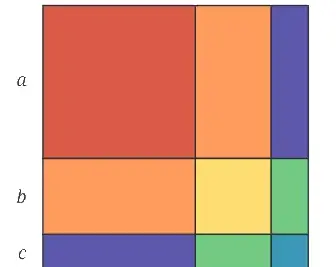
Refer to the provided geometric model (Fig. 4.4). Label the constituent squares and rectangles to demonstrate that it visually represents the identity (a + b + c)² = a² + b² + c² + 2ab + 2bc + 2ca.
Show answer & explanation
Answer: Labelling the 3 by 3 grid: diagonal squares a2, b2, c2 and rectangle pairs ab, ab, bc, bc, ca, ca; total area = a2 + b2 + c2 + 2ab + 2bc + 2ca = (a + b + c)2
Explanation: The big square has side a + b + c, and each side is divided into segments of lengths a, b and c, cutting the figure into a 3 by 3 grid of nine pieces. The three pieces on the diagonal are squares: an a x a square (area a2), a b x b square (area b2) and a c x c square (area c2). The remaining six pieces are rectangles that come in equal pairs: two a x b rectangles (area ab each), two b x c rectangles (area bc each) and two c x a rectangles (area ca each). The whole figure is a square of side (a + b + c), so its area (a + b + c)2 equals the sum of the nine labelled pieces, giving (a + b + c)2 = a2 + b2 + c2 + 2ab + 2bc + 2ca.
Q14Visualising Identitieshard3 marks
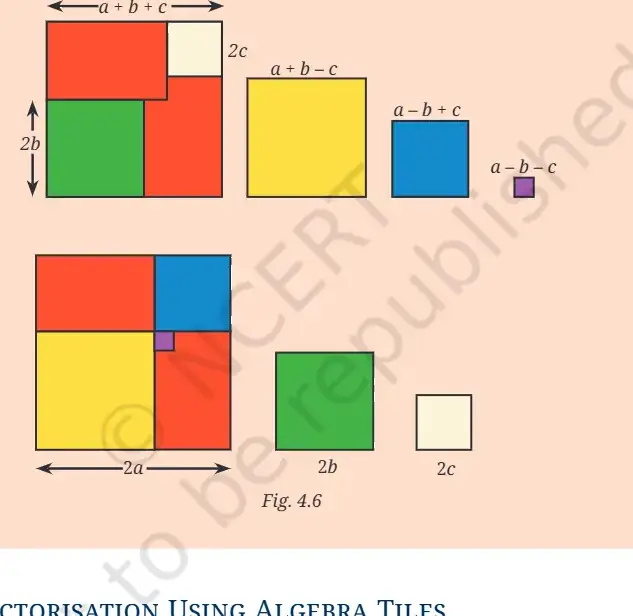
Examine the two rows of diagrams provided. Determine and state the algebraic identity that they visually represent.
Show answer & explanation
Answer: (a + b + c)2 + (a + b - c)2 + (a - b + c)2 + (a - b - c)2 = (2a)2 + (2b)2 + (2c)2 = 4(a2 + b2 + c2)
Explanation: The top row shows four squares of sides (a + b + c), (a + b - c), (a - b + c) and (a - b - c), while the bottom row shows three squares of sides 2a, 2b and 2c. In the figure, the (a + b + c) square is dissected into red pieces plus a 2b x 2b square and a 2c x 2c square, and the same red pieces together with the three smaller squares of the top row exactly fill the 2a x 2a square, so both rows are made of the same pieces and have equal total area. Algebra confirms this: each of the four squares expands to a2 + b2 + c2 with cross terms +/-2ab, +/-2bc, +/-2ca, and on adding the four expansions every cross term cancels. This leaves 4a2 + 4b2 + 4c2, which is exactly (2a)2 + (2b)2 + (2c)2.
Stuck anywhere in Chapter 4 (Exploring Algebraic Identities)? Vidya ma'am — EduLevel's AI teacher — teaches this chapter live, by voice, and solves your doubts till they click.