Ganita Manjari Class 9 Maths Chapter 6: Measuring Space: Perimeter and Area — NCERT Solutions
Chapter 6 of the new NCERT Class 9 Maths textbook Ganita Manjari (2026-27) — Measuring Space: Perimeter and Area. Below are 18 questions from this chapter with answers and step-by-step explanations, including 6 diagram-based questions with their figures. Try each one before revealing the answer — and if a concept doesn't click, Vidya ma'am teaches this exact chapter live in the EduLevel app.
What Chapter 6 covers
Perimeter of Shape
Perimeter of Circle
C/D Ratio
Pi Is Irrational
Arc Length
Area of Rectangle
Area Parallelogram
Area of Triangle
Heron's formula
Brahmagupta Formula
Squaring Rectangle
Area of Circle
Area of Sector
Ganita Manjari Chapter 6 — solved questions
Attempt each question first, then open the answer to compare your method.
Q1Heron's formulaeasy1 mark
The sides of a triangle are 3 cm, 4 cm and 5 cm. Using Heron's formula, its area is:
6 cm²
12 cm²
10 cm²
24 cm²
Show answer & explanation
Answer: 6 cm²
Explanation: The semi-perimeter is s = (3 + 4 + 5)/2 = 6 cm. By Heron's formula, area = √(6 × (6−3) × (6−4) × (6−5)) = √(6 × 3 × 2 × 1) = √36 = 6 cm².
Q2Heron's formulaeasy1 mark
For a triangle with sides 8 cm, 11 cm and 13 cm, the value of s (semi-perimeter) used in Heron's formula is:
16 cm
32 cm
8 cm
24 cm
Show answer & explanation
Answer: 16 cm
Explanation: The semi-perimeter is half of the full perimeter. Perimeter = 8 + 11 + 13 = 32 cm, so s = 32/2 = 16 cm. Using the full perimeter 32 instead of 16 is a common mistake.
Q3Heron's formulaeasy1 mark
Each side of an equilateral triangle is 4 cm. Using Heron's formula, its area is:
4√3 cm²
16√3 cm²
8√3 cm²
2√3 cm²
Show answer & explanation
Answer: 4√3 cm²
Explanation: Here s = (4 + 4 + 4)/2 = 6 cm, so s minus each side is 6 − 4 = 2 cm. Area = √(6 × 2 × 2 × 2) = √48 = 4√3 cm². This matches the direct formula (√3/4) × 4² = 4√3 cm².
Q4Heron's formulaeasy1 mark
A triangular flower bed in a school garden has sides 6 m, 8 m and 10 m. Its area is:
24 m²
48 m²
30 m²
40 m²
Show answer & explanation
Answer: 24 m²
Explanation: The semi-perimeter is s = (6 + 8 + 10)/2 = 12 m. Area = √(12 × 6 × 4 × 2) = √576 = 24 m². Simply multiplying 6 × 8 = 48 forgets the required factor of 1/2.
Q5Heron's formulamedium1 mark
A triangular park has sides 5 m, 12 m and 13 m. The cost of planting grass in it at ₹50 per m² is:
₹1500
₹3000
₹750
₹1250
Show answer & explanation
Answer: ₹1500
Explanation: s = (5 + 12 + 13)/2 = 15, so area = √(15 × 10 × 3 × 2) = √900 = 30 m². Cost = 30 × ₹50 = ₹1500.
Q6Heron's formulamedium1 mark
The sides of a triangle are in the ratio 3 : 4 : 5 and its perimeter is 36 cm. Its area is:
54 cm²
108 cm²
36 cm²
72 cm²
Show answer & explanation
Answer: 54 cm²
Explanation: Let the sides be 3x, 4x and 5x, so 12x = 36 and x = 3, giving sides 9 cm, 12 cm and 15 cm. Then s = 36/2 = 18 cm. Area = √(18 × 9 × 6 × 3) = √2916 = 54 cm².
Q7Heron's formulamedium1 mark
The perimeter of an isosceles triangle is 36 cm and each of its equal sides is 13 cm. Its area is:
60 cm²
65 cm²
120 cm²
30 cm²
Show answer & explanation
Answer: 60 cm²
Explanation: The base = 36 − 13 − 13 = 10 cm, and s = 36/2 = 18 cm. Area = √(18 × (18−13) × (18−13) × (18−10)) = √(18 × 5 × 5 × 8) = √3600 = 60 cm².
Q8Heron's formulamedium1 mark
A triangular metal sheet has sides 7 cm, 24 cm and 25 cm. Using Heron's formula, its area is:
84 cm²
168 cm²
300 cm²
87.5 cm²
Show answer & explanation
Answer: 84 cm²
Explanation: s = (7 + 24 + 25)/2 = 28 cm. Area = √(28 × 21 × 4 × 3) = √7056 = 84 cm². Multiplying 7 × 24 = 168 without the factor 1/2, or pairing the wrong sides like 1/2 × 24 × 25 = 300, gives the wrong answer.
Q9Heron's formulamedium1 mark
Each side of an equilateral triangle is 2√3 cm. Its area is:
3√3 cm²
12√3 cm²
6√3 cm²
3 cm²
Show answer & explanation
Answer: 3√3 cm²
Explanation: Here s = (3 × 2√3)/2 = 3√3 cm, and s minus each side = 3√3 − 2√3 = √3 cm. Area = √(3√3 × √3 × √3 × √3) = √27 = 3√3 cm². This matches (√3/4) × (2√3)² = (√3/4) × 12 = 3√3 cm².
Q10Heron's formulahard1 mark
The sides of a triangle are in the ratio 12 : 17 : 25 and its perimeter is 540 cm. Its area is:
9000 cm²
10200 cm²
20400 cm²
4500 cm²
Show answer & explanation
Answer: 9000 cm²
Explanation: Let the sides be 12x, 17x and 25x, so 54x = 540 and x = 10, giving sides 120 cm, 170 cm and 250 cm. Then s = 540/2 = 270 cm. Area = √(270 × 150 × 100 × 20) = √81000000 = 9000 cm². Assuming a right angle and taking 1/2 × 120 × 170 = 10200 is incorrect because this triangle is not right-angled.
Q11Heron's formulahard1 mark
The sides of a triangle are 13 cm, 14 cm and 15 cm. The length of the altitude drawn to the side of length 14 cm is:
12 cm
6 cm
11.2 cm
84 cm
Show answer & explanation
Answer: 12 cm
Explanation: s = (13 + 14 + 15)/2 = 21 cm, so area = √(21 × 8 × 7 × 6) = √7056 = 84 cm². Area is also 1/2 × base × height, so 84 = 1/2 × 14 × h = 7h. Therefore h = 84/7 = 12 cm.
Q12Heron's formulahard1 mark
A farmer's field is in the shape of a rhombus with each side 30 m and one diagonal 48 m. The area of the field is:
864 m²
432 m²
1440 m²
720 m²
Show answer & explanation
Answer: 864 m²
Explanation: The diagonal divides the rhombus into two equal triangles, each with sides 30 m, 30 m and 48 m. For one triangle, s = (30 + 30 + 48)/2 = 54 m, and area = √(54 × 24 × 24 × 6) = √186624 = 432 m². The rhombus is made of two such triangles, so its area = 2 × 432 = 864 m².
Q13Arc Lengtheasy1 mark
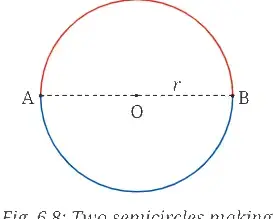
Referring to Fig. 6.8, determine the length of a semicircle that has a radius of 'r'.
Show answer & explanation
Answer: Length of the semicircle = πr
Explanation: The circumference of a full circle of radius r is 2πr. Fig. 6.8 shows that two equal semicircular arcs (the red and blue arcs on either side of diameter AB) together make up the whole circle. So the length of one semicircle = (1/2) × 2πr = πr.
Q14C/D Ratiomedium3 marks
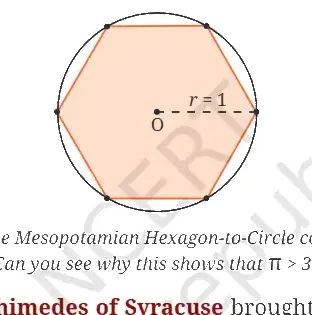
Referring to the diagram of a hexagon inscribed in a circle of radius 1 (Fig. 6.6), explain the reasoning that leads to the conclusion that π > 3.
Show answer & explanation
Answer: The hexagon's perimeter is 6 and the circumference is longer than it, so π = circumference/diameter > 6/2 = 3.
Explanation: Joining the centre O to the six vertices divides the regular hexagon into 6 triangles, each with a central angle of 360°/6 = 60° between two radii; since the two radii are equal, each triangle is equilateral, so every side of the hexagon equals the radius 1. Hence the perimeter of the hexagon = 6 × 1 = 6. Each side is a chord of the circle, and the arc joining the same two points is longer than the chord (a straight segment is the shortest path between two points), so the circumference C > 6. The diameter is d = 2, so π = C/d > 6/2 = 3.
Q15Arc Lengtheasy1 mark
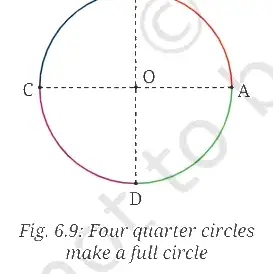
As illustrated in Fig. 6.9, calculate the length of a quarter circle with a given radius.
Show answer & explanation
Answer: Length of the quarter circle = 2πr/4 = πr/2
Explanation: Fig. 6.9 shows that four equal quarter-circle arcs together make a full circle of radius r. The full circumference is 2πr, so each quarter circle has length (1/4) × 2πr = πr/2.
Q16Area Parallelogramhard3 marks
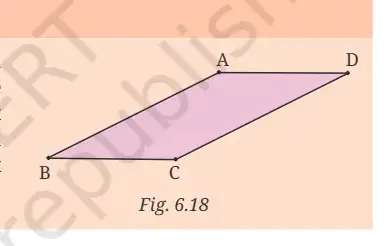
Consider a 'thin' parallelogram where the foot of the perpendicular from vertex C does not fall on the base AD (as shown in Fig. 6.18). The standard construction for the area formula seems to fail. How can this issue be resolved?
Show answer & explanation
Answer: Cut the thin parallelogram into smaller parallelograms that are not thin (e.g., by the segment through the midpoints of the slant sides, parallel to AD); the cut-and-shift construction works on each piece and the areas add, so area = base × height still holds.
Explanation: Join the midpoints of the two slant sides AB and DC; this segment is parallel to AD and equal to it, cutting the parallelogram into two parallelograms, each with the same base length AD, half the height, and only half the sideways slant. Repeating this if needed, after a few cuts each small parallelogram is no longer thin, i.e., the foot of the perpendicular from its top vertex falls on its base. The standard construction (cut off a right triangle and shift it to the other end) then converts each piece into a rectangle of area AD × (its height). Adding all the pieces gives total area = AD × h, so the formula area = base × height remains valid even for thin parallelograms. Alternatively, one can take the other pair of sides (AB and DC) as base, for which the perpendicular from the opposite vertex does fall on the base.
Q17Area of Trianglehard3 marks
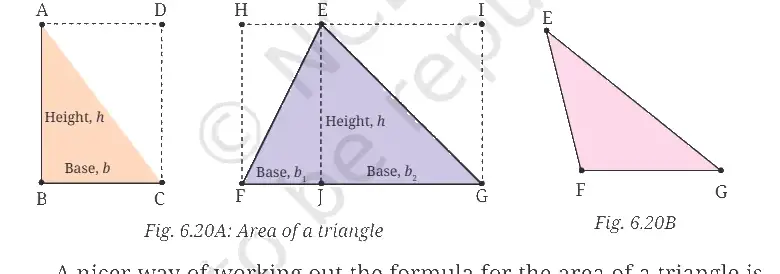
The method of enclosing a triangle in a rectangle to find its area works for right-angled and acute triangles. Does a similar 'gap' in the argument appear if the triangle is obtuse, like triangle EFG in Fig. 6.20B? Explain how you would determine the area in this case.
Show answer & explanation
Answer: Yes, a gap appears: the perpendicular from E meets FG only on extending it. Extend GF to the foot H; then ar(EFG) = ar(EHG) − ar(EHF) = 1/2 × FG × EH, so area = 1/2 × base × height still holds.
Explanation: For an acute triangle, the perpendicular from the top vertex falls inside the base and splits the triangle into two right triangles, each half of a rectangle. In the obtuse triangle EFG (obtuse at F), the perpendicular from E meets the line FG at a point H lying outside the segment FG, so this splitting is impossible; that is the gap. Extend GF to the foot H of the perpendicular from E. Then EHG and EHF are right triangles, and ar(EFG) = ar(EHG) − ar(EHF) = 1/2 × HG × EH − 1/2 × HF × EH = 1/2 × (HG − HF) × EH = 1/2 × FG × EH. Since EH is the height corresponding to base FG, the formula area = 1/2 × base × height continues to hold. (One could also take the longest side EG as base, for which the perpendicular from F falls inside and the original argument works directly.)
Q18Heron's formulaeasy2 marks
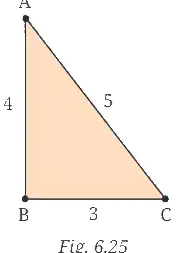
Determine the area of a triangle that has side lengths of 3 units, 4 units, and 5 units.
Show answer & explanation
Answer: Area = 6 square units
Explanation: By Heron's formula, s = (3 + 4 + 5)/2 = 6. Area = sqrt(s(s − a)(s − b)(s − c)) = sqrt(6 × 3 × 2 × 1) = sqrt(36) = 6 square units. Check: since 32 + 42 = 9 + 16 = 25 = 52, the triangle is right-angled at B (Fig. 6.25), so area = 1/2 × 3 × 4 = 6 square units, which agrees.
Stuck anywhere in Chapter 6 (Measuring Space: Perimeter and Area)? Vidya ma'am — EduLevel's AI teacher — teaches this chapter live, by voice, and solves your doubts till they click.