Ganita Manjari Class 9 Maths Chapter 3: The World of Numbers — NCERT Solutions
Chapter 3 of the new NCERT Class 9 Maths textbook Ganita Manjari (2026-27) — The World of Numbers. Below are 6 questions from this chapter with answers and step-by-step explanations, including 2 diagram-based questions with their figures. Try each one before revealing the answer — and if a concept doesn't click, Vidya ma'am teaches this exact chapter live in the EduLevel app.
What Chapter 3 covers
The Dawn of Mathematics
A History Written in Bone
Indian Context
The Revolution of Śhūnya
Integers Expanding
Fractions and Rational Numbers
Representation of Rational Numbers
Irrational Numbers
Real Numbers
Ganita Manjari Chapter 3 — solved questions
Attempt each question first, then open the answer to compare your method.
Q1Irrational Numberseasy1 mark
Which of the following numbers is irrational?
22/7
√25
0.101001000100001...
3.272727...
Show answer & explanation
Answer: 0.101001000100001...
Explanation: 22/7 is a ratio of two integers, so it is rational, even though it is often used to approximate π. √25 = 5 and 3.272727... is a repeating decimal, so both are rational. The decimal 0.101001000100001... never terminates and never repeats because the number of zeros keeps increasing, so it cannot be written as p/q and is irrational.
Q2Irrational Numberseasy1 mark
A number is rational if it can be written in the form p/q, where:
p and q are integers and q ≠ 0
p and q are any real numbers and q ≠ 0
p and q are integers and p ≠ 0
p and q are natural numbers only
Show answer & explanation
Answer: p and q are integers and q ≠ 0
Explanation: By definition, a rational number is any number that can be written as p/q where p and q are integers and q ≠ 0. The condition q ≠ 0 is needed because division by zero is not defined. Restricting to natural numbers would wrongly exclude negative rationals like −3/4, and demanding p ≠ 0 would wrongly exclude 0, which is rational since 0 = 0/1.
Q3Irrational Numberseasy1 mark
The decimal expansion of an irrational number is always:
terminating
non-terminating and repeating
non-terminating and non-repeating
terminating and repeating
Show answer & explanation
Answer: non-terminating and non-repeating
Explanation: A rational number always has a decimal expansion that either terminates or repeats a block of digits. An irrational number cannot be written as p/q, so its decimal expansion goes on forever without any repeating block. For example, √2 = 1.41421356... never terminates and never repeats.
Q4Irrational Numbershard1 mark
In the standard proof that √2 is irrational, we assume √2 = p/q where p and q are coprime integers and q ≠ 0. The contradiction reached in the proof is that:
Both p and q turn out to be even, so they are not coprime
p turns out to be odd while q is even
p² turns out to be negative
q turns out to be equal to p
Show answer & explanation
Answer: Both p and q turn out to be even, so they are not coprime
Explanation: From √2 = p/q, squaring gives p² = 2q², so p² is even, which forces p to be even, say p = 2m. Substituting gives 4m² = 2q², so q² = 2m², which forces q to be even as well. Then p and q share the common factor 2, contradicting the assumption that they are coprime, so √2 cannot be written as p/q.
Q5Irrational Numbersmedium3 marks
Is it possible to represent the square root of 2 as a fraction p/q, where p and q are integers?
Show answer & explanation
Answer: No. √2 cannot be written as p/q with integers p and q (q ≠ 0); it is an irrational number.
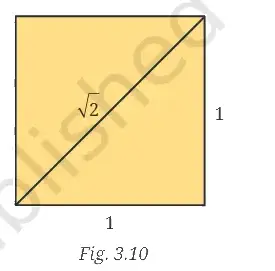
Explanation: √2 is the length of the diagonal of the unit square in Fig. 3.10, since 12 + 12 = 2. Suppose, to the contrary, that √2 = p/q where p and q are integers with no common factor and q ≠ 0. Squaring gives p2 = 2q2, so p2 is even, which forces p to be even; write p = 2m. Then 4m2 = 2q2, so q2 = 2m2, which makes q even as well. Now p and q share the common factor 2, contradicting our assumption that the fraction was in lowest terms. Hence no such fraction exists and √2 is irrational.
Q6Irrational Numbersmedium3 marks
Using a ruler and compass, extend the method for constructing √2 to construct line segments with lengths of √3 and √5. Furthermore, provide a general method for constructing a line segment of length √n for any positive integer n.
Show answer & explanation
Answer: √3 = hypotenuse of a right triangle with legs √2 and 1; √5 = hypotenuse of a right triangle with legs 2 and 1; in general, √n = hypotenuse of a right triangle with legs √(n-1) and 1, built successively starting from length 1 and transferred to the number line with a compass.
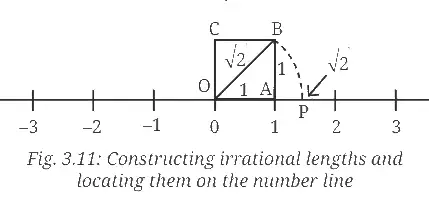
Explanation: In Fig. 3.11, OB = √2 is obtained as the hypotenuse of the right triangle with legs OA = 1 and AB = 1, and an arc of radius OB centred at O locates √2 at P on the number line. For √3, draw a segment BD of length 1 perpendicular to OB at B; by the Pythagoras theorem OD = √((√2)2 + 12) = √3, and swinging an arc of radius OD onto the number line marks √3. For √5, take a right triangle with legs 2 and 1, giving hypotenuse √(22 + 12) = √5 (equivalently, repeat the unit-perpendicular step on √3 to get √4 = 2, and once more to get √5). In general, once a segment of length √(n-1) has been constructed, erect a perpendicular of unit length at its endpoint; the hypotenuse of the resulting right triangle is √((n-1) + 1) = √n. Starting from 1 and repeating this step, a segment of length √n can be constructed for every positive integer n and transferred to the number line with a compass.
Stuck anywhere in Chapter 3 (The World of Numbers)? Vidya ma'am — EduLevel's AI teacher — teaches this chapter live, by voice, and solves your doubts till they click.