Exploration Class 9 Science Chapter 1: Exploration: Entering the World of Secondary Science — NCERT Solutions
Chapter 1 of the new NCERT Class 9 Science textbook Exploration (2026-27) — Exploration: Entering the World of Secondary Science. Below are 10 questions from this chapter with answers and step-by-step explanations, including 3 diagram-based questions with their figures. Try each one before revealing the answer — and if a concept doesn't click, Vidya ma'am teaches this exact chapter live in the EduLevel app.
What Chapter 1 covers
Example 1.1
Exploration Chapter 1 — solved questions
Attempt each question first, then open the answer to compare your method.
Q1Example 1.1medium3 marks
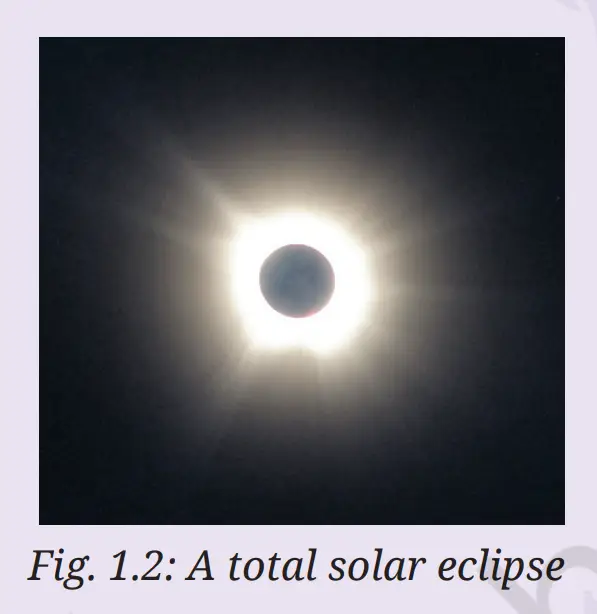
A widely circulated claim suggests that eating food during an eclipse is harmful. Using scientific principles, evaluate this claim. Does food change significantly if left in a shadow, and is there a physical, chemical, or biological mechanism to support such a claim?
Show answer & explanation
Answer: The claim is a myth: a solar eclipse is only the Moon's shadow falling on Earth, food does not change when kept in shadow, and there is no physical, chemical, or biological mechanism that could make eating during an eclipse harmful.
Explanation: An eclipse occurs when the Moon comes between the Sun and the Earth, so its shadow falls on part of the Earth; the only change is that less sunlight reaches that region for a short time. Food kept in shadow does not change significantly, and we routinely keep food in dark cupboards, in refrigerators, and overnight without any harm. Physically, no new rays or radiation are produced during an eclipse; in fact, the amount of sunlight reaching us decreases. Chemically, the brief absence of sunlight triggers no reaction in food, and biologically, the growth of microbes depends on temperature, moisture, and time, not on the position of the Moon. Since no mechanism supports the claim and there is no evidence of food spoiling faster during eclipses, scientific thinking tells us it is a superstition, not a fact.
Q2Example 1.1medium3 marks
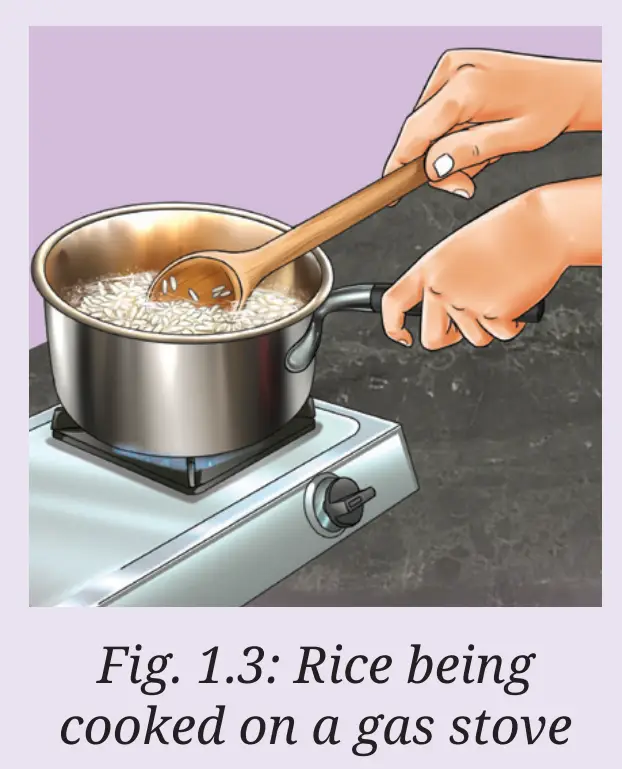
Estimate the quantity of rice required to feed a family of four for one month. The text provides context that an average adult needs 2000-2500 kilocalories per day and 100g of uncooked rice provides a certain amount of calories.
Show answer & explanation
Answer: About 70-85 kg of rice for the month (roughly 75 kg), if rice is taken as the family's only source of calories.
Explanation: Follow the assumption the question sets up: rice supplies all the energy. An adult needs about 2000-2500 kcal per day, and raw rice gives roughly 350 kcal per 100 g, so one person needs about 2000/350 x 100 = 570 g to 2500/350 x 100 = 715 g per day. For four people that is about 2.3 to 2.9 kg per day, and over 30 days about 70 to 85 kg per month. An estimate like this is meant to land in the right range, not on an exact figure - note that a real family eats far less rice than this, because in practice dal, vegetables, oil and milk supply much of the energy.
Q3Example 1.1medium3 marks
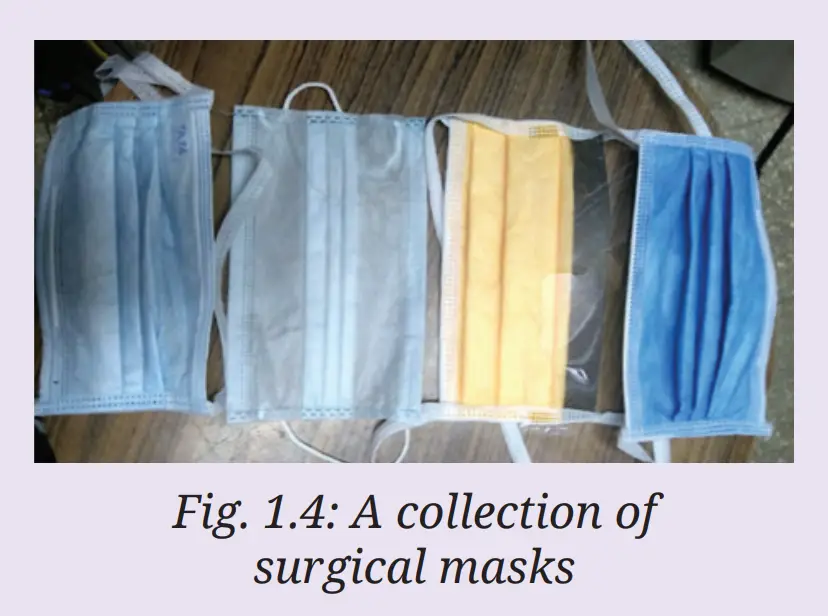
Explain the scientific principles behind the functioning of a protective face mask.
Show answer & explanation
Answer: A mask works on the principle of filtration: its layers of non-woven fabric form a fine mesh that traps dust particles and respiratory droplets carrying germs, while air molecules, being far smaller, pass through so we can still breathe.
Explanation: A surgical mask is made of several layers of non-woven fabric whose fibres criss-cross to form a very fine mesh. When we breathe, tiny air molecules pass easily through the gaps, but larger dust particles and the small liquid droplets released while coughing, sneezing, or talking get trapped in the fibre layers; this physical process is filtration. Disease-causing microbes such as viruses and bacteria travel riding on these droplets, so trapping the droplets protects both the wearer and the people nearby. Using multiple layers with small pore size improves the filtering, and special masks like the N95 additionally use electrostatically charged fibres that attract and hold very fine particles.
Q4Example 1.1medium3 marks
Recall a recent prediction made by you or your family, such as the result of a sports game. Analyze whether this prediction was founded on evidence and logical reasoning or primarily on conjecture. Explain how applying scientific thinking could enhance the accuracy of similar predictions.
Show answer & explanation
Answer: Sample answer: our prediction of a cricket match result was mostly conjecture (loyalty to a favourite team and gut feeling) with only a little evidence; scientific thinking would improve it by basing the prediction on relevant data such as recent form, conditions, and head-to-head record, reasoning logically from that evidence, and revising the prediction as new information arrives.
Explanation: This is an open-ended question, so any honest example analysed properly is acceptable. Most everyday predictions, like the result of a cricket match, mix a little evidence (recent form of the teams, playing conditions) with a lot of conjecture (support for a favourite team, gut feeling, or superstition). Scientific thinking asks us to rely only on relevant evidence and logical reasoning: collect data such as past performance and conditions, look for patterns, make the prediction while accepting its uncertainty, and update it when new information comes in. A prediction made this way is still not guaranteed to be correct, but it will be right far more often than one based on emotion or guesswork.
Q5Example 1.1easy1 mark
What is the reason for using the letter 'c' to represent the speed of light?
Show answer & explanation
Answer: The letter c comes from the Latin word celeritas, meaning swiftness or speed.
Explanation: Many symbols in science come from Latin or Greek roots. The speed of light in vacuum is denoted by c after the Latin word celeritas, which means swiftness or speed. It is also convenient to remember that c is a universal constant of nature, about 3 x 10⁸ m/s in vacuum, which is why the same symbol appears in famous relations such as E = mc2.
Q6Example 1.1medium3 marks
Imagine you are creating a model to calculate the travel time for a bicycle ride from your school to your home. Identify the key factors you would include in your model and the factors you would omit. Explain why omitting certain details can be beneficial for the model.
Show answer & explanation
Answer: Include: distance of the route and average cycling speed (with a small allowance for slopes, traffic signals, and stops), giving time = distance / average speed; omit: colour and make of the bicycle, clothes worn, small gusts of wind, exact speed at every moment. Omitting such details keeps the model simple and easy to use while hardly changing the answer.
Explanation: A model is a simplified representation of a real situation built to answer a specific question, here how long the ride will take. The factors that strongly affect the answer are the distance of the route and the average speed of cycling, perhaps adjusted slightly for slopes, traffic signals, and rest stops; with these, time = distance / average speed. Details like the bicycle's colour, the rider's clothes, minor wind, or the exact number of pedal strokes hardly change the result, so they are left out. Omitting them is beneficial because the model stays simple, quick to calculate, and easy to understand, while still being accurate enough for its purpose; including every detail would make it complicated without meaningfully improving the answer.
Q7Example 1.1medium2 marks
Consider a cricket ball struck for a six. If you were to create a simplified model of this event, which details would you consider essential to include, and which details would you choose to disregard?
Show answer & explanation
Answer: Essential: the speed of the ball as it leaves the bat, the angle at which it is hit, the height at which it is struck, and gravity; disregard: the ball's colour and brand, the bowler's action, crowd noise, and, in a first simple model, even spin, wind, and air resistance.
Explanation: To model the flight of the ball we keep only the factors that decide its path: the speed with which it leaves the bat, the angle of the hit, the height at which it is struck, and the downward pull of gravity. With just these, the ball can be treated as a simple projectile and the distance it travels can be estimated. Factors like the colour or brand of the ball, the bowler's run-up, and the crowd's noise do not affect the flight at all, while spin, wind, and air resistance change it only somewhat, so a first simple model can ignore them too. This is how scientific models work: keep what matters for the question being asked and drop the rest, adding refinements only if more accuracy is needed.
Q8Example 1.1medium3 marks
Calculate an estimate for the total volume of air, in litres, that a person breathes in a single day. Begin by estimating the number of breaths taken per minute and the volume of air in a single breath. The goal is to arrive at a reasonable approximation, not an exact value.
Show answer & explanation
Answer: About 10,000 litres per day: roughly 15 breaths per minute x 0.5 litre per breath = 7.5 litres per minute, which is 7.5 x 60 x 24 = 10,800 litres in a day, i.e. of the order of 104 litres.
Explanation: This is a Fermi-style estimation built from reasonable assumptions. A person at rest breathes about 12-16 times a minute, so take about 15 breaths per minute, and each normal breath moves about half a litre of air. The air breathed per minute is therefore about 15 x 0.5 = 7.5 litres, which gives 7.5 x 60 = 450 litres per hour and 450 x 24 = 10,800 litres per day. Rounding off, a person breathes air of the order of 104 litres, that is, roughly ten thousand litres a day. The exact figure varies with age, body size, and activity, so any nearby value reached with sound reasoning is acceptable.
Q9Example 1.1medium2 marks
Explain the reasons why weather forecasts are not always accurate.
Show answer & explanation
Answer: Weather depends on a huge number of continuously changing, interconnected factors, and forecasts come from simplified models fed with slightly imperfect measurements; small errors in the starting data grow rapidly in such a complex system, so predictions, especially long-range ones, can go wrong.
Explanation: Weather is decided by a very large number of interlinked factors such as temperature, air pressure, humidity, and wind speed and direction, all changing continuously over huge regions. Forecasters feed measurements of these into computer models, but every model is a simplified version of the real atmosphere, and every measurement carries small errors. In such a complex system, tiny errors in the initial data grow quickly with time, so the forecast gradually drifts away from what actually happens. This is why forecasts are stated as probabilities, such as chances of rain, and why short-range forecasts are fairly reliable while longer-range ones often go wrong.
Q10Example 1.1easy2 marks
Provide an example of a scenario where an approximate answer is sufficient and another scenario where a precise and exact value is necessary.
Show answer & explanation
Answer: Approximate is sufficient when estimating the rice needed by a family for a month or the paint needed for a wall; a precise, exact value is necessary when a doctor fixes the dose of a medicine or an engineer machines a part that must fit exactly.
Explanation: The level of accuracy needed depends on the purpose. When buying rice for a month, judging how much paint a wall needs, or estimating the crowd at a fair, a rough figure is enough because a small error causes no real loss. But when a doctor decides the dose of a medicine, an engineer makes a machine part that must fit another, or a chemist weighs reactants for a reaction, even a small error can lead to harm or failure, so exact values are essential. Part of scientific thinking is recognising how much accuracy a given situation actually demands.
Stuck anywhere in Chapter 1 (Exploration: Entering the World of Secondary Science)? Vidya ma'am — EduLevel's AI teacher — teaches this chapter live, by voice, and solves your doubts till they click.