Exploration Class 9 Science Chapter 10: Sound Waves: Characteristics and Applications — NCERT Solutions
Chapter 10 of the new NCERT Class 9 Science textbook Exploration (2026-27) — Sound Waves: Characteristics and Applications. Below are 12 questions from this chapter with answers and step-by-step explanations, including 6 diagram-based questions with their figures. Try each one before revealing the answer — and if a concept doesn't click, Vidya ma'am teaches this exact chapter live in the EduLevel app.
What Chapter 10 covers
Production of Sound
Tuning fork
Propagation of Sound
Sound Waves
Energy of Sound
Characteristics of Wave
Exploration Chapter 10 — solved questions
Attempt each question first, then open the answer to compare your method.
Q1Tuning forkeasy3 marks
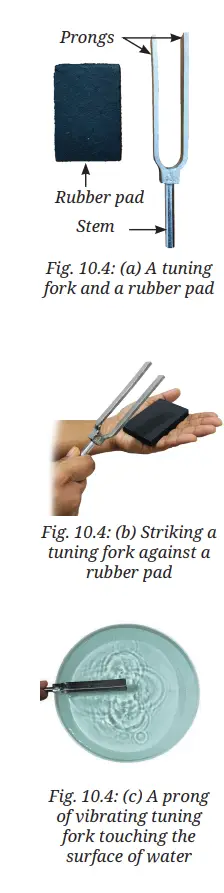
An experiment is performed with a tuning fork. After striking it on a rubber pad, answer the following: (i) Is a sound audible when the tuning fork is brought close to the ear? (ii) What is observed when a vibrating prong of the tuning fork gently touches the surface of water in a container? (iii) What do these observations conclude about the production of sound?
Show answer & explanation
Answer: (i) Yes, a humming sound is heard; (ii) the water surface gets agitated and ripples are produced; (iii) sound is produced by vibrating bodies.
Explanation: (i) When the struck tuning fork is brought near the ear, a soft humming sound is clearly audible because its prongs are vibrating. (ii) When a vibrating prong just touches the water surface, the water is disturbed - it splashes and circular ripples spread out, as seen in Fig. 10.4(c). This shows the prong is moving rapidly to and fro even though the motion is too fast to see directly. (iii) Together these observations conclude that sound is produced by vibrating objects: as long as the prongs vibrate, sound is produced, and the vibration is confirmed by the disturbance created on the water.
Q2Characteristics of Waveeasy2 marks
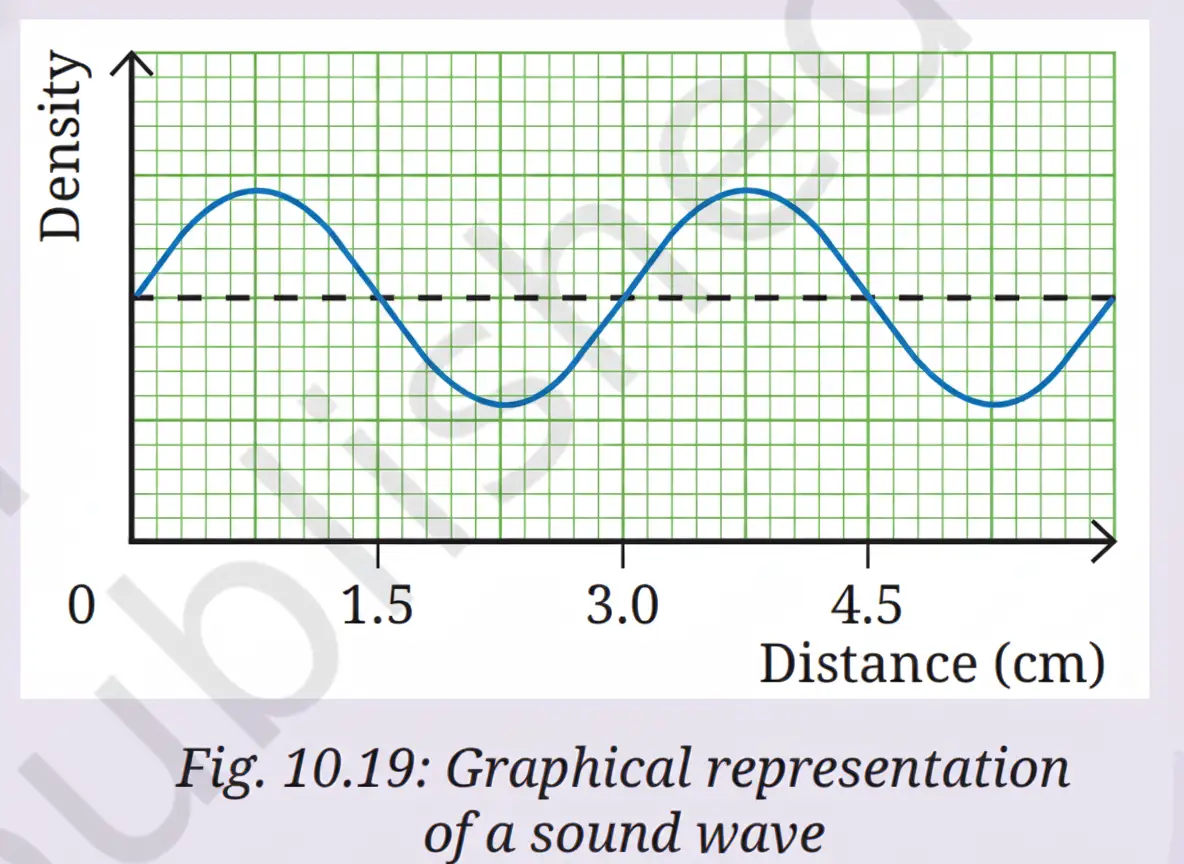
Examine the graphical representation of a sound wave in Figure 10.19. From the graph, determine the value of half of the wave's wavelength.
Show answer & explanation
Answer: Half of the wavelength = 1.5 cm (since the wavelength lambda = 3.0 cm).
Explanation: In Fig. 10.19 the density curve starts on the mean (dashed) line at 0, rises to a crest, crosses the mean line at 1.5 cm, dips to a trough and returns to the mean line at 3.0 cm. So one complete wave (one crest + one trough) occupies 3.0 cm, i.e. wavelength lambda = 3.0 cm; this also matches the crest-to-crest distance on the graph. Therefore half the wavelength = 3.0/2 = 1.5 cm, which is the distance between two successive crossings of the mean density line.
Q3Energy of Soundeasy2 marks
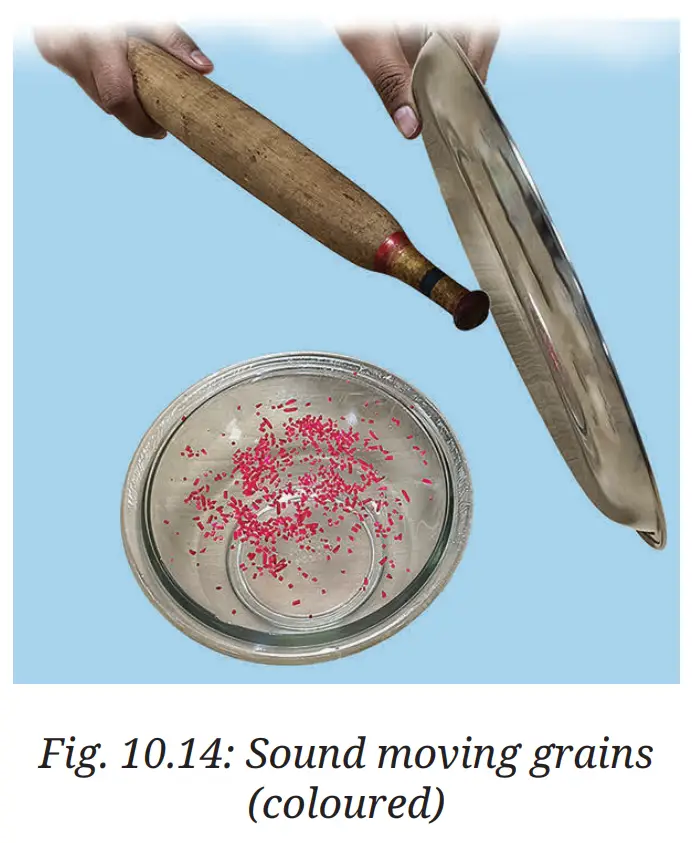
In an experiment where a sheet is stretched over a container with grains sprinkled on it (as shown in the figure), a loud sound is produced near the container. What effect, if any, does the sound have on the grains?
Show answer & explanation
Answer: The grains jump up and down (dance) on the stretched sheet, showing that sound carries energy.
Explanation: The loud sound travels through the air as a wave and strikes the stretched sheet, setting it into vibration. The vibrating sheet tosses the grains lying on it, so they are seen jumping up and down. Since the grains are made to move without anything touching them, the experiment shows that sound carries energy from the source to the sheet through the air.
Q4Production of Soundmedium3 marks
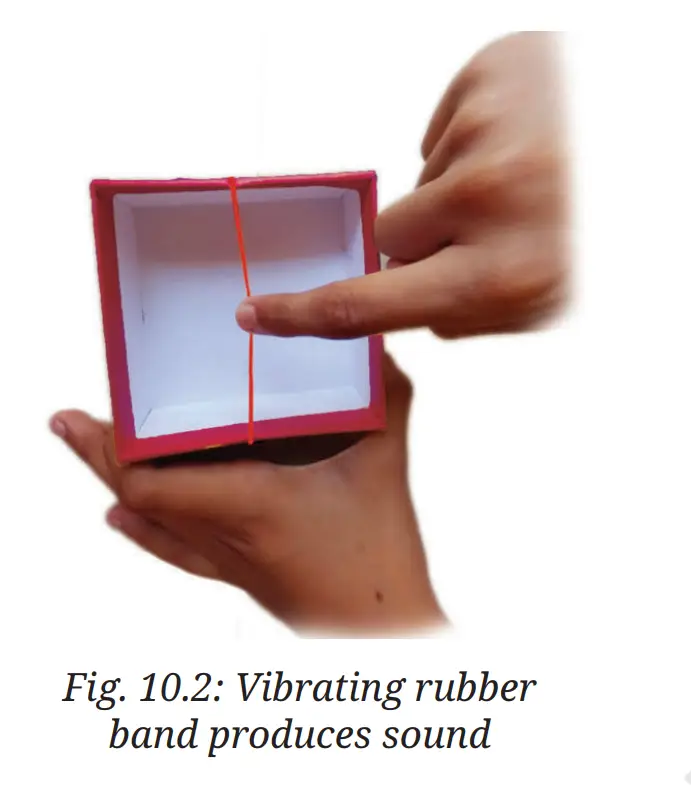
Based on an experiment with a rubber band stretched over an open box, answer the following: (i) What do you observe and hear when the band is plucked? (ii) What happens to the sound when the vibration of the band stops? (iii) How does changing the tension of the rubber band affect the sound produced when it is plucked? (iv) If the rubber band is removed and stretched between two fingers near your ear and then plucked, is sound still produced? How does its loudness compare to the previous setup?
Show answer & explanation
Answer: (i) The band vibrates to and fro (looks blurred) and a sound is heard; (ii) the sound stops; (iii) a tighter band gives a shriller (higher-pitch) sound, a looser band a duller (lower-pitch) sound; (iv) yes, sound is still produced, but it is much fainter than with the box.
Explanation: (i) On plucking, the rubber band moves rapidly to and fro (it appears blurred) and simultaneously a sound is heard, showing the vibrating band is producing the sound. (ii) The moment the band stops vibrating, the sound also stops - no vibration, no sound. (iii) Increasing the tension makes the band vibrate faster (higher frequency), so the sound becomes shriller (higher pitch); decreasing the tension gives a duller, lower-pitch sound. (iv) When the band is stretched between two fingers and plucked near the ear, a sound is still produced because the band still vibrates, but it is much feebler - the open box in the earlier setup acts as a sound board, its walls and the air inside also vibrate and make the sound louder.
Q5Production of Soundeasy2 marks
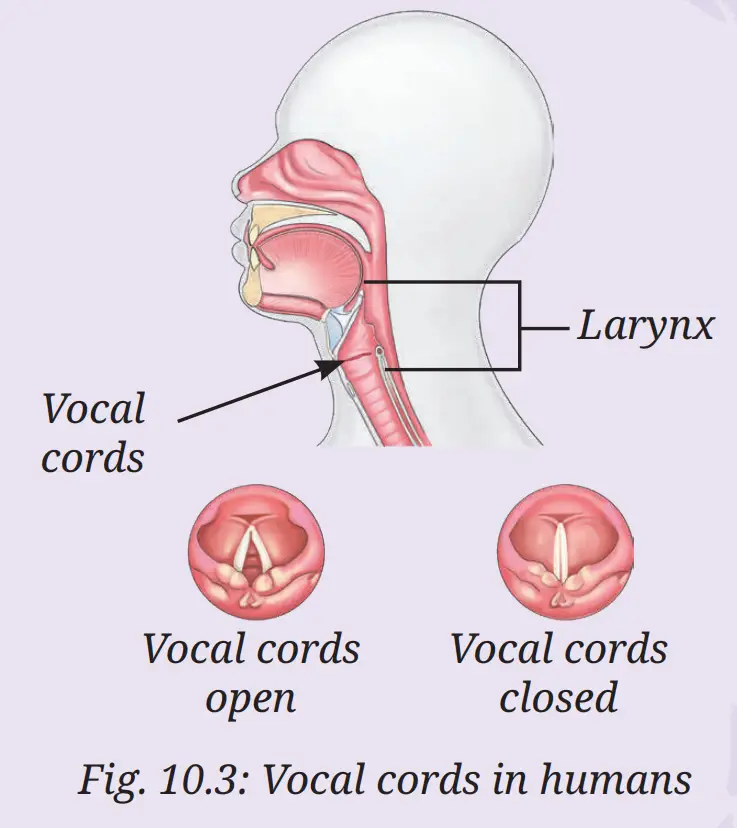
Describe how sound is produced by humans. As you speak or sing, gently place your fingers on your throat. What sensation do you feel, and what does this indicate about the source of the sound?
Show answer & explanation
Answer: Human sound is produced in the larynx (voice box): air from the lungs forced through the slit between the vocal cords makes the cords vibrate; fingers on the throat feel a vibration, indicating the sound comes from the vibrating vocal cords.
Explanation: In humans, sound is produced in the larynx (voice box), situated in the throat at the upper end of the windpipe, which has two vocal cords stretched across it with a narrow slit between them (Fig. 10.3). When we speak or sing, air from the lungs is forced through this slit and the vocal cords vibrate, producing sound; muscles attached to the cords change their tightness and the gap between them, which changes the type of voice. On placing the fingers gently on the throat while speaking, a trembling or shaking sensation (vibration) is felt. This indicates that the source of the sound is the vibrating vocal cords - again confirming that sound is produced by vibrations.
Q6Characteristics of Wavemedium3 marks
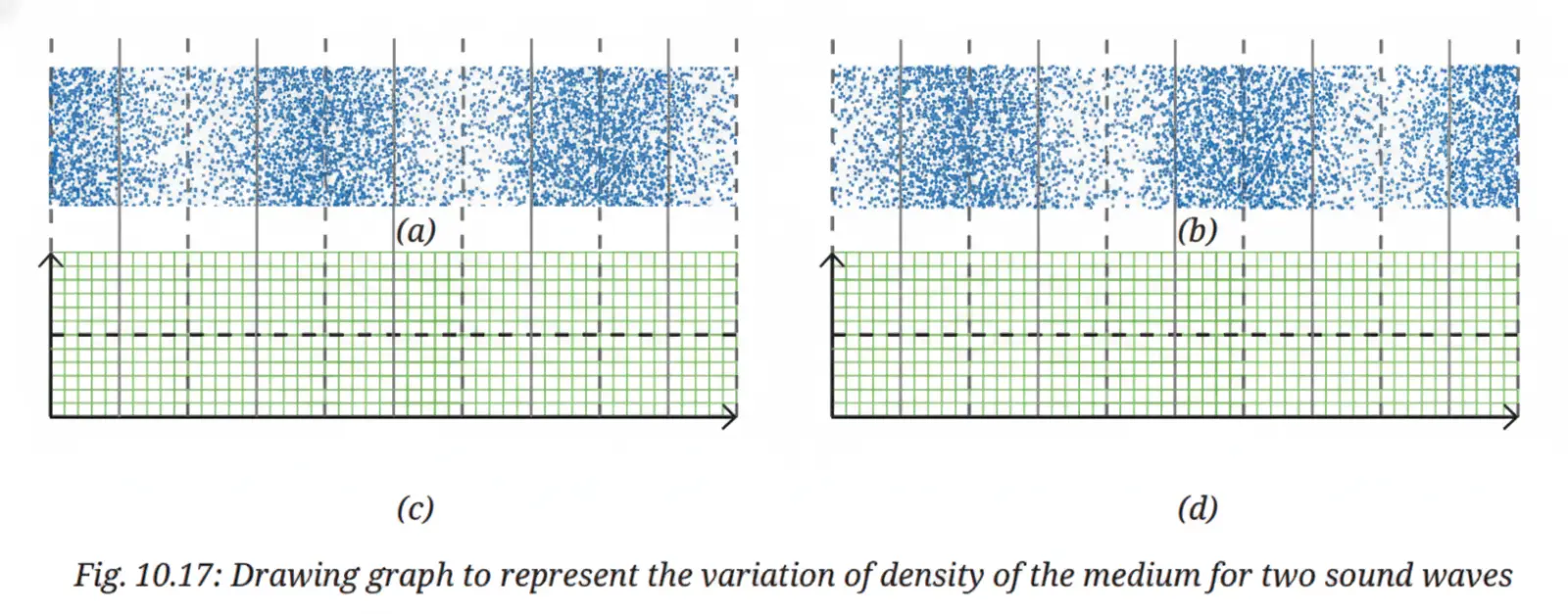
Figure 10.17 (a) and (b) depict the density variation of a medium for two different sound waves. On these figures, identify and label the regions of compression with 'C' and rarefaction with 'R'. Subsequently, for the empty graphs provided in Figure 10.17 (c) and (d), label the axes appropriately and sketch the corresponding density variation curves for the waves shown in (a) and (b) respectively.
Show answer & explanation
Answer: Label C at the crowded (dense-dot) bands and R at the spread-out bands in (a) and (b); in (c) and (d) take x-axis = distance and y-axis = density, and draw a wave-like curve about the mean-density (dashed) line with a crest below each C and a trough below each R.
Explanation: In the dot pictures, a compression is a region where the particles of the medium are crowded together (high density), so every dark, closely packed band in (a) and (b) is labelled C; a rarefaction is a region where the particles are spread apart (low density), so every lighter, sparse band is labelled R. For graphs (c) and (d), the horizontal axis is labelled distance and the vertical axis density, with the dashed horizontal line representing the mean (undisturbed) density. The curve is drawn as a smooth wave oscillating about this mean line: it rises to a crest (maximum density) exactly below each compression and falls to a trough (minimum density) exactly below each rarefaction of the wave directly above it. One compression plus one adjacent rarefaction makes one complete wavelength, so the spacing of crests in (c) and (d) must match the spacing of the C regions in (a) and (b) respectively - the wave whose compressions are closer together gets a curve with more cycles in the same length (shorter wavelength).
Q7Propagation of Soundeasy1 mark
Consider the following statements.
Assertion (A): The sound from a ringing bell inside a sealed jar becomes inaudible as the air is removed from the jar.
Reason (R): A medium is necessary for the propagation of sound.
Select the correct option regarding these statements.
Both A and R are true, and R is the correct explanation of A.
Both A and R are true, but R is not the correct explanation of A.
A is true, but R is false.
A is false, but R is true.
Show answer & explanation
Answer: Both A and R are true, and R is the correct explanation of A.
Explanation: The assertion correctly describes the outcome of the bell jar experiment, which demonstrates that sound cannot travel in a vacuum. The reason states the scientific principle that sound, being a mechanical wave, requires a material medium to propagate. The reason perfectly explains why the assertion is true.
Q8Energy of Soundeasy1 mark
When the sound from a vibrating tuning fork propagates to a listener's ear, what is it that is actually transmitted from the source to the ear? Choose from the following options:
(i) The air particles that were initially near the tuning fork
(ii) The energy that is transported by the sound waves
(iii) The material of the tuning fork itself
(iv) An uninterrupted flow of compressed air
Air particles near the tuning fork
Energy carried by sound waves
The tuning fork material
A continuous stream of compressed air
Show answer & explanation
Answer: Energy carried by sound waves
Explanation: Sound waves are a form of energy that propagates through a medium by causing particles to vibrate. The particles themselves do not travel the distance, but they transfer the energy.
Q9Propagation of Soundmedium1 mark
Consider the following statements.
Assertion (A): The regions of compression and rarefaction propagate through the medium.
Reason (R): The individual particles of the medium travel progressively forward along with the wave.
Select the correct option describing the relationship between these two statements.
Both A and R are true, and R is the correct explanation of A.
Both A and R are true, but R is not the correct explanation of A.
A is true but R is false.
A is false, but R is true.
Show answer & explanation
Answer: A is true but R is false.
Explanation: Assertion (A) is true because sound propagates as a wave of compressions and rarefactions. Reason (R) is false because particles in the medium only oscillate about their mean positions and do not travel with the wave.
Q10Propagation of Soundeasy1 mark
Select the statement that provides the strongest evidence for sound being a mechanical wave.
(i) Sound exhibits reflection
(ii) Sound requires a medium for propagation
(iii) Sound possesses frequency
(iv) Sound transports energy
Sound exhibits reflection
Sound requires a medium for propagation
Sound possesses frequency
Sound transports energy
Show answer & explanation
Answer: Sound requires a medium for propagation
Explanation: A mechanical wave is defined by its requirement of a medium for propagation, which distinguishes it from electromagnetic waves. The other options are general properties of most waves.
Q11Characteristics of Wavemedium1 mark
If the frequency of a sound wave traveling through a medium is increased, which of the following properties will also increase?
(i) wavelength
(ii) speed
(iii) number of compressions per second
(iv) time period
wavelength
speed
number of compressions per second
time period
Show answer & explanation
Answer: number of compressions per second
Explanation: Frequency is defined as the number of oscillations or compressions passing a point per second. Therefore, increasing frequency directly increases the number of compressions per second.
Q12Characteristics of Waveeasy1 mark
Calculate the frequency of a sound wave if 20 compressions are observed to pass a specific point over a duration of 4 seconds. The options are: (i) 80 Hz, (ii) 5 Hz, (iii) 10 Hz, (iv) 0.2 Hz.
80 Hz
5 Hz
10 Hz
0.2 Hz
Show answer & explanation
Answer: 5 Hz
Explanation: Frequency is the number of oscillations (or compressions) per unit time. Frequency = Number of compressions / Time = 20 / 4s = 5 Hz.
Stuck anywhere in Chapter 10 (Sound Waves: Characteristics and Applications)? Vidya ma'am — EduLevel's AI teacher — teaches this chapter live, by voice, and solves your doubts till they click.