Exploration Class 9 Science Chapter 5: Exploring Mixtures and their Separation — NCERT Solutions
Chapter 5 of the new NCERT Class 9 Science textbook Exploration (2026-27) — Exploring Mixtures and their Separation. Below are 16 questions from this chapter with answers and step-by-step explanations, including 8 diagram-based questions with their figures. Try each one before revealing the answer — and if a concept doesn't click, Vidya ma'am teaches this exact chapter live in the EduLevel app.
What Chapter 5 covers
Classify Mixtures
Solutions
Concentration Solution
Solubility Substances
Methods Separation
Heterogeneous Mixtures
Exploration Chapter 5 — solved questions
Attempt each question first, then open the answer to compare your method.
Q1Methods Separationeasy2 marks
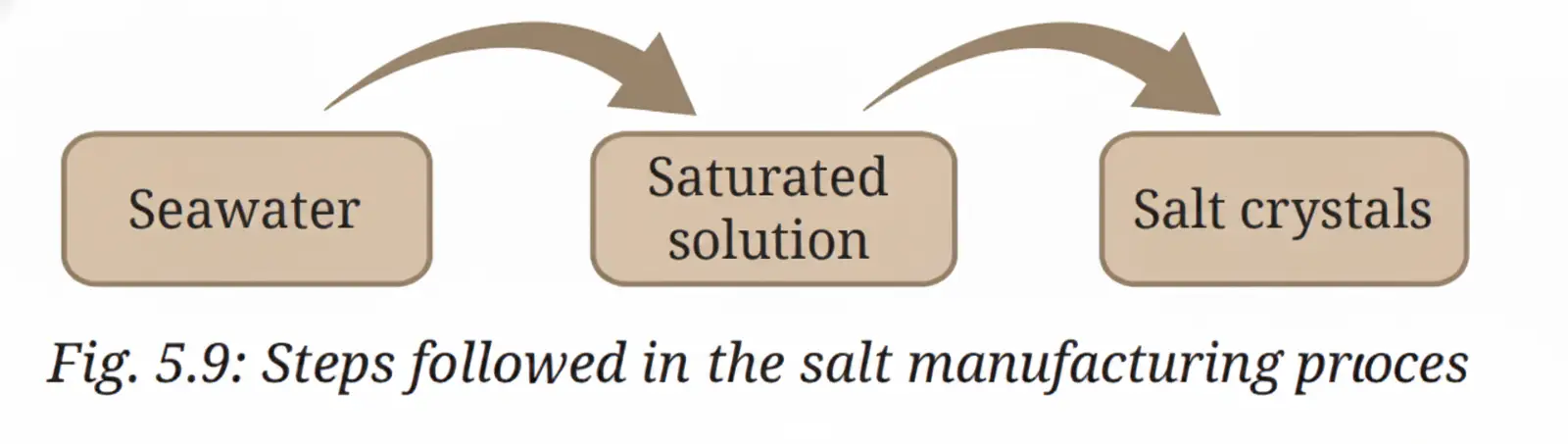
Based on the process shown in the accompanying figure for obtaining salt crystals from seawater, describe the steps involved in your own words.
Show answer & explanation
Answer: Seawater is trapped in shallow pits, the Sun's heat evaporates the water until the solution becomes saturated, and on further evaporation the excess salt crystallises out; the salt crystals are then collected.
Explanation: Seawater is a solution of salt in water. It is collected in shallow pits or pans where the heat of the Sun evaporates the water slowly. As water is lost, the solution becomes more and more concentrated until it is saturated, that is, it cannot hold any more dissolved salt at that temperature. On further evaporation the excess salt separates out as solid crystals (crystallisation), which are collected, and the process is repeated with fresh seawater.
Q2Classify Mixturesmedium3 marks
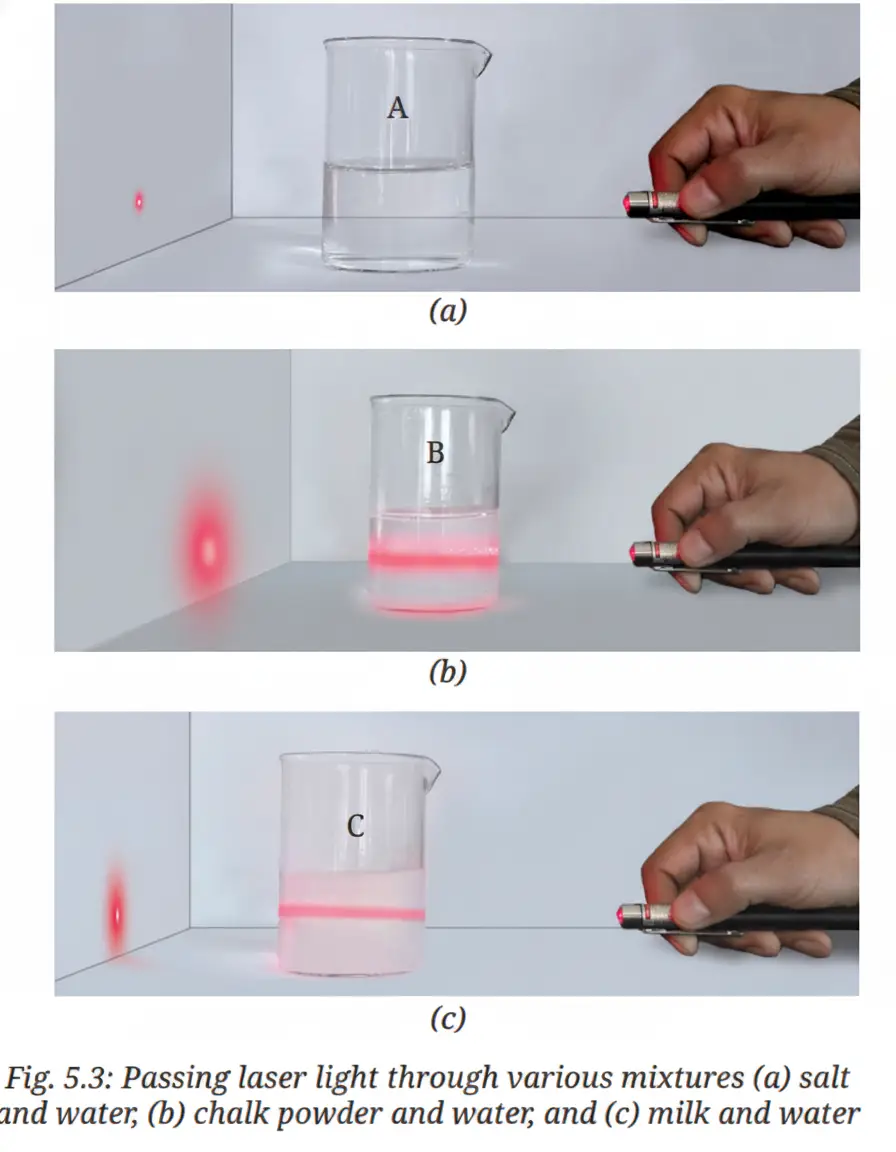
An experiment involves preparing three mixtures: (A) salt in water, (B) chalk powder in water, and (C) milk in water. Based on this setup, record your observations for the following:
1. In which of the mixtures are the constituent particles visible to the naked eye?
2. What do you observe when a beam of light from a laser pointer is passed through each mixture, as depicted in the figure?
3. Predict the appearance of each mixture after it has been left undisturbed for several minutes.
Show answer & explanation
Answer: 1. Particles are visible only in B (chalk powder in water); 2. the laser path is not visible inside A (only a dot on the wall) but is clearly visible inside B and C due to scattering of light (Tyndall effect); 3. A stays clear and unchanged, the chalk in B settles at the bottom leaving clearer water above, and C remains uniform with no settling.
Explanation: Salt in water is a true solution, chalk powder in water is a suspension, and milk in water is a colloid. Solution particles are smaller than 1 nm, so they are invisible and cannot scatter light; the beam passes straight through beaker A leaving only a spot on the wall. Suspension particles are larger than 100 nm, so they can be seen with the naked eye, scatter the laser strongly making its path visible in B, and settle at the bottom under gravity on standing. Colloidal particles (between 1 nm and 100 nm) are too small to be seen and too small to settle, yet large enough to scatter light, so the beam path is visible in C (Tyndall effect) and the mixture stays uniform on standing.
Q3Solubility Substancesmedium3 marks
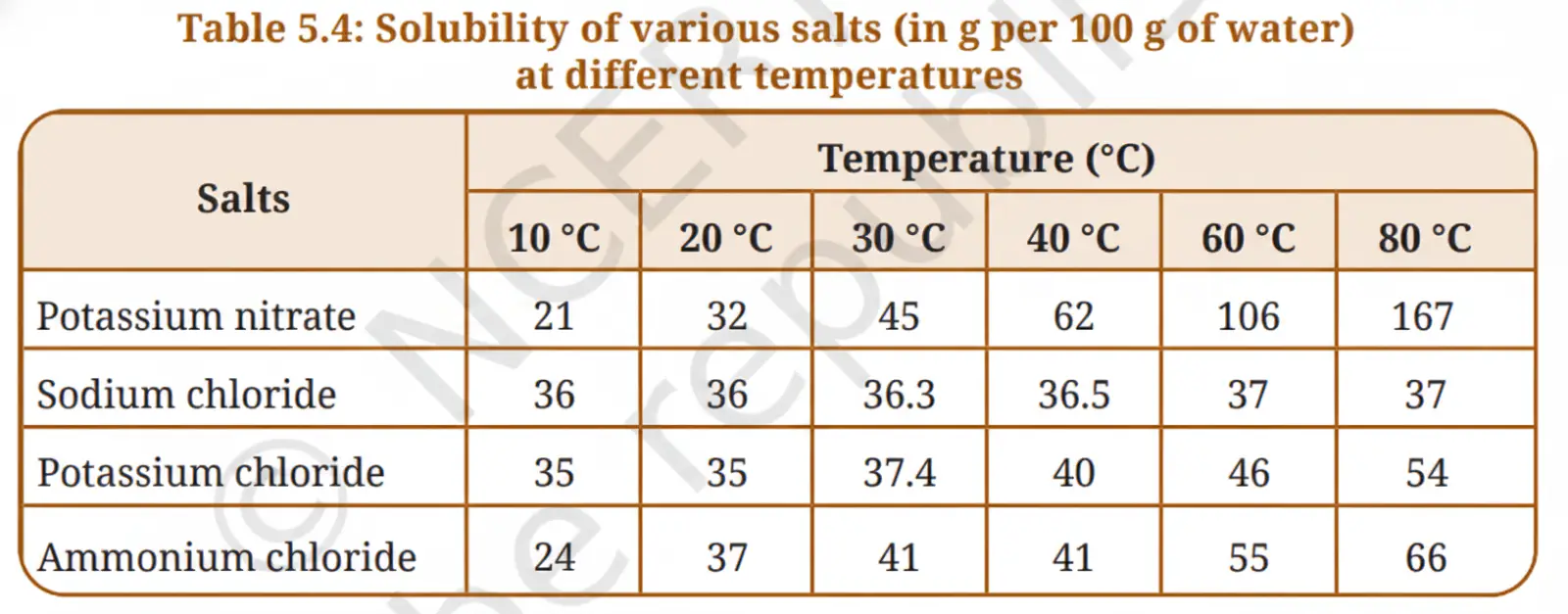
Using the solubility data provided in Table 5.4, answer the following:
(i) Calculate the mass of potassium nitrate required to create a saturated solution in 50 g of water at 40 °C.
(ii) A saturated solution of potassium chloride is prepared at 80 °C and then cooled to room temperature (25 °C). Describe the expected observation and explain why it occurs.
(iii) Analyze the effect of temperature on the solubility of the salts listed. Compare how the solubility of the four salts changes as the temperature increases from 10 °C to 80 °C.
Show answer & explanation
Answer: (i) 31 g of potassium nitrate; (ii) excess KCl separates out as solid crystals on cooling, because its solubility falls from 54 g per 100 g of water at 80 °C to about 35-36 g at 25 °C; (iii) solubility of all four salts increases with temperature but to different extents - potassium nitrate rises sharply (21 to 167), ammonium chloride moderately (24 to 66), potassium chloride slowly (35 to 54), and sodium chloride hardly changes (36 to 37).
Explanation: (i) At 40 °C the solubility of potassium nitrate is 62 g per 100 g of water, so for 50 g of water the mass needed is 62 x 50/100 = 31 g. (ii) Solubility of potassium chloride decreases as temperature falls; a solution saturated at 80 °C holds 54 g per 100 g of water, but at 25 °C water can hold only about 35-36 g, so the extra KCl can no longer stay dissolved and crystallises out, leaving a solution that is saturated at the lower temperature. (iii) Reading each row of Table 5.4 from 10 °C to 80 °C shows that solubility increases with temperature for every salt, but the extent differs greatly: potassium nitrate shows the steepest rise, ammonium chloride a moderate rise, potassium chloride only a small rise, and sodium chloride remains almost unaffected by temperature.
Q4Methods Separationmedium2 marks
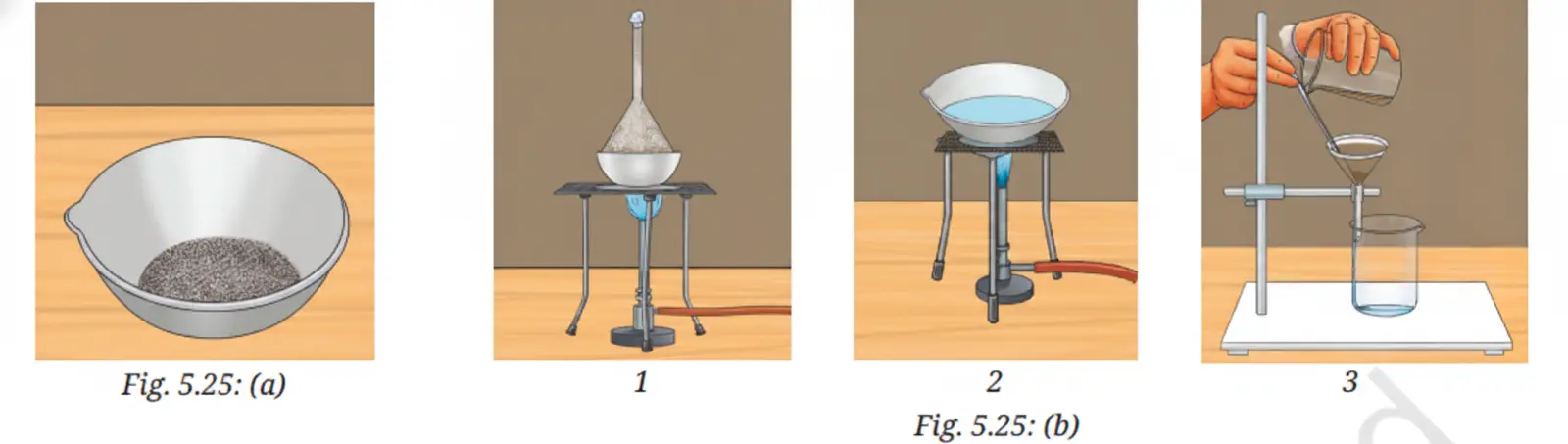
You are provided with a mixture containing sand, common salt, and naphthalene, as shown in Fig. 5.25a. Figure 5.25b illustrates several separation steps. Determine the correct order of these techniques to isolate each component from the mixture.
Show answer & explanation
Answer: Correct order: 1 -> 3 -> 2, i.e., sublimation first (removes naphthalene), then add water and filter (step 3, sand is retained on the filter paper), and finally evaporate the filtrate (step 2) to recover the common salt.
Explanation: Naphthalene sublimes, so the mixture is first heated under an inverted funnel (step 1); naphthalene vapours rise and condense on the cooler walls of the funnel, leaving sand and salt behind. Water is then added to the remaining mixture: salt dissolves while sand does not, so on filtration (step 3) the sand stays on the filter paper and the salt solution passes through as the filtrate. Finally, the filtrate is heated in an evaporating dish (step 2); the water evaporates and solid common salt is left behind. Each step works because it uses a property unique to one component - sublimation of naphthalene, insolubility of sand, and non-volatility of salt.
Q5Methods Separationmedium3 marks
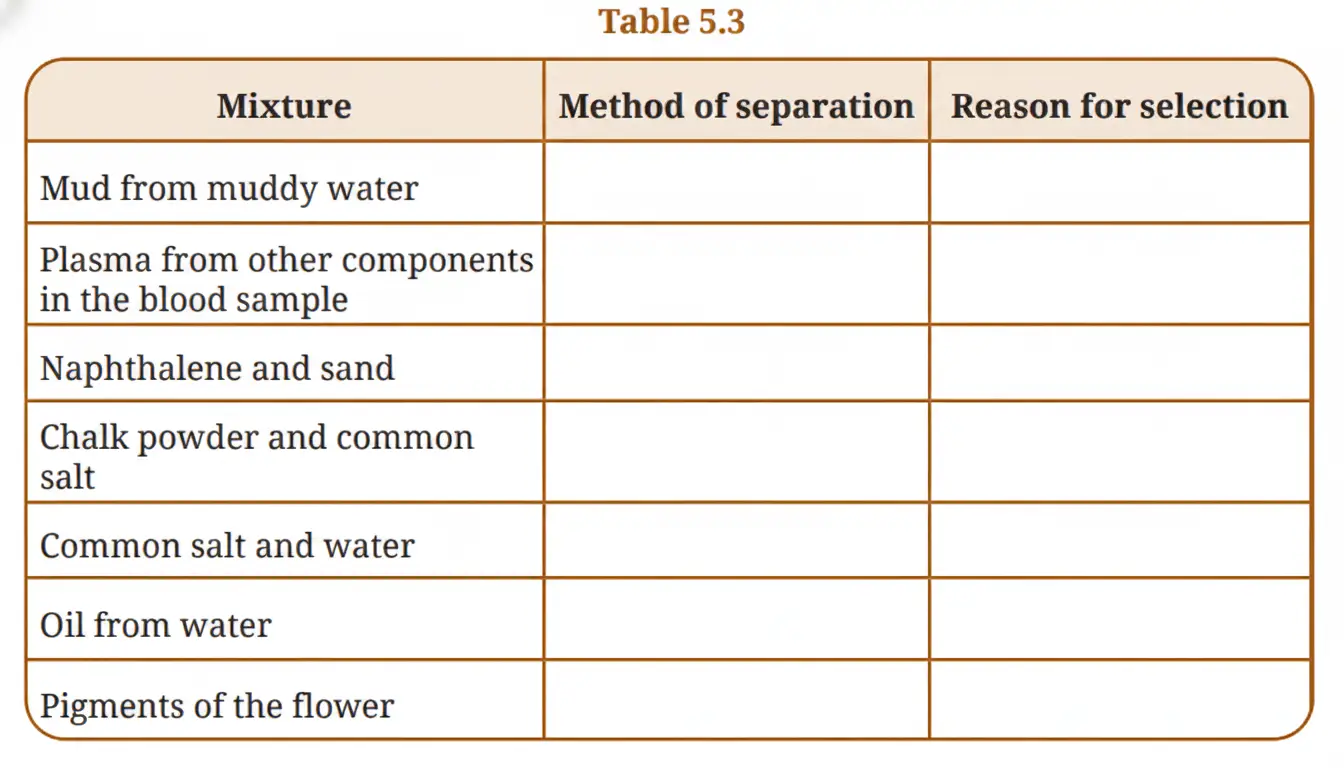
For each mixture listed in Table 5.3, propose a suitable separation method and provide a reason for your choice. If a mixture cannot be separated by common methods, explain why.
Show answer & explanation
Answer: Mud from muddy water - filtration (mud particles are insoluble and large enough to be retained by filter paper); plasma from blood - centrifugation (components of different densities separate on spinning); naphthalene and sand - sublimation (naphthalene sublimes, sand does not); chalk powder and common salt - dissolve in water, filter out chalk, then evaporate the filtrate (salt is soluble, chalk is not); common salt and water - evaporation or distillation (salt is non-volatile); oil from water - separating funnel (immiscible liquids of different densities form layers); pigments of a flower - paper chromatography (pigments travel at different rates with the solvent).
Explanation: The method for each mixture is chosen from the property in which the two components differ. Mud particles are insoluble and larger than the pores of filter paper, so filtration retains them. Blood cells are denser than plasma, so rapid spinning in a centrifuge packs them down, leaving plasma on top. Naphthalene changes directly from solid to vapour on heating while sand does not; chalk is insoluble in water while salt dissolves; and salt, being non-volatile, is left behind when the water is evaporated or the water is recovered by distillation. Oil and water are immiscible and have different densities, so they form separate layers in a separating funnel, while flower pigments differ in solubility in the solvent, so they rise to different heights on chromatography paper. Every mixture in the table can therefore be separated by a common method.
Q6Heterogeneous Mixturesmedium3 marks
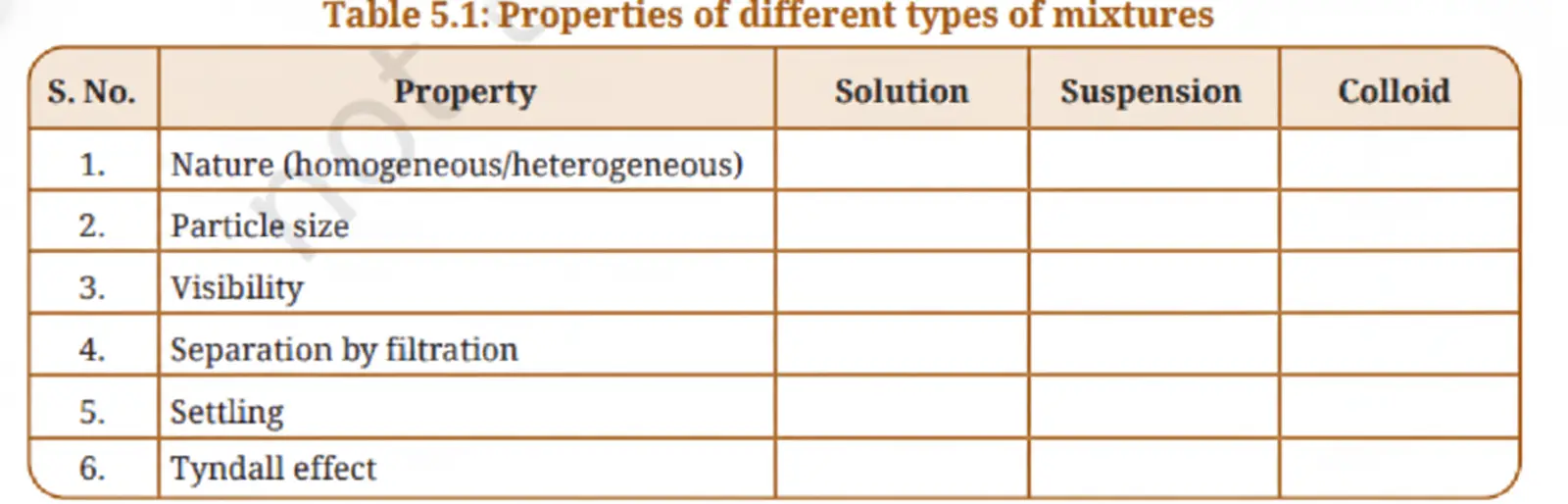
Complete the following table to compare the distinct properties of solutions, suspensions, and colloids.
Show answer & explanation
Answer: Particle size: solution smaller than 1 nm; colloid 1 nm to 1000 nm; suspension larger than 1000 nm. Nature: solution homogeneous, colloid and suspension heterogeneous. Visibility: particles invisible in a solution, invisible to the eye but light-scattering in a colloid, visible in a suspension. Filtration: only a suspension can be separated by filter paper. Settling: only a suspension settles on standing. Tyndall effect: shown by colloids (and suspensions), not by solutions.
Explanation: Fill the table from the defining property of each mixture - particle size - and let the other rows follow from it. Below 1 nm the particles are individual ions or molecules, so a solution is homogeneous, never settles, passes through filter paper and shows no Tyndall effect. Between 1 nm and 1000 nm the particles are big enough to scatter a light beam (Tyndall) but still too small to settle or be filtered out, which is a colloid. Above 1000 nm the particles are heavy enough to settle under gravity and large enough to be trapped by filter paper, which is a suspension. Use the 1 nm and 1000 nm boundaries this book states; an older convention put the colloid range at 1-100 nm.
Q7Methods Separationhard3 marks
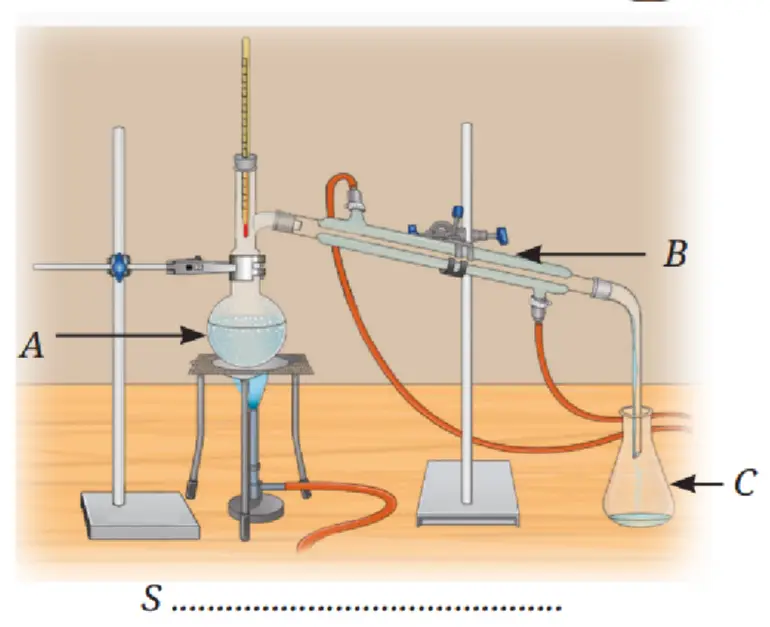
Analyze the setup shown in Fig. 5.26.
(i) Name the separation method indicated by 'S'.
(ii) Identify the parts labeled A, B, and C in the apparatus.
(iii) Using the boiling point data from Table 5.5, determine which of the following mixtures can be separated using this technique: (a) water and acetone, (b) water and salt, (c) acetone and alcohol, (d) sand and salt, (e) alcohol and chloroform, (f) alcohol and benzene.
Show answer & explanation
Answer: (i) S = distillation (simple distillation); (ii) A = distillation flask (round-bottom flask containing the mixture, fitted with a thermometer), B = condenser, C = conical flask (receiver) that collects the distillate; (iii) separable by this technique: (a) water and acetone and (b) water and salt; not separable by it: (c) acetone and alcohol, (e) alcohol and chloroform, (f) alcohol and benzene (boiling point difference less than 25 °C, fractional distillation needed) and (d) sand and salt (both non-volatile solids, no liquid to boil).
Explanation: In the set-up, the mixture is boiled in flask A, the vapour of the lower-boiling component passes into condenser B where it is cooled back to liquid, and the liquid collects in receiver C - this is distillation. Simple distillation works for a miscible liquid pair whose boiling points differ by more than about 25 °C, or for a liquid containing a dissolved non-volatile solid. Water (100 °C) and acetone (56 °C) differ by 44 °C, so they separate well, and in salt water only the water vaporises, leaving salt behind in the flask. Acetone and alcohol (56 vs 78 °C), alcohol and chloroform (78 vs 61 °C) and alcohol and benzene (78 vs 80 °C) have boiling point gaps smaller than 25 °C, so simple distillation cannot separate them and fractional distillation would be required. Sand and salt are both non-volatile solids, so distillation does not apply to them at all.
Q8Classify Mixtureseasy2 marks
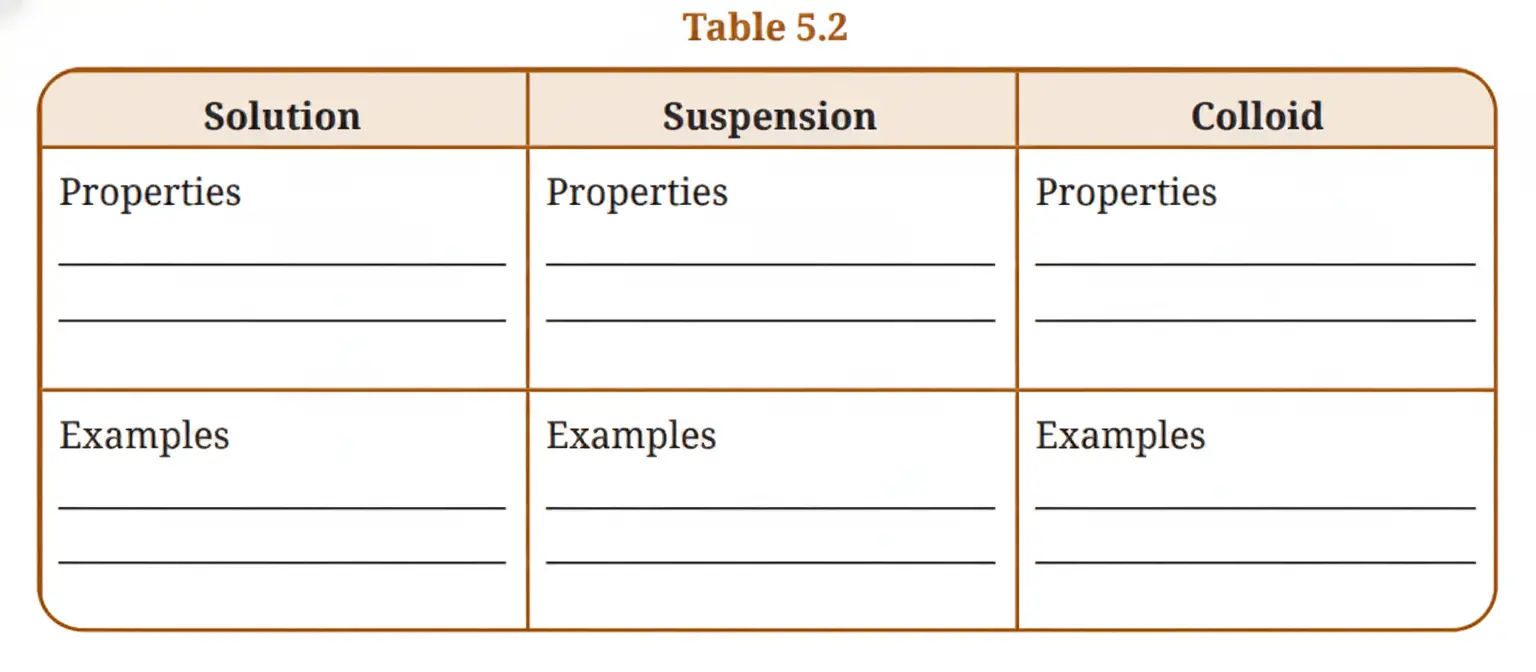
Categorize mixtures as solutions, suspensions, or colloids based on their properties. Complete Table 5.2 using the descriptive terms from the provided box. Note that terms can be used multiple times.
Show answer & explanation
Answer: Solution: transparent, small-sized particles (less than 1 nm), particles remain evenly distributed, does not settle down, cannot be separated by filtration; examples - salt solution, brass. Suspension: heterogeneous mixture, large-sized particles (more than 1000 nm), settles down when left undisturbed, scatters light, separates by filtration; examples - sand in water, mud. Colloid: heterogeneous mixture, moderate-sized particles (1 nm to 1000 nm), particles remain evenly distributed, does not settle down, scatters light, cannot be separated by filtration; examples - milk, smoke, butter.
Explanation: Sort every term in the box by particle size, because size decides all the other behaviour. Solutions have the smallest particles, so they are transparent, stay evenly mixed and slip through filter paper - and note that brass belongs here, a solid solution of zinc in copper, which shows a solution need not be a liquid. Suspensions have the largest particles, so they look heterogeneous, settle out on standing and can be filtered. Colloids sit in between: the particles are too small to settle or be filtered but large enough to scatter light, which is why milk, smoke and butter all show the Tyndall effect while staying evenly distributed.
Q9Solutionseasy2 marks
Explain whether it is feasible to dissolve one metal into another.
Show answer & explanation
Answer: Yes - when metals are melted together, they dissolve in one another and on cooling solidify as an alloy, which is a homogeneous mixture (a solid solution); for example, zinc dissolved in copper gives brass.
Explanation: In the solid state, one metal cannot spread appreciably into another, but on heating the metals melt and their atoms mix freely, just like a solute dissolving in a liquid solvent. When this uniform molten mixture cools, it solidifies with one metal evenly distributed throughout the other, forming an alloy. Alloys are therefore regarded as solid solutions in which the metal present in the larger amount acts as the solvent. Brass (zinc in copper) and bronze (tin in copper) are everyday examples, showing that dissolving one metal into another is feasible.
Q10Concentration Solutioneasy2 marks
Besides agricultural applications, provide other examples from daily life where preparing a solution with the correct proportion of solute to solvent is essential for its intended purpose.
Show answer & explanation
Answer: Examples: ORS (oral rehydration solution) with the correct salt-sugar proportion, doses of liquid medicines and syrups, normal saline used for intravenous drips, diluting antiseptics like Dettol before use, adding chlorine in a fixed proportion to disinfect drinking water or swimming pools, and preparing cleaning or disinfectant solutions of the right strength.
Explanation: The usefulness of a solution depends on its concentration, that is, the amount of solute dissolved in a given amount of solvent. Too little solute makes the solution ineffective, while too much can be harmful: an ORS with the wrong salt concentration can worsen dehydration instead of curing it, and an over-concentrated medicine dose can be toxic. Antiseptics disinfect safely only at the recommended dilution, saline given in a drip must match the salt concentration of body fluids, and excess chlorine makes drinking water unsafe. Hence, in each of these daily-life uses, the solute and solvent must be taken in the correct proportion for the solution to serve its purpose.
Q11Heterogeneous Mixturesmedium2 marks
If two immiscible liquids that have the same density are mixed together in a separating funnel, how will the layers be formed?
Show answer & explanation
Answer: No distinct layers will form - because the two immiscible liquids have the same density, neither liquid sinks below or floats above the other; they remain mixed as dispersed droplets, so a separating funnel cannot separate them.
Explanation: In a separating funnel, immiscible liquids separate into layers because the denser liquid sinks to the bottom while the lighter one floats on top. Layer formation thus depends on a difference in density, not merely on immiscibility. If the two liquids have equal densities, there is no tendency for one to settle below the other, so instead of two clear layers the mixture stays as a turbid dispersion of droplets of one liquid spread through the other. Such a pair therefore cannot be separated using a separating funnel.
Q12Classify Mixturesmedium3 marks
Answer the following conceptual questions:
(i) Explain why suspended particles in muddy water settle down, whereas they do not in milk.
(ii) Differentiate between the processes of evaporation and boiling.
(iii) What causes the path of sunlight to become visible as bright rays when it passes through small openings in the foliage of a dense tree?
Show answer & explanation
Answer: (i) Muddy water is a suspension, with particles larger than 1000 nm that are heavy enough to settle, while milk is a colloid, with particles in the 1-1000 nm range that stay dispersed. (ii) Evaporation is slow, happens only at the surface and at any temperature; boiling is fast, happens throughout the bulk and only at the boiling point. (iii) The beam is seen because colloidal dust and tiny water droplets in the air scatter the light - the Tyndall effect.
Explanation: Each part turns on particle size or on where a change happens. (i) Settling is decided by size: mud particles exceed 1000 nm, so gravity pulls them down and the water clears, whereas milk's fat and protein particles lie between 1 nm and 1000 nm, small enough that they stay evenly dispersed indefinitely. (ii) Evaporation only involves the faster molecules escaping from the surface, so it is slow and needs no particular temperature, while boiling forms bubbles of vapour throughout the liquid and only once the boiling point is reached. (iii) A light beam is invisible unless something scatters it into your eye; the colloid-sized dust and droplets in air do exactly that, which is why the path of sunlight shows up through a gap.
Q13Methods Separationhard3 marks
A hypothesis states that cooling a hot, saturated copper sulfate solution rapidly in ice-cold water produces smaller, less well-formed crystals compared to cooling it slowly at room temperature. Design and describe an experiment to verify this hypothesis.
Show answer & explanation
Answer: Prepare one hot saturated copper sulfate solution and divide it equally into two identical dishes; cool dish 1 rapidly by placing it in ice-cold water and let dish 2 cool slowly, undisturbed, at room temperature; then compare the crystals formed in each with a hand lens - if dish 1 has many small, irregular crystals while dish 2 has fewer, larger, well-shaped ones, the hypothesis is verified.
Explanation: A fair test must change only one variable, the rate of cooling, so the same saturated solution is split into two equal portions kept in identical containers under otherwise identical conditions. On rapid cooling in ice-cold water, the solubility of copper sulfate drops suddenly and the excess solute is forced out of solution very quickly, giving its particles little time to arrange themselves in an orderly pattern, so many tiny, poorly formed crystals appear. On slow cooling at room temperature, crystallisation proceeds gradually and the particles get enough time to build large, well-defined crystals. Observing both sets of crystals with a hand lens or microscope and comparing their size and shape shows whether the results match the hypothesis; repeating the experiment makes the conclusion more reliable.
Q14Solutionsmedium1 mark
Consider the following statements.
Assertion (A): Solutions do not exhibit the Tyndall effect.
Reason (R): The particles in solutions are larger than 100 nm, so they cannot scatter light.
Choose the correct option:
Both A and R are true, and R is the correct explanation of A.
Both A and R are true, but R is not the correct explanation of A.
A is true, but R is false.
A is false, but R is true.
Show answer & explanation
Answer: A is true, but R is false.
Explanation: A true solution does not show the Tyndall effect, so the assertion is correct. The reason, however, is wrong: the particles of a solution are extremely small, less than 1 nm in diameter, not larger than 100 nm. It is precisely because they are so small that they cannot scatter a beam of light passing through the solution. Particles larger than 100 nm occur in suspensions, and suspensions do scatter light and make the beam path visible.
Q15Classify Mixturesmedium1 mark
From the given options, identify the one that correctly classifies each mixture as either homogeneous (Hm) or heterogeneous (Ht).
Explanation: Muddy water (suspension), milk (colloid), and blood (colloid) are all heterogeneous. Brass (alloy) is a homogeneous mixture. Option (iv) correctly classifies all of them.
Q16Heterogeneous Mixturesmedium1 mark
Among the listed mixtures, determine which ones will exhibit the Tyndall Effect. Select the correct combination from the options provided.
Mixtures:
(a) air and dust particles
(b) copper sulfate and water
(c) starch and water
(d) acetone and water
(i) a and b
(ii) b and d
(iii) a and c
(iv) c and d
Show answer & explanation
Answer: (iii) a and c
Explanation: The Tyndall effect is shown by colloids and suspensions. Air with dust particles (aerosol) and starch in water are colloids, while copper sulfate solution and acetone in water are true solutions. Therefore, (a) and (c) will show the effect.
Stuck anywhere in Chapter 5 (Exploring Mixtures and their Separation)? Vidya ma'am — EduLevel's AI teacher — teaches this chapter live, by voice, and solves your doubts till they click.