Exploration Class 9 Science Chapter 7: Work, Energy, and Simple Machines — NCERT Solutions
Chapter 7 of the new NCERT Class 9 Science textbook Exploration (2026-27) — Work, Energy, and Simple Machines. Below are 14 questions from this chapter with answers and step-by-step explanations, including 8 diagram-based questions with their figures. Try each one before revealing the answer — and if a concept doesn't click, Vidya ma'am teaches this exact chapter live in the EduLevel app.
What Chapter 7 covers
Work Done
Constant Force
Zero Work
Positive Negative
Work-Energy Theorem
Forms of Energy
Kinetic Energy
Potential Energy
Gravitational Potential
Conservation of Mechanical Energy
Power
Simple Machines
Pulley
Inclined Plane
Lever
Exploration Chapter 7 — solved questions
Attempt each question first, then open the answer to compare your method.
Q1Work-Energy Theoremmedium3 marks
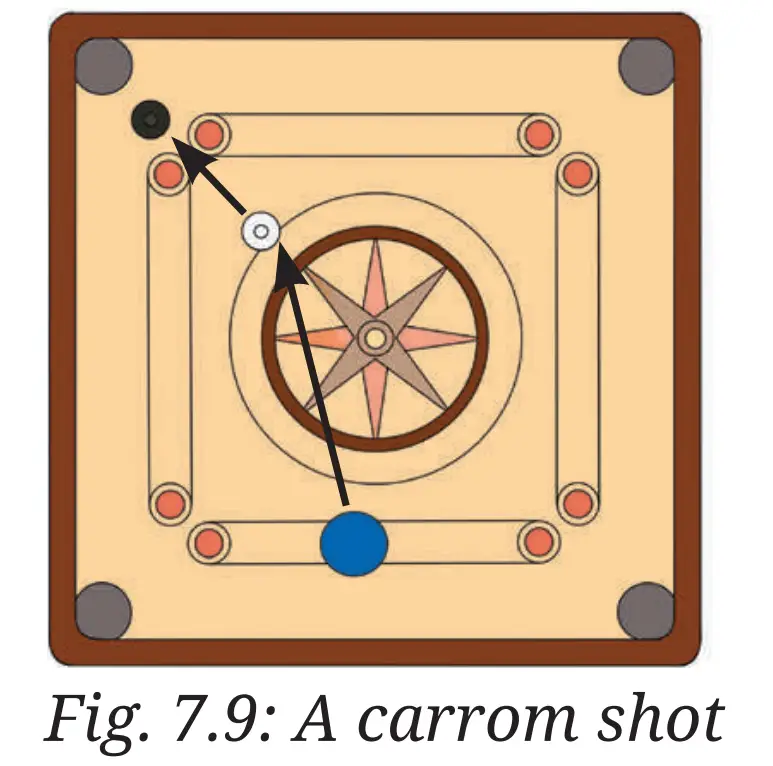
In a carrom game, a player uses a striker to hit a black coin, as depicted in the figure. Analyze the collisions that occur and identify which object does work on another. Also, describe the energy transformations that take place during these interactions.
Show answer & explanation
Answer: Two collisions. First the striker does positive work on the white coin, increasing its kinetic energy, while the white coin does an equal amount of negative work back on the striker, slowing it. Then the white coin does positive work on the black coin, and the black coin does negative work back on the white coin. Energy chain: the player's muscular energy becomes the striker's kinetic energy, then the white coin's, then the black coin's, with some lost as sound at each impact and as heat through friction.
Explanation: Follow the arrows in the figure: the striker hits the white coin, and the white coin then hits the black coin - the striker never touches the black coin. In each collision the body that strikes pushes the struck body through a distance in the direction of the push, so it does positive work and the struck body gains kinetic energy. By Newton's third law the struck body pushes back with an equal and opposite force, so it does an equal negative amount of work on the body that hit it, which is why the striker slows down after the impact and the white coin slows after passing the motion on. Energy is transferred along the chain and never created: muscular energy to striker, striker to white coin, white coin to black coin, with a little turning into sound at each click and into heat through friction with the board - which is why every piece eventually stops.
Q2Work-Energy Theoremmedium3 marks
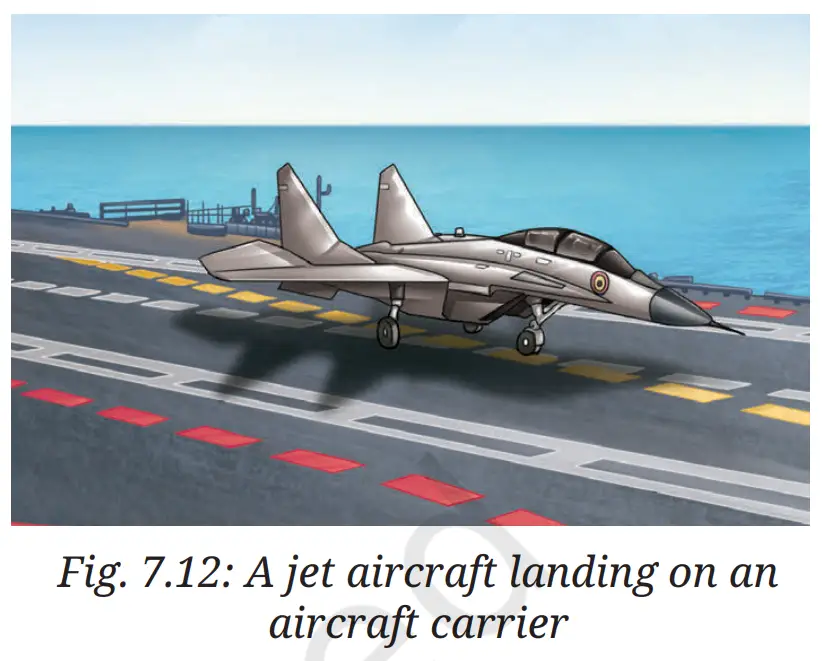
An aircraft with a mass of 15000 kg lands on a carrier. A wire exerts a constant stopping force of 367500 N, bringing the jet to a halt over a distance of 100 m. Calculate the aircraft's velocity just before it was caught by the wire.
Show answer & explanation
Answer: v = 70 m/s (252 km/h)
Explanation: By the work-energy theorem, the work done by the stopping force equals the kinetic energy lost by the aircraft: F x s = (1/2) m v2. Work done by the wire = 367500 N x 100 m = 36750000 J. So (1/2) x 15000 x v2 = 36750000, giving v2 = (2 x 36750000)/15000 = 4900. Therefore v = 70 m/s, which is the aircraft's speed just before being caught by the wire.
Q3Conservation of Mechanical Energymedium3 marks
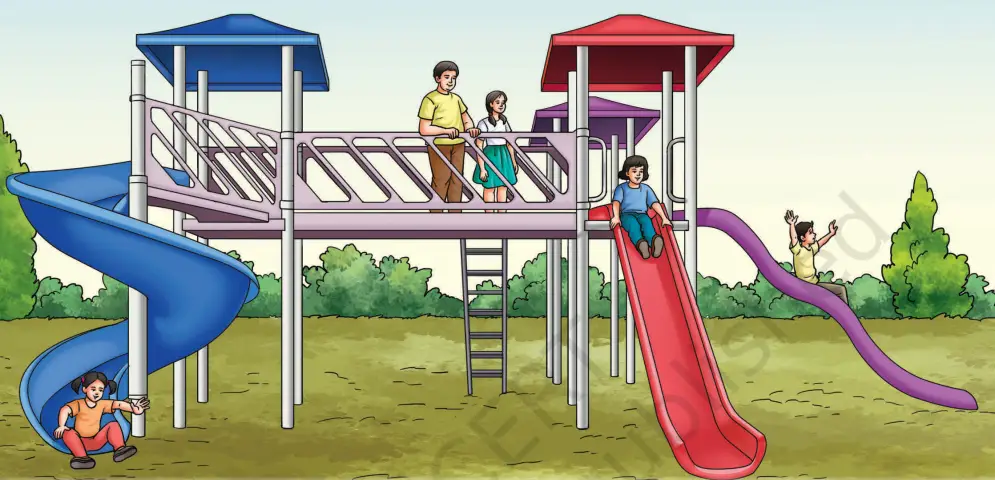
Based on the provided image of a playground, consider the following scenarios: (i) What factors influence the magnitude of a child's velocity upon reaching the bottom of the blue slide? (ii) If two children with different masses slide down the same slide, will they both have the same velocity at the bottom? (iii) Identify which of the slides shown would result in the child having the largest velocity magnitude upon reaching the bottom.
Show answer & explanation
Answer: (i) The height of the slide and g (not mass or shape); (ii) Yes, both reach the bottom with the same velocity magnitude; (iii) All three slides start from the same platform height, so ideally the velocity magnitude is the same for all.
Explanation: By conservation of mechanical energy, the potential energy at the top converts to kinetic energy at the bottom: mgh = (1/2) m v2, so v = (2gh)^(1/2). (i) The speed at the bottom depends only on the vertical height h of the slide and the acceleration due to gravity g; friction would reduce it slightly. (ii) Mass cancels out of the equation, so children of different masses reach the bottom of the same slide with the same speed. (iii) In the figure the blue spiral slide, the red straight slide, and the purple wavy slide all start from the same platform, i.e. the same height, so neglecting friction every slide gives the same speed at the bottom regardless of its length or shape.
Q4Levermedium2 marks
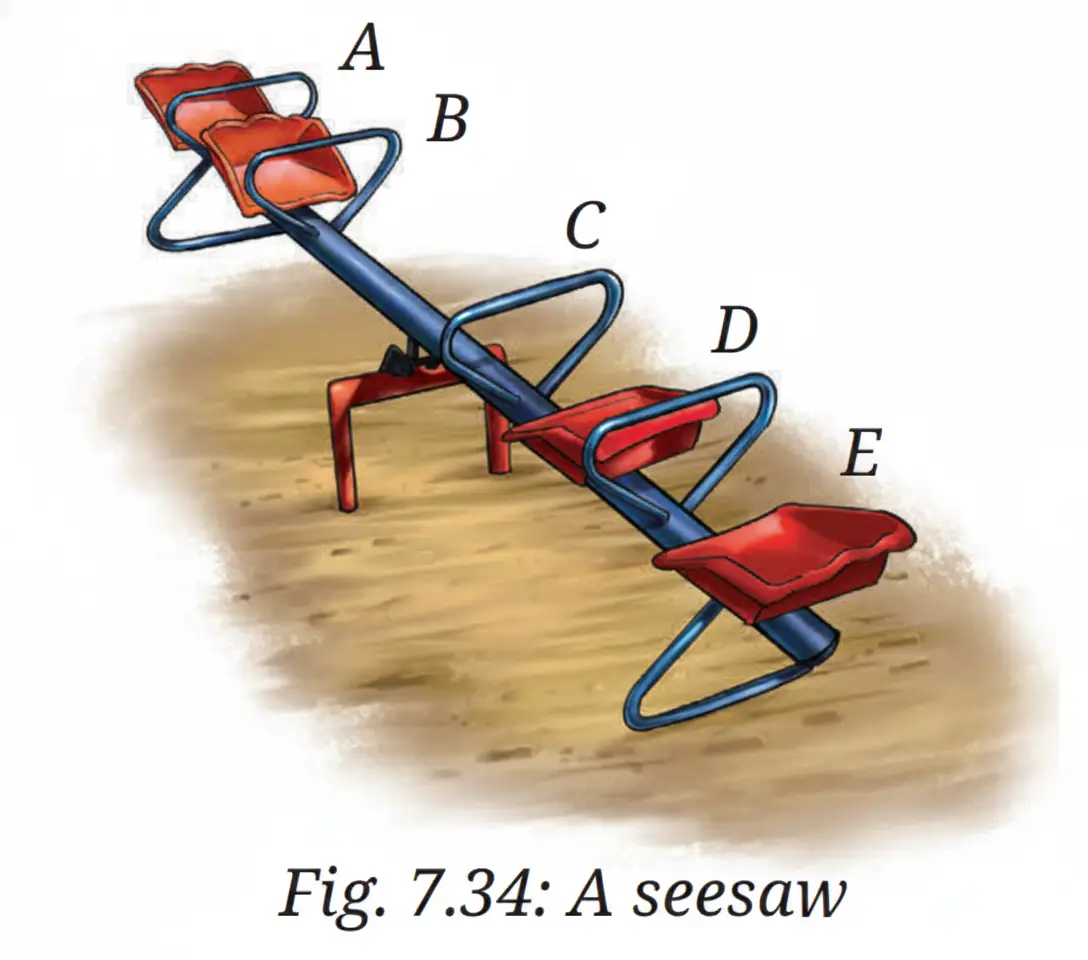
A seesaw, with its fulcrum at point C, has four seats labeled A, B, D, and E as shown in the figure. The distances are given as AC = EC = 2 m and BC = DC = 1 m. Determine the seats on which two children, with masses of 15 kg and 30 kg respectively, should sit to balance the seesaw.
Show answer & explanation
Answer: The 15 kg child on seat A and the 30 kg child on seat D (equivalently, 15 kg on E and 30 kg on B).
Explanation: A seesaw balances when the turning effects on both sides of the fulcrum are equal: weight1 x distance1 = weight2 x distance2. The lighter child must sit farther from the fulcrum C and the heavier child closer. Check: 15 kg x 2 m = 30 kg m and 30 kg x 1 m = 30 kg m, so the two sides balance. Since A and B are on one side of C and D and E on the other, the 15 kg child sits at A (2 m) with the 30 kg child at D (1 m), or the 15 kg child at E with the 30 kg child at B.
Q5Gravitational Potentialeasy2 marks
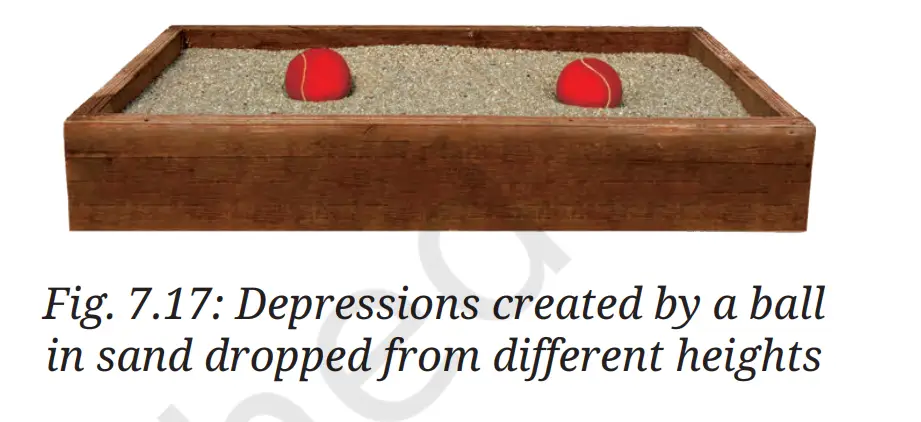
A heavy ball is dropped into a container of loose sand from a height of 1 m. (i) Is a depression formed? Explain why. (ii) The experiment is repeated from a height of 2 m. Compare the depths of the two depressions. Is there a difference? Identify which drop created the deepest depression and which created the shallowest.
Show answer & explanation
Answer: (i) Yes, the falling ball does work on the sand; (ii) Yes, the 2 m drop makes the deepest depression and the 1 m drop the shallowest.
Explanation: (i) At a height of 1 m the ball has gravitational potential energy PE = mgh. As it falls this converts to kinetic energy, and on hitting the sand the ball does work on the sand by pushing the grains aside, forming a depression. (ii) From 2 m the ball has twice the potential energy (PE is proportional to h), so it reaches the sand with more kinetic energy and does more work on it. Hence the 2 m drop creates the deeper depression and the 1 m drop creates the shallower one.
Q6Work-Energy Theoremhard3 marks
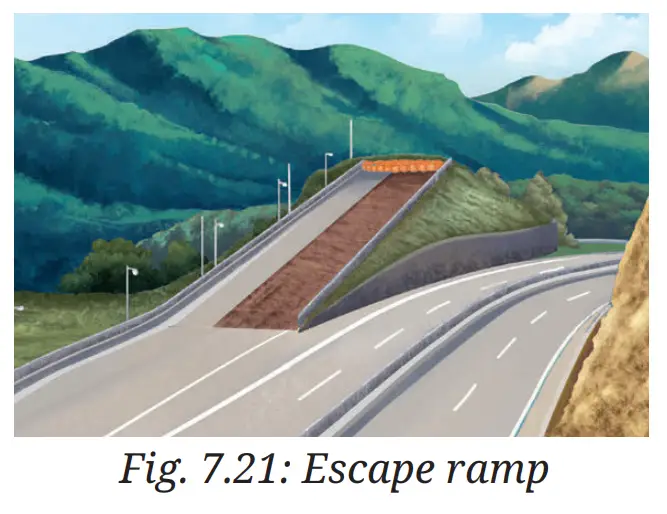
An escape ramp, as depicted in Fig. 7.21, is designed to stop vehicles with brake failure. A truck with a mass of 10,000 kg is moving at 72 km/h when it enters a 30-degree inclined escape ramp. A resistive force of 50,000 N is exerted by the sand on the ramp. What is the minimum length the ramp must have to bring the truck to a complete stop? Use g = 10 m/s². (Hint: For a 30° incline, the vertical rise is 1 meter for every 2 meters traveled along the ramp).
Show answer & explanation
Answer: Minimum ramp length L = 20 m
Explanation: The truck's speed is 72 km/h = 20 m/s, so its kinetic energy is KE = (1/2) m v2 = (1/2) x 10000 x 202 = 2000000 J. This energy must be used up by climbing the ramp and by working against the sand. For a ramp of length L, the vertical rise is L/2, so the gain in potential energy is mgh = 10000 x 10 x (L/2) = 50000L J, and the work done against the sand's resistive force is 50000 x L = 50000L J. Setting total energy absorbed equal to the kinetic energy: 50000L + 50000L = 2000000, so 100000L = 2000000 and L = 20 m.
Q7Levereasy2 marks
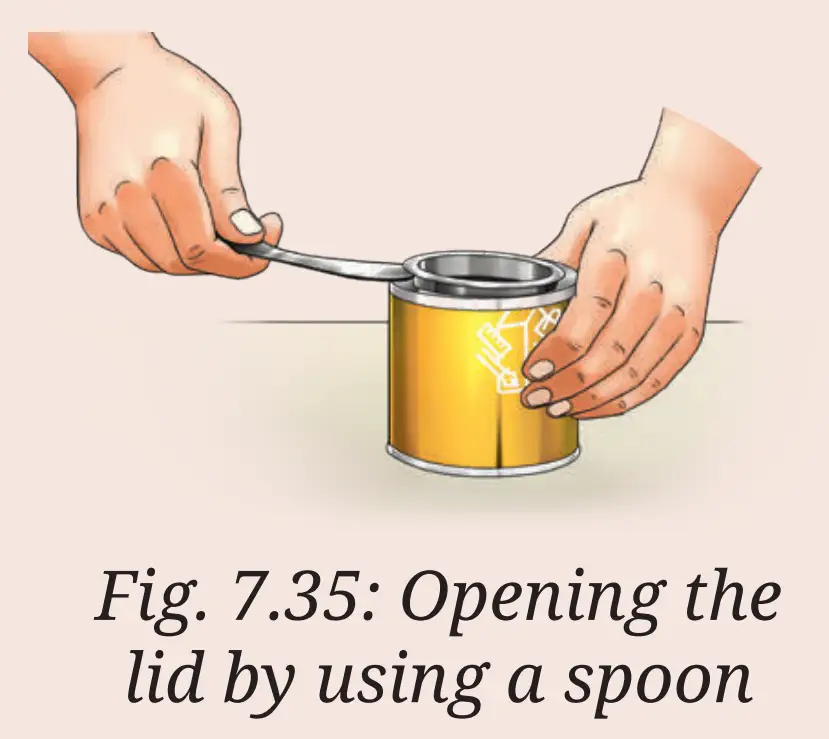
Explain the principle that makes it easier to pry open the lid of a can with a spoon, as illustrated in the provided figure.
Show answer & explanation
Answer: The spoon acts as a lever with the can's rim as the fulcrum; the long effort arm and short load arm give a mechanical advantage greater than 1, so a small effort produces a large force on the lid.
Explanation: The spoon works on the principle of the lever. The rim of the can acts as the fulcrum, the effort is applied at the far end of the spoon's handle, and the load is the tightly fitted lid close to the fulcrum. Since the effort arm (rim to hand) is much longer than the load arm (rim to lid edge), the mechanical advantage = effort arm / load arm is greater than 1. A small downward effort on the handle is therefore multiplied into a large upward force on the lid, prying it open easily.
Q8Inclined Planeeasy2 marks
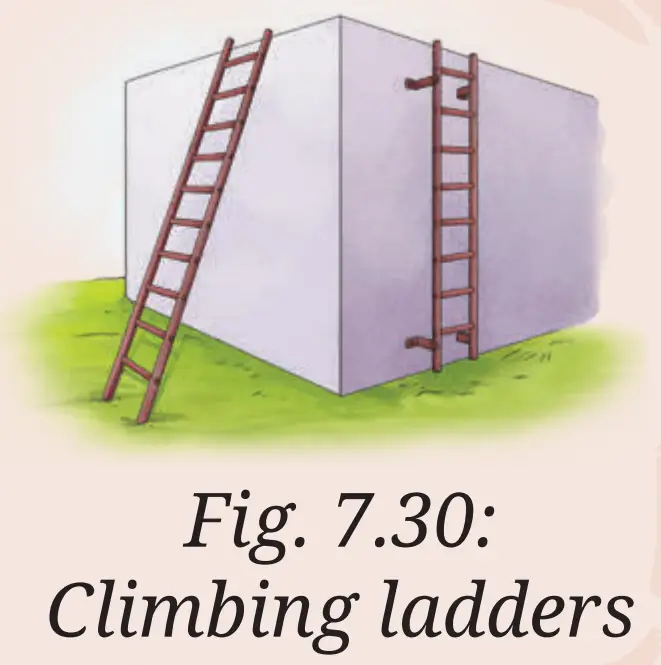
Explain the reason why it is easier to ascend to a higher level using an inclined ladder as opposed to a vertical one.
Show answer & explanation
Answer: An inclined ladder acts as an inclined plane: the same height is gained over a longer distance, so less force is needed at each step (part of the weight is supported by the ladder), though the total work done (mgh) is the same.
Explanation: An inclined ladder works on the principle of the inclined plane. To reach the same height h, the climber travels a longer distance along the incline than along a vertical ladder. Since work done against gravity is fixed at W = mgh, spreading it over a longer distance means the force the climber must exert at each moment is smaller; the ladder's normal reaction supports part of the body's weight. On a vertical ladder the climber's muscles must support and lift the entire body weight directly. Less required force makes the inclined climb easier, even though the total work done is the same.
Q9Kinetic Energyeasy1 mark
A vehicle's velocity is doubled. How does its new kinetic energy compare to its initial kinetic energy?
Show answer & explanation
Answer: The kinetic energy becomes 4 times the initial kinetic energy.
Explanation: Kinetic energy is given by KE = (1/2) m v2, so it is proportional to the square of the velocity. If the velocity is doubled (v -> 2v), the new kinetic energy is (1/2) m (2v)2 = 4 x (1/2) m v2. Hence the kinetic energy becomes four times its initial value.
Q10Gravitational Potentialeasy2 marks
Consider an object near the Earth's surface. (i) Does its potential energy change if it moves horizontally at a constant velocity? (ii) What happens to its potential energy if it is slowly lifted vertically?
Show answer & explanation
Answer: (i) No, the potential energy stays the same; (ii) The potential energy increases.
Explanation: Gravitational potential energy is PE = mgh, which depends only on the object's height above the reference level. (i) In horizontal motion the height h does not change, so the potential energy remains constant; no work is done against gravity. (ii) When the object is lifted vertically, h increases, so its potential energy increases by mgh; the work done against gravity in lifting it is stored as this gain in potential energy.
Q11Work Doneeasy1 mark
Complete the following statement: The formula for work done is Work = ___ × ___, where the second term is displacement measured in the direction of the force.
Show answer & explanation
Answer: Work = Force x Displacement (in the direction of the force), i.e. W = F x s.
Explanation: Work is done when a force acting on an object moves it through some distance. It is defined as W = F x s, where F is the applied force and s is the displacement of the object measured along the direction of the force. Its SI unit is the joule (J), where 1 J = 1 N x 1 m.
Q12Simple Machinesmedium3 marks
Using everyday materials like cardboard, rulers, pencils, thread, or paper cups, construct a working model of one or more simple machines (such as a lever, pulley, or inclined plane). Use your model to lift a small weight (the load). Measure the force you apply (the effort) and the weight of the load, and then calculate the mechanical advantage of your machine.
Show answer & explanation
Answer: Activity: build the machine, measure load and effort, and compute Mechanical Advantage = Load / Effort (e.g., a lever lifting a 2 N load with 0.5 N effort has MA = 4).
Explanation: Sample model: rest a ruler (lever arm) on a pencil placed under it (fulcrum), keep the load (a paper cup with coins) near one end and press down on the other end to lift it. Measure the load's weight and the applied effort using a rubber-band spring balance or known weights. Mechanical advantage is calculated as MA = Load / Effort. For example, if a 2 N load is lifted by applying only 0.5 N of effort, MA = 2 / 0.5 = 4, meaning the machine multiplies the applied force 4 times. Keeping the fulcrum closer to the load increases the MA; actual values will vary with your model.
Q13Inclined Planeeasy1 mark
An inclined ramp is used to lift an object over a step that is 30 cm high. The ramp's length is 50 cm, and its horizontal base is 40 cm. Determine the mechanical advantage provided by this ramp.
Show answer & explanation
Answer: Mechanical advantage = 50/30 = 5/3, approximately 1.67
Explanation: For an inclined plane, the mechanical advantage is the ratio of the length of the slope to the vertical height gained: MA = length of ramp / height of step. Here MA = 50 cm / 30 cm = 5/3, which is approximately 1.67. This means the effort needed to push the object up the ramp is only about 3/5 of the force needed to lift it straight up; the horizontal base (40 cm) is not used in the calculation.
Q14Positive Negativeeasy2 marks
A girl is exercising by lifting a dumbbell and then slowly lowering it. Determine the instances when the work done by the girl on the dumbbell is positive and when it is negative.
Show answer & explanation
Answer: Work done by the girl is positive while lifting the dumbbell and negative while slowly lowering it.
Explanation: Work is positive when the force and the displacement are in the same direction, and negative when they are opposite. While lifting, the girl applies an upward force on the dumbbell and the dumbbell moves upward, so her force and the displacement are in the same direction and the work she does is positive. While slowly lowering it, she still pushes upward to support the dumbbell, but the dumbbell moves downward; her force is opposite to the displacement, so the work done by her on the dumbbell is negative.
Stuck anywhere in Chapter 7 (Work, Energy, and Simple Machines)? Vidya ma'am — EduLevel's AI teacher — teaches this chapter live, by voice, and solves your doubts till they click.