Exploration Class 9 Science Chapter 11: Reproduction: How Life Continues — NCERT Solutions
Chapter 11 of the new NCERT Class 9 Science textbook Exploration (2026-27) — Reproduction: How Life Continues. Below are 15 questions from this chapter with answers and step-by-step explanations, including 8 diagram-based questions with their figures. Try each one before revealing the answer — and if a concept doesn't click, Vidya ma'am teaches this exact chapter live in the EduLevel app.
What Chapter 11 covers
Asexual Reproduction
Vegetative Propagation
Budding in Hydra
Sexual Reproduction
Meiosis Variations
Human Reproduction
Exploration Chapter 11 — solved questions
Attempt each question first, then open the answer to compare your method.
Q1Human Reproductioneasy3 marks
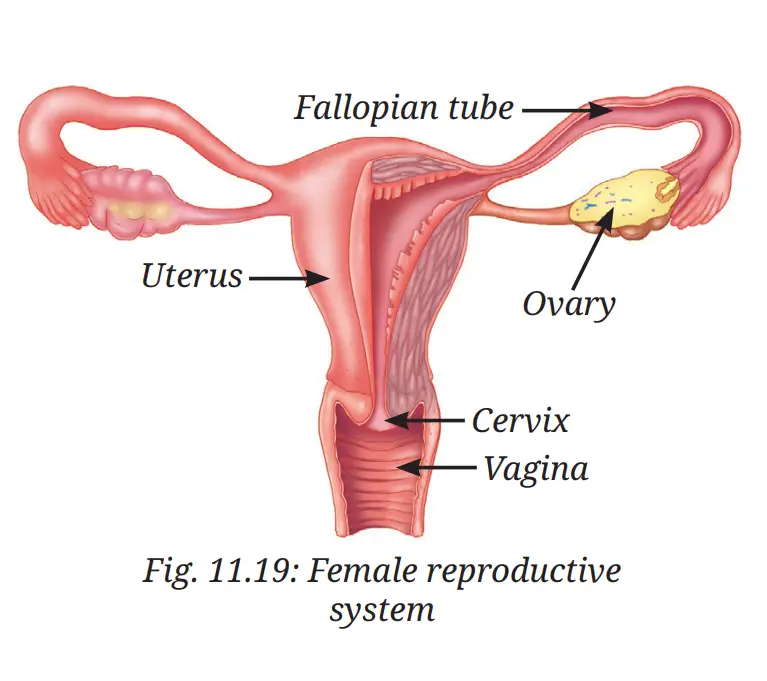
Identify and describe the main organs that make up the human female reproductive system, using the provided diagram for reference (Fig. 11.19).
Show answer & explanation
Answer: Ovaries (produce the ova and female hormones), fallopian tubes or oviducts (carry the ovum and are the site of fertilisation), the uterus (where the embryo implants and develops), the cervix (narrow lower neck of the uterus) and the vagina (receives sperms and acts as the birth canal).
Explanation: The female reproductive system is built to produce eggs, allow fertilisation and nourish the embryo till birth, so each organ labelled in Fig. 11.19 matches one of these jobs. The two ovaries are the primary sex organs; they produce the ova (egg cells) by meiosis and also secrete the female sex hormones. An ovum released by an ovary is picked up by the fallopian tube (oviduct), and it is inside this tube that a sperm fuses with the egg, so fertilisation in humans is internal. The fertilised egg, or zygote, then moves down into the uterus, a muscular pear-shaped organ whose thick lining allows the embryo to implant and grow into a baby. The cervix is the narrow lower neck of the uterus that opens into the vagina, and the vagina receives the sperms during mating and later forms the birth canal through which the baby is delivered.
Q2Sexual Reproductionhard3 marks
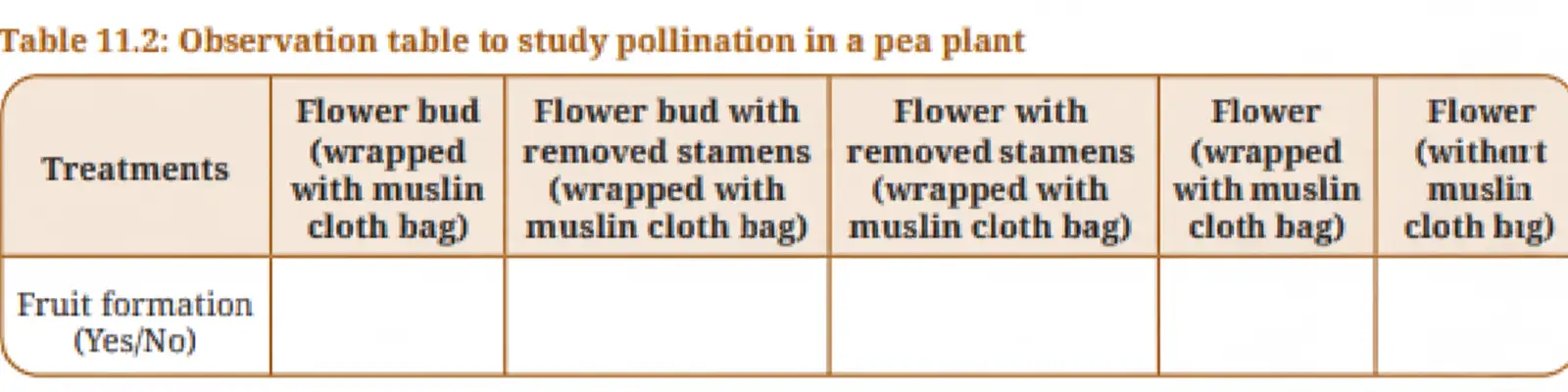
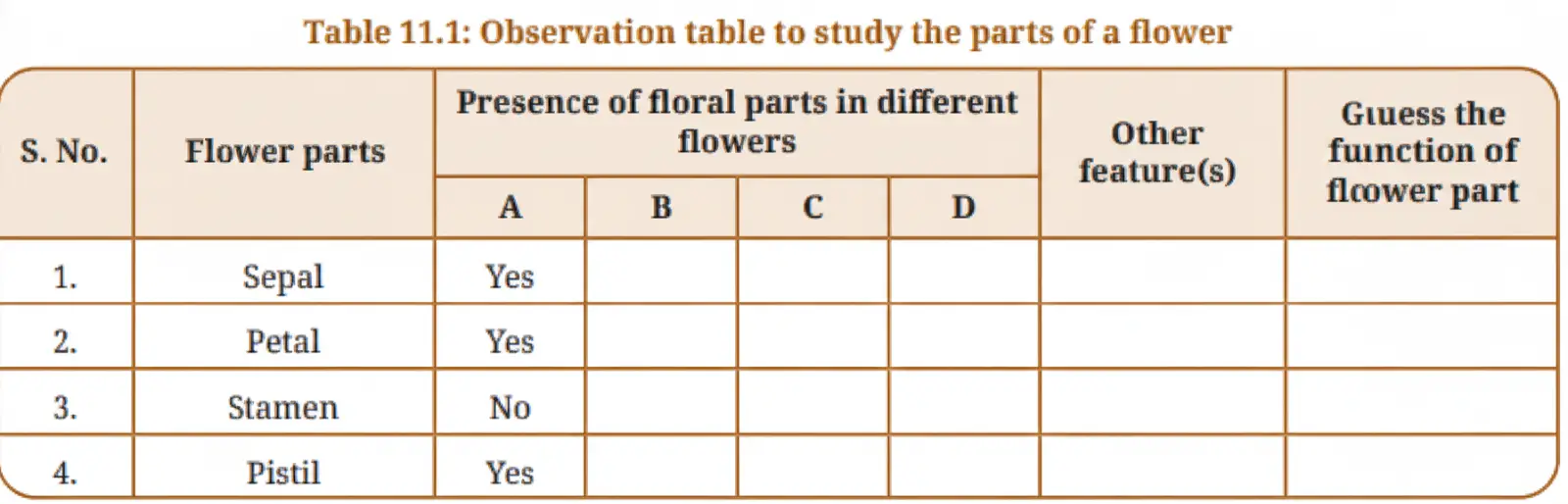
An experiment is conducted on pea plants to investigate the conditions for fruit formation, with different treatments applied to flowers as shown in the accompanying table. Predict which of the treatments will result in the flowers developing into fruits. From these expected outcomes, what can you infer about the process necessary for fruit formation in plants?
Show answer & explanation
Answer: In table order the results are Yes, No, Yes, Yes, Yes: only the flower bud whose stamens were removed and then bagged fails to form a fruit. This shows that pollination, the transfer of pollen to the stigma, is essential for fruit formation, and that a pea flower self-pollinates while it is still a closed bud.
Explanation: A pea flower is bisexual and its petals form a closed keel that encloses the stamens and the pistil, so pollen falls on the stigma of the same flower while the flower is still a bud; this is self-pollination. A muslin bag only keeps out insects and foreign pollen and cannot stop this self-pollination, so a bud or a flower bagged with its stamens intact still forms a fruit. Removing the stamens from a bud takes away the only source of pollen before pollination can happen, so the stigma receives no pollen, there is no fertilisation, and no fruit is formed. Removing the stamens from an already opened flower is too late, because pollination has already taken place inside the bud, so that flower still develops into a fruit. The experiment therefore shows that pollination followed by fertilisation is necessary before the ovary can grow into a fruit.
Q3Vegetative Propagationmedium3 marks
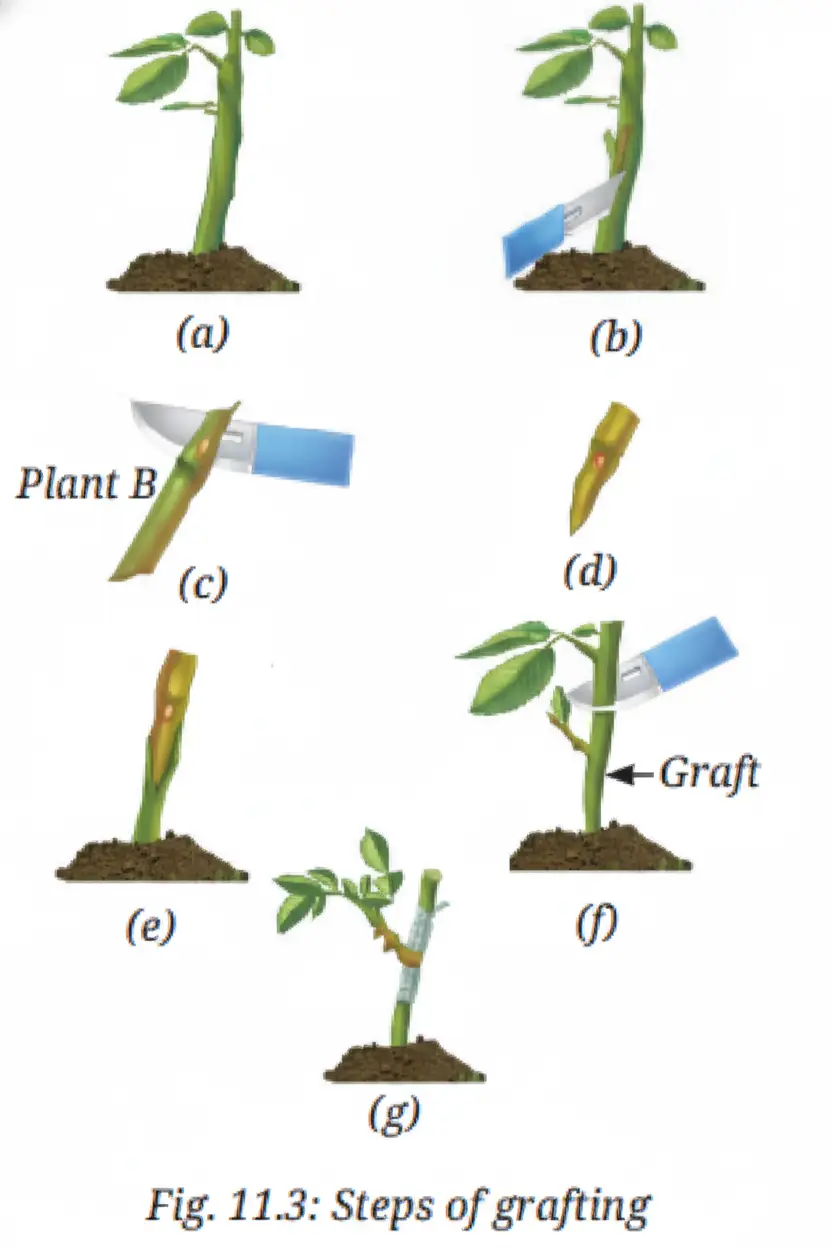
Outline the step-by-step procedure for grafting, a technique used to join parts from two different plants. Your explanation should include selecting a stock and a scion, making appropriate cuts, inserting the scion into the stock, securing the joint, and caring for the plant to promote successful fusion and growth.
Show answer & explanation
Answer: Select a healthy rooted plant as the stock and a bud-bearing twig of the desired plant as the scion; cut the stock stem and make a slit in it, give the scion a matching slanting or wedge-shaped cut, insert the scion into the stock so that their cut (cambium) surfaces touch closely, tie the joint firmly with tape, and keep the plant watered and shaded until the tissues fuse and the scion sprouts.
Explanation: Grafting is a method of artificial vegetative propagation in which the stem of one plant is joined to the rooted stem of another so that the two grow as a single plant. The lower rooted part is the stock and it supplies water and minerals absorbed from the soil, while the upper cut twig, the scion, carries the buds and decides the characters of the shoot, flowers and fruit. The cuts on the stock and the scion must match and be pressed together so that their cambium layers, the actively dividing tissue, are in contact; only then can new cells form and fuse the two parts into one continuous plant. Tying the joint holds the parts firm and prevents drying and infection, and watering with shade until the graft takes ensures the scion survives on the water supplied by the stock. Since the scion is a part of the parent plant and no gametes are involved, the new shoot is genetically identical to the parent, which is how a desired variety of fruit is reproduced exactly.
Q4Vegetative Propagationeasy3 marks
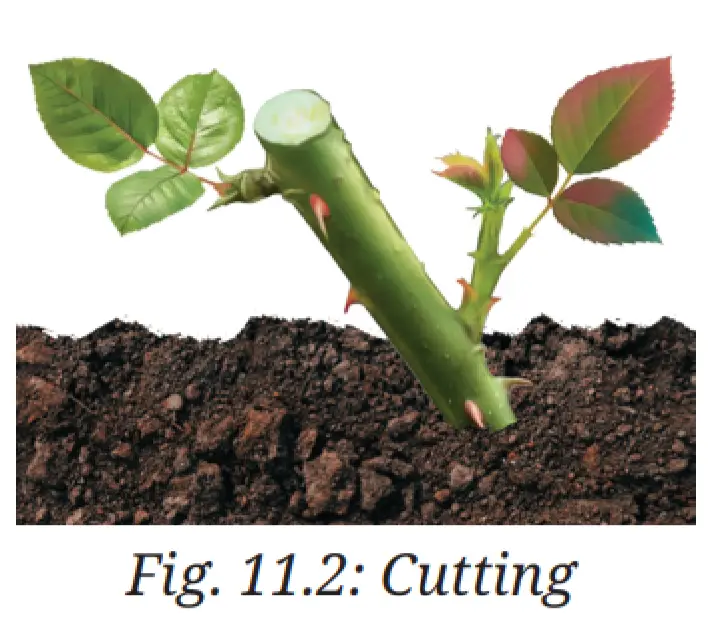
Perform an activity to investigate vegetative propagation using the cutting method. The process involves interacting with a gardener, observing how cuttings are prepared (noting their length and the number of nodes), collecting the cuttings, planting them at a 45-degree angle in soil with compost, and then watering them regularly while observing for any signs of growth. Record all your observations.
Show answer & explanation
Answer: Expected observation: a cutting about 15 to 20 cm long bearing 3 to 4 nodes, planted slantingly at 45 degrees with one or two nodes buried in moist compost-rich soil, develops adventitious roots from the buried nodes in about 2 to 3 weeks and new shoots with leaves from the buds above the soil, growing into a new plant identical to the parent.
Explanation: A cutting is a piece of stem bearing nodes, and the node is the important part because it carries a bud and meristematic (actively dividing) tissue from which new roots and shoots can arise. The buried nodes, kept moist and in contact with the soil, give out adventitious roots, while the buds at the nodes above the soil grow into new shoots with leaves, so the same cutting builds both the organ systems it needs. The cutting is planted slantingly at about 45 degrees so that a greater length of stem stays in contact with moist soil, which increases the surface available for root formation and helps the cutting stand firm. Compost supplies nutrients and regular watering prevents the cutting from drying out before its roots form, since at first it has no root system of its own. As no gametes and no fertilisation are involved, this is vegetative (asexual) propagation and the new plant is a clone, genetically identical to the parent, so it keeps the parent's flower colour and other desirable characters.
Q5Human Reproductioneasy3 marks
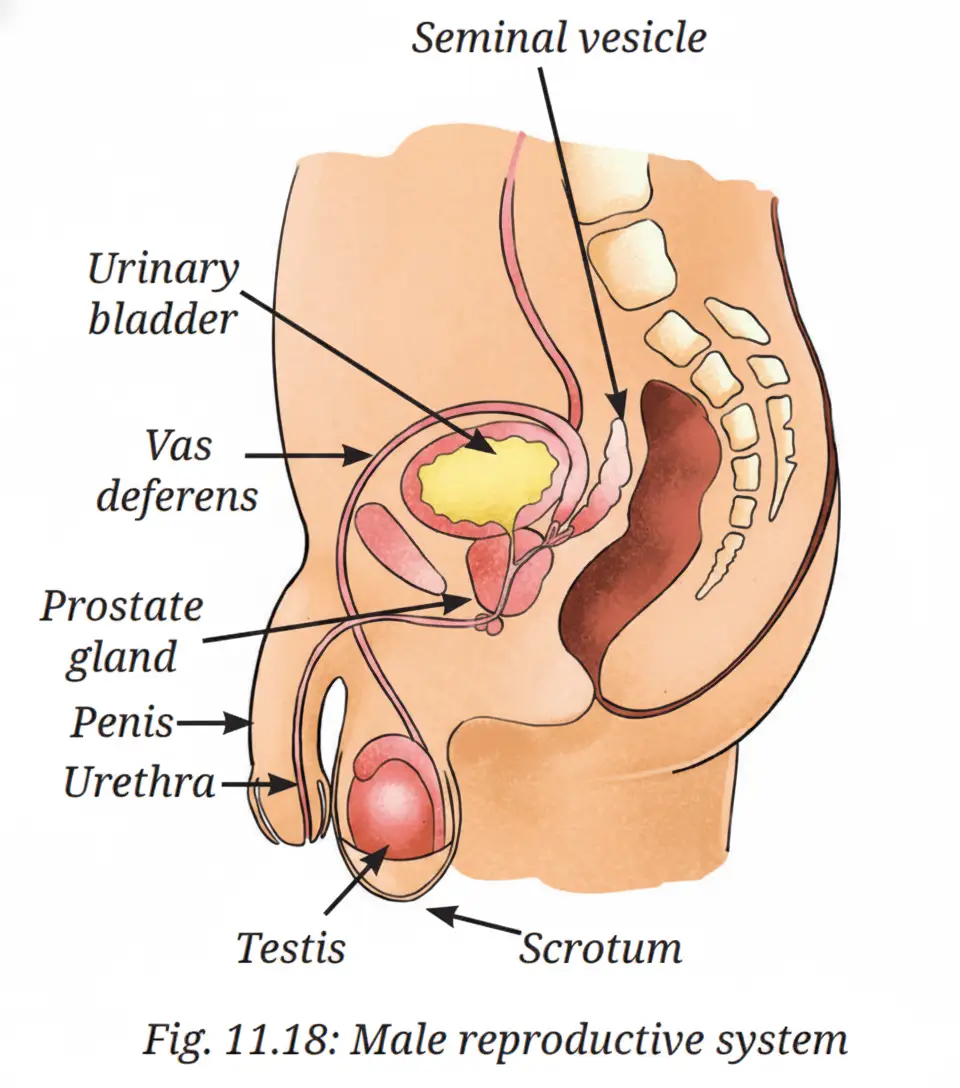
Identify and describe the primary components and accessory glands that constitute the human male reproductive system, as illustrated in the accompanying diagram (Fig. 11.18).
Show answer & explanation
Answer: Primary parts are the testes (lying in the scrotum) which produce sperms and testosterone, the vas deferens which carries the sperms, the urethra which is the common passage for sperms and urine, and the penis which delivers the sperms; the accessory glands are the seminal vesicles and the prostate gland, whose secretions nourish the sperms and make them motile, forming semen along with the sperms.
Explanation: The male reproductive system has to produce sperms, nourish them and deliver them into the female body, and each part labelled in Fig. 11.18 performs one of these jobs. The testes are the primary sex organs; they produce sperms by meiosis and secrete the male hormone testosterone, and they lie in the scrotum, a sac outside the abdomen that keeps them a few degrees cooler than body temperature, a condition sperm formation requires. Sperms made in a testis travel through the vas deferens, which opens into the urethra, a common tube that carries both sperms and urine and runs through the penis, the organ that transfers sperms into the female body. The seminal vesicles and the prostate gland are the accessory glands: they add their secretions to the sperms, providing nutrition and a fluid medium in which the sperms can swim. This mixture of sperms and glandular secretions is called semen.
Q6Sexual Reproductionmedium3 marks
Perform an activity to study the parts of a flower. Collect various types of flowers from your local environment. Carefully observe and identify each part, from the outermost whorl to the innermost. Record the presence of these parts for different flowers using a table. Based on your observations, analyze the function of each part. Additionally, prepare transverse and longitudinal sections of the ovary to observe its internal structure under a microscope and create a labeled diagram of your observation.
Show answer & explanation
Answer: From the outermost whorl inwards the parts are the calyx of sepals (protect the bud), the corolla of petals (attract pollinators), the androecium of stamens, each an anther on a filament (the anther makes pollen grains), and the innermost gynoecium or pistil made of stigma, style and ovary (the stigma receives pollen and the ovary holds the ovules); transverse and longitudinal sections of the ovary show ovules attached to the placenta inside the ovary chambers. Flower A, having no stamen, is a unisexual (female or pistillate) flower, while flowers with both stamen and pistil are bisexual.
Explanation: A flower is the reproductive part of a plant and is made of four whorls borne on the thalamus, which is why the observation is made from the outermost whorl inwards. The outermost calyx is made of green sepals that enclose and protect the flower while it is still a bud, and next comes the corolla of brightly coloured, often scented petals that attracts insects and birds for pollination. The third whorl, the androecium, is the male part made of stamens, each having an anther that produces pollen grains carrying the male gametes on a stalk called the filament; the innermost gynoecium or pistil is the female part with a sticky stigma that receives the pollen, a style, and a swollen ovary containing the ovules. A transverse section of the ovary shows the ovules attached to the placenta inside chambers called locules and a longitudinal section shows the same ovules in side view, which matters because after fertilisation each ovule becomes a seed and the whole ovary becomes the fruit. In Table 11.1 flower A has sepal, petal and pistil but no stamen, so it is a unisexual female flower such as a papaya or pumpkin female flower, whereas flowers having both stamens and pistil, like hibiscus or mustard, are bisexual.
Q7Meiosis Variationsmedium3 marks
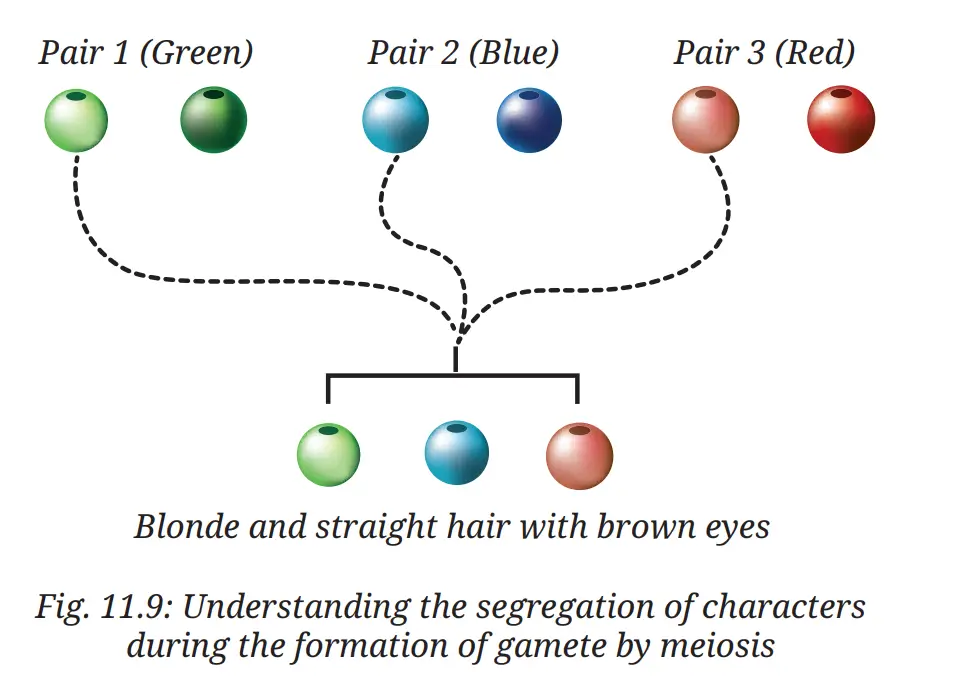
In an activity modeling genetic inheritance with three pairs of characters, how many distinct combinations can be formed? Extrapolating from this, consider the vast number of potential combinations possible with 23 pairs of human chromosomes, each carrying genetic data for numerous traits.
Show answer & explanation
Answer: Three pairs give 23 = 8 distinct combinations; extrapolating the same rule, the 23 pairs of human chromosomes give 223 = 8,388,608 (about 8.4 million) genetically different gametes, and the chance fusion of two such gametes allows about 223 x 223, roughly 7 x 10¹³, different zygotes.
Explanation: During meiosis the two chromosomes of a pair separate and only one of them enters each gamete, and every pair segregates independently of the other pairs. So each pair offers 2 possible choices, and with 3 pairs the total number of combinations is 2 x 2 x 2 = 23 = 8, which is why one bead of each colour is picked to build each gamete in Fig. 11.9. Applying the same rule to the 23 pairs of chromosomes in a human gives 223 = 8,388,608 genetically different gametes from a single person. Since a zygote is formed by the chance fusion of one such sperm with one such egg, the possible combinations rise to about 223 x 223, roughly 7 x 10¹³, and crossing over between the chromosomes of a pair makes the number effectively unlimited. This independent assortment during meiosis is the main source of variation and explains why children of the same parents differ from one another and from their parents.
Q8Vegetative Propagationmedium3 marks
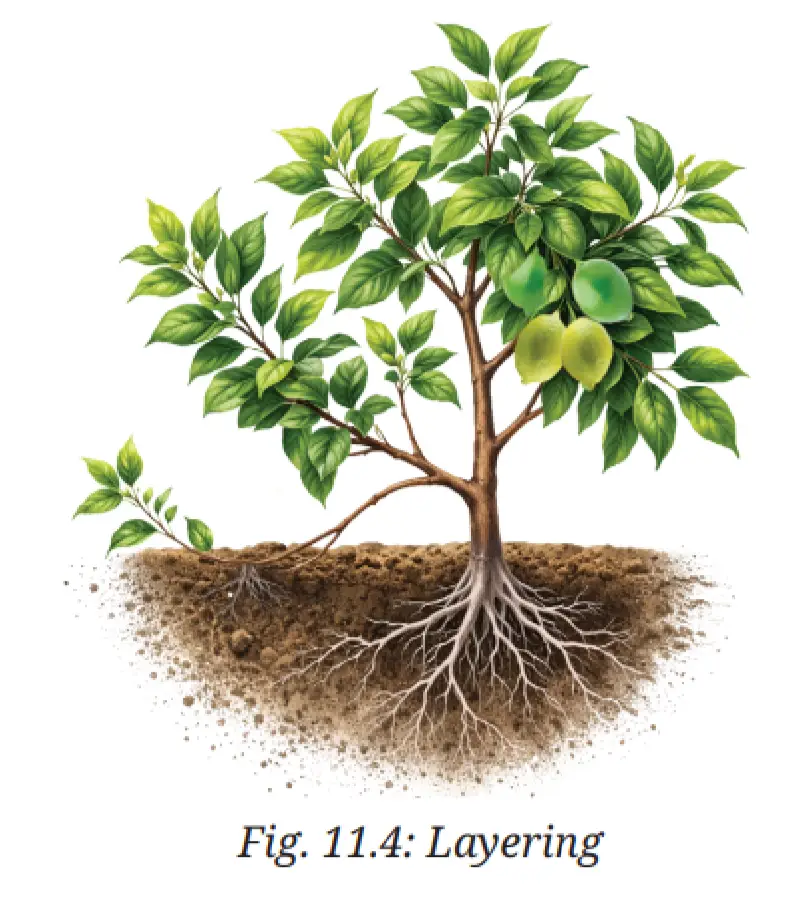
Describe the method of layering as a form of asexual plant propagation. Detail the process, which includes selecting a flexible twig, bending it to the ground and burying a section, promoting root development in the buried part, and eventually severing the new plant from its parent.
Show answer & explanation
Answer: Bend a healthy, low, flexible twig of the parent plant down to the ground, bury its middle portion in moist soil while keeping the leafy tip above the ground, allow adventitious roots to grow from the buried node while the twig still draws water and food from the parent, and then cut the rooted portion away from the parent so that it grows as a new plant identical to it, as done in jasmine, lemon and guava.
Explanation: Layering is a method of artificial vegetative propagation in which a branch is made to produce roots while it is still attached to the parent plant. The buried node is the key part, because a node carries buds and meristematic tissue from which adventitious roots arise when it is kept in moist, dark soil. The advantage over a cutting is that the twig is not separated at first, so it keeps receiving water, minerals and food from the parent through its own vascular tissue and does not dry out or starve while its roots are forming, which makes layering more reliable. Only after the buried part has grown a good root system is the twig cut away from the parent, and it then survives on its own as a new plant, as shown for the lemon plant in Fig. 11.4. Since only a body part of a single parent is involved and no gametes or fertilisation take place, the new plant is a clone, genetically identical to the parent, and it retains all the parent's desirable characters.
Q9Asexual Reproductionmedium3 marks
Under what conditions would a farmer opt for asexual methods of reproduction for their crops, and when would they prefer sexual methods?
Show answer & explanation
Answer: A farmer chooses asexual (vegetative) methods when the plants must be exactly like the parent, that is to preserve a desirable variety, to get a quicker, earlier and uniform crop, or to multiply plants that give no viable seeds such as banana, sugarcane, seedless grapes and rose; sexual methods are preferred when variation is wanted, that is to raise new or improved varieties, to obtain hybrids resistant to disease, pests or drought, and because seeds are easy to store, transport and sow.
Explanation: In asexual reproduction only one parent is involved and no gametes fuse, so the offspring are clones, genetically identical to the parent. This is exactly what a farmer wants when a variety already has good qualities such as sweet fruit, high yield or a particular flower colour, because those characters are passed on unchanged; it is also faster than growing from seed, gives a uniform crop that ripens together, and is the only choice for plants such as banana, sugarcane and seedless grapes that do not form viable seeds. Sexual reproduction, on the other hand, involves meiosis and the fusion of gametes from two parents, so the seeds give rise to plants showing variation. A farmer prefers it when variation is useful, that is to develop new and improved varieties and to breed hybrids that resist disease, pests or drought, and also because seeds are small and easy to store, transport and sow over large areas. Variation also protects the crop, since a genetically varied field is far less likely to be wiped out completely by a single disease or by a change in the weather.
Q10Meiosis Variationsmedium2 marks
What is the total number of character combinations that can be carried by gametes?
Show answer & explanation
Answer: For n pairs of chromosomes a gamete can carry 2n combinations, so the three pairs of the bead activity give 23 = 8 combinations and the 23 pairs of human chromosomes give 223 = 8,388,608 (about 8.4 million) combinations.
Explanation: A gamete is haploid, which means it receives only one chromosome from each pair, and during meiosis each pair separates independently of every other pair. Because each pair offers 2 choices and the choices are independent, the total number of combinations is obtained by multiplying 2 by itself once for every pair, that is 2n for n pairs of chromosomes. With the three pairs of beads used in the activity this gives 23 = 8 different gametes, and with the 23 pairs of chromosomes in a human it gives 223 = 8,388,608 genetically different gametes. Crossing over, in which the chromosomes of a pair exchange segments, shuffles the characters still further, so the number of possible gametes in practice is even larger than this. This is why every gamete is unique and why sexual reproduction produces so much variation.
Q11Sexual Reproductioneasy2 marks
What would be the consequence for a flowering plant if the process of pollination does not take place?
Show answer & explanation
Answer: No pollen would reach the stigma, so fertilisation could not take place and no zygote, no seeds and no fruit would be formed; the flower would simply wither and fall off, and the plant could not reproduce sexually, continuing only by vegetative propagation if it is capable of it.
Explanation: Pollination is the transfer of pollen grains from the anther to the stigma and it is the necessary first step of sexual reproduction in a flowering plant. Only after pollen lands on the stigma does it germinate and grow a pollen tube down the style to the ovule, carrying the male gamete to the female gamete for fertilisation. If pollination never happens, no pollen tube grows, the male and female gametes never fuse and no zygote is formed. As a result the ovules cannot develop into seeds and the ovary cannot ripen into a fruit, so the unfertilised flower dries up and falls off. The plant would then have no seeds to give rise to the next generation, and unless it can multiply by vegetative propagation its kind would not continue.
Q12Human Reproductioneasy2 marks
Given that human females possess XX sex chromosomes and males have XY, with the mother consistently contributing an X chromosome and the father contributing either an X or a Y, deduce which parent determines the sex of a child.
Show answer & explanation
Answer: The father determines the sex of the child, because the mother's egg always carries an X chromosome while the father's sperm may carry either an X, giving XX (a girl), or a Y, giving XY (a boy).
Explanation: Humans have 23 pairs of chromosomes, of which one pair is the sex chromosomes: XX in a female and XY in a male. During meiosis a gamete receives only one chromosome of each pair, so a mother (XX) can make only one kind of egg as far as sex is concerned, one that carries an X. A father (XY), however, makes two kinds of sperms in equal numbers, half carrying an X and half carrying a Y. If an X-bearing sperm fertilises the egg the zygote is XX and the child is a girl, and if a Y-bearing sperm fertilises it the zygote is XY and the child is a boy. Since the mother's contribution is always X and only the father's contribution varies, it is the father who determines the sex of the child. As X-bearing and Y-bearing sperms are produced in equal numbers the chance of a boy or a girl is about 50 percent each, so it is scientifically wrong and unjust to blame the mother for the sex of a child.
Q13Vegetative Propagationmedium3 marks
Explain why a population of plants created through vegetative propagation is generally more susceptible to widespread disease compared to a population grown from seeds produced by sexual reproduction.
Show answer & explanation
Answer: Plants raised by vegetative propagation are clones and are all genetically identical, so if a pathogen can attack one plant it can attack every plant and the entire crop is destroyed; plants grown from seeds of sexual reproduction are genetically varied, so some of them carry resistance, survive the disease and keep the population going.
Explanation: Vegetative propagation involves a single parent with no gametes and no fertilisation, so every new plant is produced from body cells by mitosis and is a clone, genetically identical to the parent and to all the other plants raised from it. Genes decide resistance to disease, so if the parent's genes make it susceptible to a particular fungus or virus, then every plant in that field carries exactly the same weakness. A pathogen that can overcome one plant can therefore overcome all of them, and the disease sweeps through the whole crop. In sexual reproduction, meiosis and the fusion of gametes from two parents reshuffle the genes, so plants grown from seed show variation and are not all alike. Some of these varied plants happen to carry genes for resistance; they survive the attack and continue the population, which is why variation acts as a natural insurance for a species.
Q14Asexual Reproductionmedium3 marks
Provide a reason why complex multicellular organisms, such as advanced animals and flowering plants, primarily utilize sexual reproduction, whereas simpler organisms like yeast and hydra commonly reproduce asexually.
Show answer & explanation
Answer: Simple organisms like yeast and hydra have a simple, poorly differentiated body in which almost any part can regenerate a whole organism, so quick asexual budding is enough; complex animals and flowering plants have highly specialised tissues and organ systems whose body cells cannot build a whole new individual, so they need special reproductive organs producing gametes, and sexual reproduction also gives them the variation needed to adapt, survive and evolve.
Explanation: Yeast and hydra have a very simple body design with little division of labour, so their cells are not highly specialised and almost any part of the body can grow back into a complete organism, which makes budding or fission a quick and successful way to reproduce. In complex animals and flowering plants the body is organised into specialised tissues, organs and organ systems, and a specialised body cell such as a nerve cell or a leaf cell cannot by itself build a whole new individual. Such organisms therefore maintain a separate set of reproductive organs that produce gametes by meiosis, and two gametes fuse to form a zygote that develops into the new individual. Sexual reproduction brings a second and deeper advantage: the shuffling of genes during meiosis and the fusion of gametes from two parents create variation among the offspring. Complex organisms are long-lived, produce fewer offspring and must survive changing surroundings, so this variation is essential, since it lets some individuals adapt and survive and it supplies the raw material for evolution.
Q15Sexual Reproductioneasy1 mark
Before a flower could mature, its anthers were removed. Subsequently, pollen from a different plant of the same species was applied to its stigma, leading to seed formation. Which of the following reproductive processes was intentionally facilitated?
Self-pollination
Cross-pollination
Fertilisation
Tissue culture
Show answer & explanation
Answer: Cross-pollination
Explanation: Removing the anthers (emasculation) prevents self-pollination. Introducing pollen from another plant of the same species is the definition of cross-pollination.
Stuck anywhere in Chapter 11 (Reproduction: How Life Continues)? Vidya ma'am — EduLevel's AI teacher — teaches this chapter live, by voice, and solves your doubts till they click.