Exploration Class 9 Science Chapter 9: Atomic Foundations of Matter — NCERT Solutions
Chapter 9 of the new NCERT Class 9 Science textbook Exploration (2026-27) — Atomic Foundations of Matter. Below are 16 questions from this chapter with answers and step-by-step explanations, including 7 diagram-based questions with their figures. Try each one before revealing the answer — and if a concept doesn't click, Vidya ma'am teaches this exact chapter live in the EduLevel app.
What Chapter 9 covers
Activity 9.1
Activity 9.2
Law of Conservation of Mass
Activity 9.3
Law of Constant Proportions
Dalton's Atomic Theory
How Atoms Combine?
Covalent Bond
Ionic bond
Writing Chemical Formulae
Properties Ionic
Molecular Mass
Formula Unit Mass
Exploration Chapter 9 — solved questions
Attempt each question first, then open the answer to compare your method.
Q1Activity 9.3medium3 marks
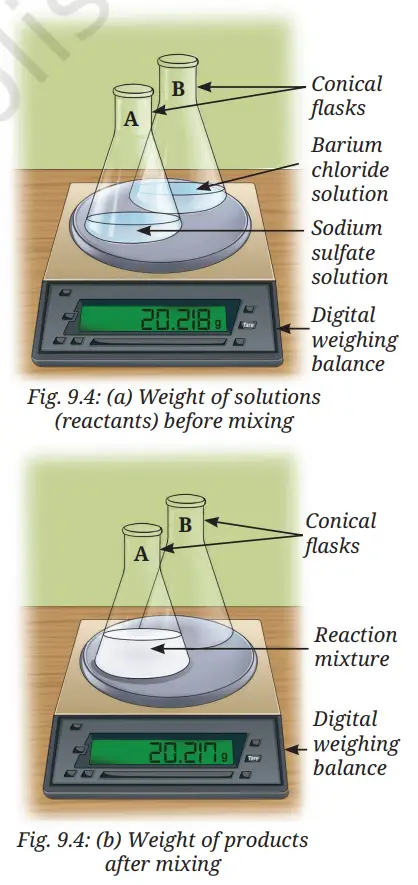
An experiment is conducted by mixing a 1% m/v sodium sulfate solution with a 1% m/v barium chloride solution within a closed system on a weighing balance, as shown in Fig. 9.4. What observations can be made about the total mass before and after the reaction? Does the reading on the balance change after the solutions are mixed? Explain the principle demonstrated by this experiment.
Show answer & explanation
Answer: The total mass remains practically unchanged (20.218 g before, 20.217 g after); the balance reading does not change on mixing, even though a white precipitate forms. This demonstrates the law of conservation of mass.
Explanation: On mixing, a double displacement reaction occurs: Na2SO4 + BaCl2 -> BaSO4 + 2NaCl, and a white insoluble precipitate of barium sulfate is seen. The system is closed, so no matter can enter or leave the flasks during the reaction; atoms are only rearranged into new substances. Fig. 9.4 shows the balance reading 20.218 g before mixing and 20.217 g after, and the 0.001 g difference is negligible experimental error. Hence total mass of products equals total mass of reactants, verifying the law of conservation of mass: mass is neither created nor destroyed in a chemical reaction.
Q2Law of Conservation of Masseasy1 mark
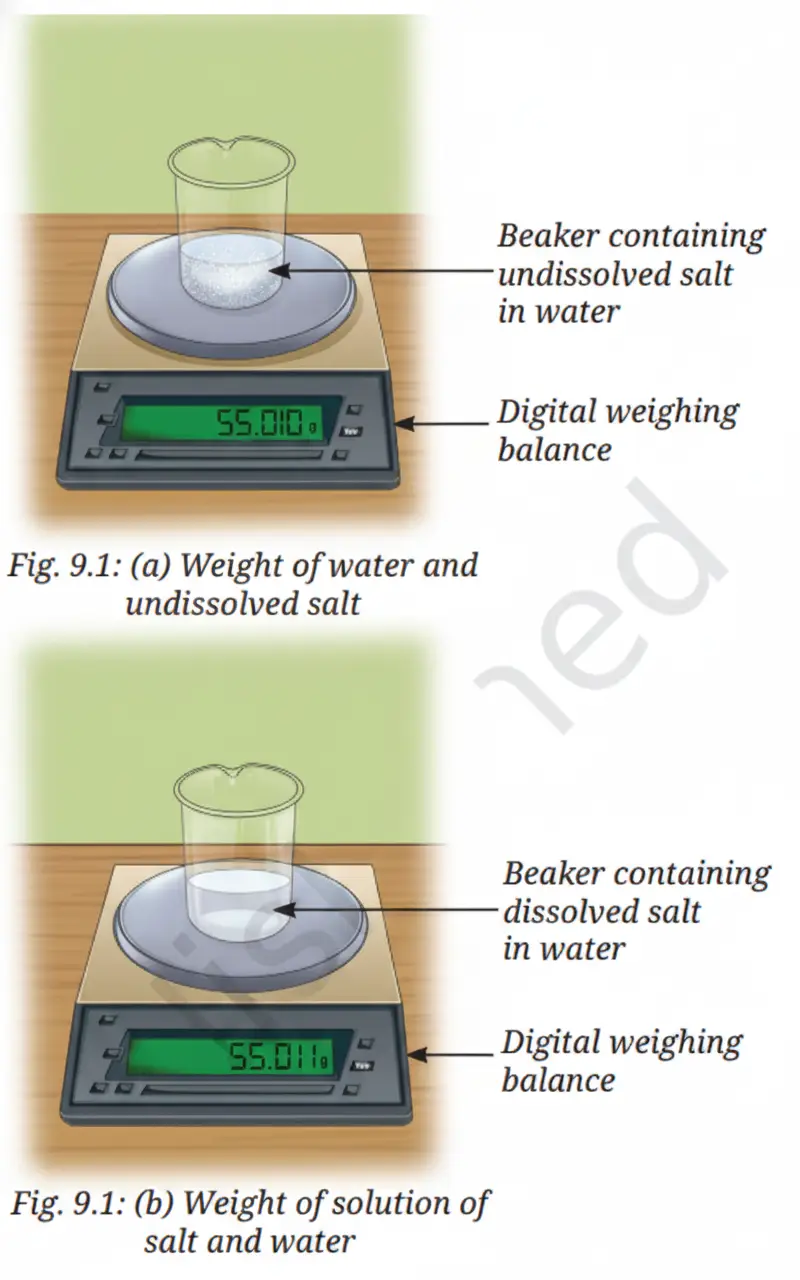
After dissolving a spatula full of common salt into 50 mL of water in a beaker on a digital balance, what observation can be made about the total mass recorded by the balance?
Show answer & explanation
Answer: The balance reading remains practically the same (55.010 g before dissolving and 55.011 g after) — the total mass does not change when the salt dissolves.
Explanation: Dissolving salt in water is a physical change in which the salt particles separate and spread uniformly between the water particles; no matter is lost from the beaker. In Fig. 9.1 the balance shows 55.010 g with undissolved salt and 55.011 g after complete dissolution, a negligible difference within experimental error. Thus even though the salt is no longer visible, the total mass is conserved.
Q3Law of Conservation of Massmedium2 marks
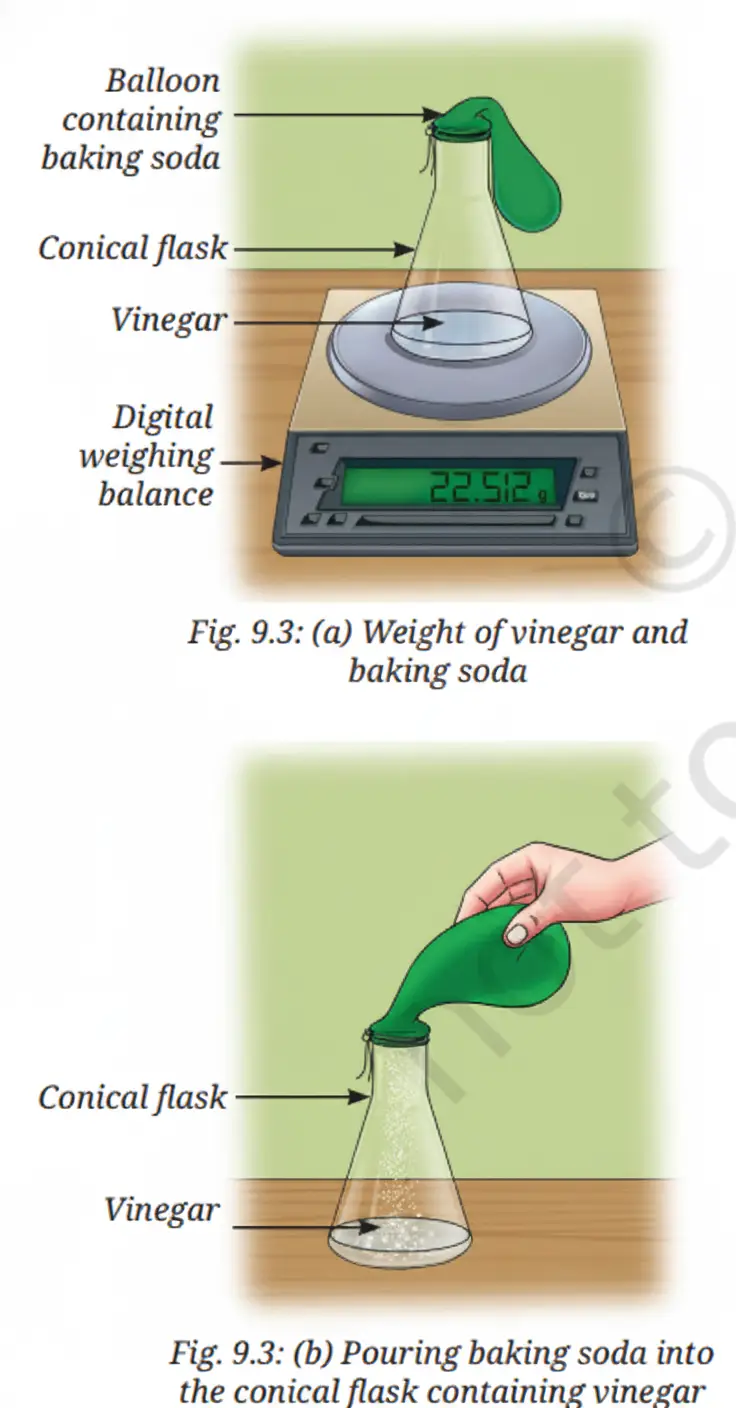
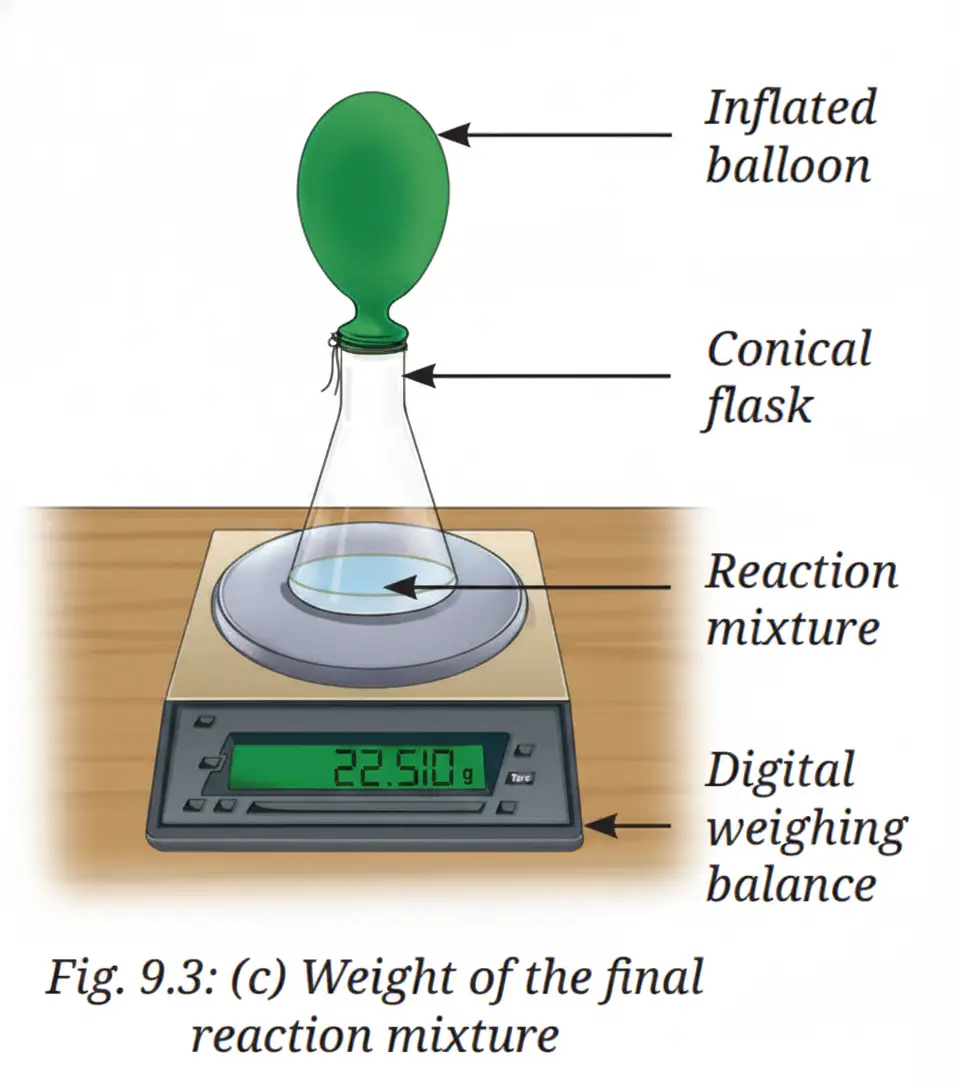
In a modified experiment, after mixing 2g of baking soda from a balloon into vinegar in a conical flask, what are your observations?
Show answer & explanation
Answer: A brisk effervescence of carbon dioxide gas is seen, the balloon fixed on the mouth of the flask inflates, and the balance reading stays practically unchanged (22.512 g before, about 22.510 g after).
Explanation: Baking soda (sodium hydrogencarbonate) reacts with the acetic acid in vinegar to release carbon dioxide gas, seen as brisk effervescence. In this modified set-up (Fig. 9.3) the balloon is tied over the mouth of the flask, so the gas cannot escape; it collects in the balloon and inflates it. Since the system is closed, the total mass of flask, contents and balloon remains the same, verifying the law of conservation of mass.
Q4Law of Conservation of Massmedium2 marks
In an experiment where baking soda from a balloon is mixed with vinegar in a sealed conical flask placed on a digital balance, what changes do you notice during the reaction?
Show answer & explanation
Answer: Brisk effervescence (bubbles of carbon dioxide gas) occurs in the flask, the balloon sealing its mouth inflates, and the reading on the balance remains practically unchanged.
Explanation: The acetic acid in vinegar reacts with baking soda to produce carbon dioxide gas, which appears as fizzing or brisk effervescence. Because the flask is sealed by the balloon, the gas cannot escape into the air; it fills the balloon and inflates it. No matter enters or leaves the closed system, so the total mass before and after the reaction stays the same, in accordance with the law of conservation of mass.
Q5Ionic bondmedium1 mark
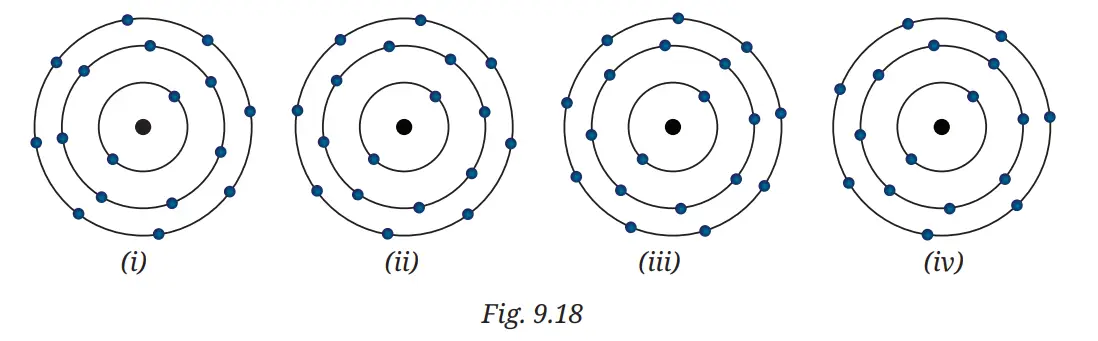
The atomic number of chlorine is 17. From the diagrams provided in Fig. 9.18, select the one that accurately depicts the structure of a chloride ion (Cl⁻).
Diagram (i)
Diagram (ii)
Diagram (iii)
Diagram (iv)
Show answer & explanation
Answer: Diagram (ii)
Explanation: A chlorine atom (atomic number 17) has 17 electrons arranged as 2, 8, 7. A chloride ion Cl- is formed when the atom gains one electron, giving 18 electrons arranged as 2, 8, 8 with a completed octet in the outermost shell. Counting the electrons in Fig. 9.18, diagram (ii) shows 2 in the first shell, 8 in the second and 8 in the third (18 in total), so it depicts Cl-. Diagrams (i) and (iv) show only 17 electrons (the neutral atom) and diagram (iii) shows 19 electrons, so they are incorrect.
Q6Law of Conservation of Masseasy2 marks
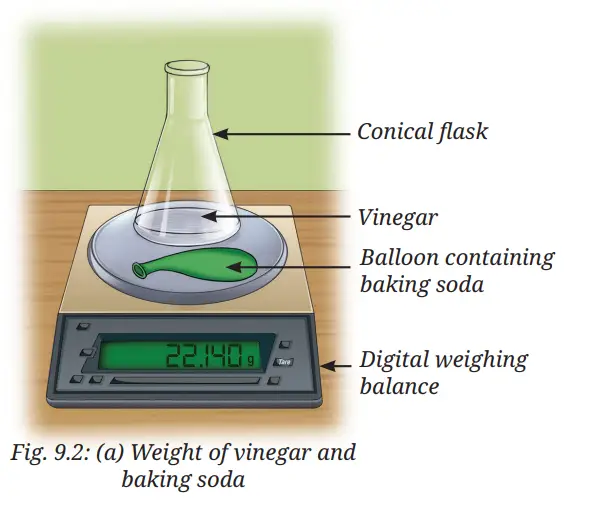
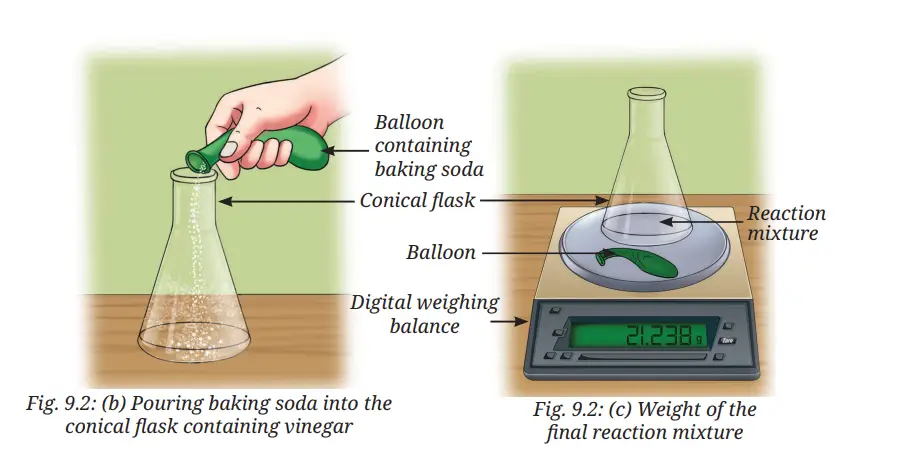
The text states that a brisk effervescence is observed and the final mass reading does not match the initial one. Propose a reason for this discrepancy in mass.
Show answer & explanation
Answer: The carbon dioxide gas produced in the reaction escaped into the air because the flask was open, so the mass of the escaped gas is missing from the final reading — mass was not actually destroyed.
Explanation: The effervescence is carbon dioxide gas formed when vinegar reacts with baking soda. In Fig. 9.2 the baking soda is poured into an open flask, so the gas escapes into the surroundings instead of being weighed. That is why the balance reads less afterwards (21.238 g against the initial 22.140 g, about 0.9 g of gas lost). The law of conservation of mass still holds: if the experiment is done in a closed system where the gas is trapped, the initial and final masses match.
Q7Law of Conservation of Massmedium2 marks
In an experiment where a chemical reaction inside a conical flask inflates an attached balloon, as depicted in Fig. 9.3c, would you expect the initial mass reading on the balance to be the same as the final mass reading? Justify your answer.
Show answer & explanation
Answer: Yes — the initial and final readings are practically the same (22.512 g and 22.510 g), because the balloon seals the flask and the carbon dioxide gas formed stays inside the closed system.
Explanation: With the balloon fixed on the mouth of the flask, the set-up is a closed system. The carbon dioxide produced by the reaction of vinegar and baking soda cannot escape; it only inflates the balloon. Since no matter enters or leaves, the total mass of the products equals the total mass of the reactants, as stated by the law of conservation of mass. The tiny difference between 22.512 g and 22.510 g is negligible experimental error.
Q8Law of Conservation of Massmedium2 marks
Compare the mass reading on the digital balance before mixing the reactants with the reading after the reaction has occurred in the sealed flask. Are they identical?
Show answer & explanation
Answer: Yes - the readings are practically identical: 22.512 g before mixing and 22.510 g after, a difference of only 0.002 g, which is ordinary balance uncertainty.
Explanation: In the sealed set-up the balloon keeps the flask closed, so the carbon dioxide produced by the reaction cannot escape - it simply inflates the balloon and stays inside the system being weighed. Since no matter enters or leaves, the total mass of the products must equal the total mass of the reactants, and the balance reads the same before and after. The 0.002 g difference is far too small to be a real loss of matter; it is the ordinary uncertainty of the balance. This is the law of conservation of mass, and it is exactly why the same reaction run in an open flask appears to lose mass - there the gas escapes and is no longer on the pan.
Q9Properties Ioniceasy1 mark
Identify the type of chemical bond in a solid compound that is a non-conductor of electricity in its solid form but becomes a conductor when dissolved in water.
Show answer & explanation
Answer: Ionic bond (electrovalent bond)
Explanation: In an ionic compound the oppositely charged ions are held rigidly at fixed positions in the solid, so they cannot move and the solid does not conduct electricity. When the compound is dissolved in water, the ions separate and become free to move, and these mobile charged particles carry the electric current. This behaviour is characteristic of ionic bonding, as in sodium chloride.
Q10Covalent Bondmedium2 marks
Given that fluorine has an atomic number of 9, describe how a molecule of fluorine (F₂) is formed.
Show answer & explanation
Answer: Each fluorine atom (electronic configuration 2, 7) shares one electron with the other, forming one shared pair of electrons — a single covalent bond — so both atoms complete their octets and an F2 molecule is formed.
Explanation: A fluorine atom has 9 electrons arranged as 2, 7, so it is one electron short of a stable octet in its outermost shell. Gaining or losing electrons is not needed when two fluorine atoms come together: each atom contributes one electron to form a shared pair between them. This shared pair constitutes a single covalent bond, and through sharing, each atom effectively has 8 electrons in its outer shell. The two bonded atoms make up the F2 molecule.
Q11Molecular Masseasy1 mark
Calculate the molecular mass of water (H₂O), using the atomic masses H = 1 u and O = 16 u.
Show answer & explanation
Answer: 18 u
Explanation: Molecular mass is the sum of the atomic masses of all atoms in one molecule. A water molecule contains 2 hydrogen atoms and 1 oxygen atom. Molecular mass of H2O = 2 x 1 + 1 x 16 = 2 + 16 = 18 u.
Q12Formula Unit Masseasy1 mark
Calculate the formula unit mass of sodium oxide (Na₂O), using the atomic masses Na = 23 u and O = 16 u.
Show answer & explanation
Answer: 62 u
Explanation: Formula unit mass is the sum of the atomic masses of all atoms in one formula unit of an ionic compound. One formula unit of Na2O contains 2 sodium atoms and 1 oxygen atom. Formula unit mass = 2 x 23 + 1 x 16 = 46 + 16 = 62 u.
Q13Ionic bondmedium2 marks
Provide an explanation for why an aqueous solution of salt is electrically conductive, whereas a sugar solution is not.
Show answer & explanation
Answer: Salt is an ionic compound that dissociates in water into free Na+ and Cl- ions which move and carry current; sugar is a covalent compound that dissolves as neutral molecules, so its solution has no charged particles to conduct electricity.
Explanation: Electrical conduction in a solution requires mobile charged particles. Common salt (NaCl) is ionic: on dissolving, it separates into sodium ions (Na+) and chloride ions (Cl-) that are free to move through the water and carry the electric current. Sugar is a covalently bonded compound: it dissolves as whole neutral molecules and produces no ions. With no charge carriers present, the sugar solution does not conduct electricity.
Q14How Atoms Combine?easy2 marks
Explain the distinction between the chemical symbols O and O₂ when referring to oxygen.
Show answer & explanation
Answer: O is the symbol for a single atom of the element oxygen, while O2 is the formula of an oxygen molecule made of two oxygen atoms chemically combined — the form in which oxygen gas actually exists in nature.
Explanation: O represents one atom of oxygen; it stands for the element and does not exist freely as a single atom under ordinary conditions. O2 represents one molecule of oxygen, formed when two oxygen atoms combine by sharing electrons (a covalent bond). Oxygen gas in air exists as these diatomic O2 molecules, so O denotes the atom while O2 denotes the actual molecule of the gas.
Q15Dalton's Atomic Theorymedium1 mark
An assertion and a reason are given below.
Assertion (A): 2 g of hydrogen combines with 16 g of oxygen to yield 18 g of water.
Reason (R): As per Dalton's Atomic Theory, atoms join in a simple whole number ratio by mass to create compounds.
Which of the following options is correct?
(i) Both A and R are true, and R is the correct explanation for A.
(ii) Both A and R are true, but R is not the correct explanation for A.
(iii) A is true, but R is false.
(iv) A is false, but R is true.
Both A and R are true, and R is the correct explanation of A.
Both A and R are true, but R is not the correct explanation of A.
A is true, but R is false.
A is false, but R is true.
Show answer & explanation
Answer: A is true, but R is false.
Explanation: Assertion (A) is true as it correctly demonstrates the Law of Conservation of Mass (2g + 16g = 18g). Reason (R) is false because Dalton's Atomic Theory states that atoms combine in a simple whole-number ratio of atoms, not by mass.
Q16Properties Ionicmedium1 mark
Evaluate the following statements:
Assertion (A): In its molten form, copper sulfate is an electrical conductor, but it is not in its solid form.
Reason (R): In the molten state, copper and sulfate ions are held in fixed lattice positions, whereas in the solid state, they are mobile.
Select the correct choice from the options below:
Both A and R are correct, and R provides the correct explanation for A.
Both A and R are correct, but R does not provide the correct explanation for A.
A is correct, but R is incorrect.
A is incorrect, but R is correct.
Show answer & explanation
Answer: A is correct, but R is incorrect.
Explanation: The assertion is true because ionic substances like copper sulfate conduct electricity only when their ions are mobile, which is the case in the molten state. The reason is false because it incorrectly describes the state of ions; they are fixed in the solid state and mobile in the molten state.
Stuck anywhere in Chapter 9 (Atomic Foundations of Matter)? Vidya ma'am — EduLevel's AI teacher — teaches this chapter live, by voice, and solves your doubts till they click.