Chapter 4 of the new NCERT Class 9 Science textbook Exploration (2026-27) — Describing Motion. Below are 18 questions from this chapter with answers and step-by-step explanations, including 6 diagram-based questions with their figures. Try each one before revealing the answer — and if a concept doesn't click, Vidya ma'am teaches this exact chapter live in the EduLevel app.
What Chapter 4 covers
Motion Around Us
Straight Line Motion
Describing Position
Distance & Displacement
Average Speed & Velocity
Average Acceleration
Graphical Representation
Position-time Graphs
Velocity-time Graphs
Kinematic Equations
Motion in a Plane
Uniform Circular Motion
Exploration Chapter 4 — solved questions
Attempt each question first, then open the answer to compare your method.
Q1Average Speed & Velocityeasy1 mark
A cyclist covers a distance of 30 km in 2 hours. What is the speed of the cyclist?
60 km/h
15 km/h
32 km/h
7.5 km/h
Show answer & explanation
Answer: 15 km/h
Explanation: Speed = distance ÷ time. Here distance = 30 km and time = 2 hours. So speed = 30 ÷ 2 = 15 km/h.
Q2Average Speed & Velocityeasy1 mark
What is the SI unit of speed?
km/h
m/s
m/s²
m
Show answer & explanation
Answer: m/s
Explanation: Speed = distance ÷ time. In SI units, distance is measured in metres (m) and time in seconds (s). So the SI unit of speed is m/s. km/h is commonly used in daily life, but it is not the SI unit.
Q3Average Speed & Velocityeasy1 mark
A train moving at a uniform speed covers 120 m in 6 s. What is its speed?
720 m/s
12 m/s
20 m/s
126 m/s
Show answer & explanation
Answer: 20 m/s
Explanation: Speed = distance ÷ time = 120 ÷ 6 = 20 m/s. Multiplying 120 × 6 = 720 or adding 120 + 6 = 126 are common slips; speed always means distance divided by time.
Q4Average Speed & Velocityeasy1 mark
Which of the following physical quantities has both magnitude and direction?
Speed
Distance
Time
Velocity
Show answer & explanation
Answer: Velocity
Explanation: Velocity is speed in a specified direction, so it has both magnitude and direction. Speed, distance and time have only magnitude and no direction. This is why velocity can be zero for a round trip even when speed is not.
Q5Average Speed & Velocitymedium2 marks
A car travels the first 60 km of its journey at 30 km/h and the next 60 km at 60 km/h. What is its average speed for the whole journey?
45 km/h
40 km/h
90 km/h
30 km/h
Show answer & explanation
Answer: 40 km/h
Explanation: Time for the first part = 60 ÷ 30 = 2 h, and time for the second part = 60 ÷ 60 = 1 h. Total distance = 60 + 60 = 120 km and total time = 2 + 1 = 3 h. Average speed = total distance ÷ total time = 120 ÷ 3 = 40 km/h. Simply averaging 30 and 60 to get 45 km/h is wrong because the car spends different amounts of time at the two speeds.
Q6Average Speed & Velocitymedium2 marks
A bus covers 120 km in the first 3 hours of a journey and then 80 km in the next 1 hour. What is the average speed of the bus for the entire journey?
50 km/h
60 km/h
40 km/h
80 km/h
Show answer & explanation
Answer: 50 km/h
Explanation: Total distance = 120 + 80 = 200 km. Total time = 3 + 1 = 4 h. Average speed = 200 ÷ 4 = 50 km/h. Averaging the two leg speeds (40 km/h and 80 km/h) to get 60 km/h is incorrect because the bus travels for unequal times at these speeds.
Q7Average Speed & Velocitymedium2 marks
An athlete runs exactly one complete round of a circular track of total length 400 m in 100 s, finishing at the same point where he started. What is the magnitude of his average velocity?
4 m/s
0 m/s
40 m/s
0.25 m/s
Show answer & explanation
Answer: 0 m/s
Explanation: Average velocity = displacement ÷ time. Since the athlete returns to his starting point, his displacement is 0 m even though the distance covered is 400 m. So average velocity = 0 ÷ 100 = 0 m/s. His average speed, on the other hand, is 400 ÷ 100 = 4 m/s.
Q8Average Speed & Velocitymedium2 marks
A car is moving at a speed of 72 km/h. What is this speed in m/s?
7.2 m/s
20 m/s
72 m/s
259.2 m/s
Show answer & explanation
Answer: 20 m/s
Explanation: To convert km/h into m/s, multiply by 1000 and divide by 3600, which is the same as multiplying by 5/18. So 72 km/h = 72 × 1000 ÷ 3600 = 20 m/s.
Q9Average Speed & Velocitymedium2 marks
A metro train moves at a uniform speed of 25 m/s. How much distance will it cover in 4 minutes?
100 m
6 km
1.5 km
600 m
Show answer & explanation
Answer: 6 km
Explanation: First convert the time into seconds: 4 minutes = 4 × 60 = 240 s. Distance = speed × time = 25 × 240 = 6000 m = 6 km. Using 4 directly without converting minutes to seconds gives the wrong answer 100 m.
Q10Average Speed & Velocityhard3 marks
A car covers the first half of the distance between two cities at 40 km/h and the second half at 60 km/h. What is its average speed for the whole journey?
50 km/h
48 km/h
24 km/h
100 km/h
Show answer & explanation
Answer: 48 km/h
Explanation: Take each half as 120 km. Time for the first half = 120 ÷ 40 = 3 h and time for the second half = 120 ÷ 60 = 2 h. Average speed = total distance ÷ total time = 240 ÷ 5 = 48 km/h. The answer 50 km/h comes from wrongly averaging the two speeds directly, which ignores that the car spends more time at the slower speed.
Q11Average Speed & Velocityhard3 marks
Starting from his home, a boy runs 3 km due east and then 4 km due north, taking a total time of 1 hour. What is the magnitude of his average velocity?
7 km/h
12 km/h
5 km/h
3.5 km/h
Show answer & explanation
Answer: 5 km/h
Explanation: Displacement is the straight-line distance from the starting point to the final point. Since east and north are at right angles, displacement = √(3² + 4²) = √25 = 5 km. Average velocity = displacement ÷ time = 5 ÷ 1 = 5 km/h. His average speed is different: total path ÷ time = 7 ÷ 1 = 7 km/h.
Q12Average Speed & Velocityhard3 marks
A train has to cover a 60 km journey at an average speed of 40 km/h. It covers the first 30 km at 30 km/h. At what speed must it cover the remaining 30 km?
50 km/h
45 km/h
60 km/h
40 km/h
Show answer & explanation
Answer: 60 km/h
Explanation: Total time allowed = total distance ÷ average speed = 60 ÷ 40 = 1.5 h. Time already used for the first 30 km = 30 ÷ 30 = 1 h. So the remaining 30 km must be covered in 1.5 − 1 = 0.5 h, which requires a speed of 30 ÷ 0.5 = 60 km/h. Picking 50 km/h so that the two speeds average to 40 is the classic mistake, because average speed is not the mean of the two speeds.
Q13Uniform Circular Motionmedium3 marks
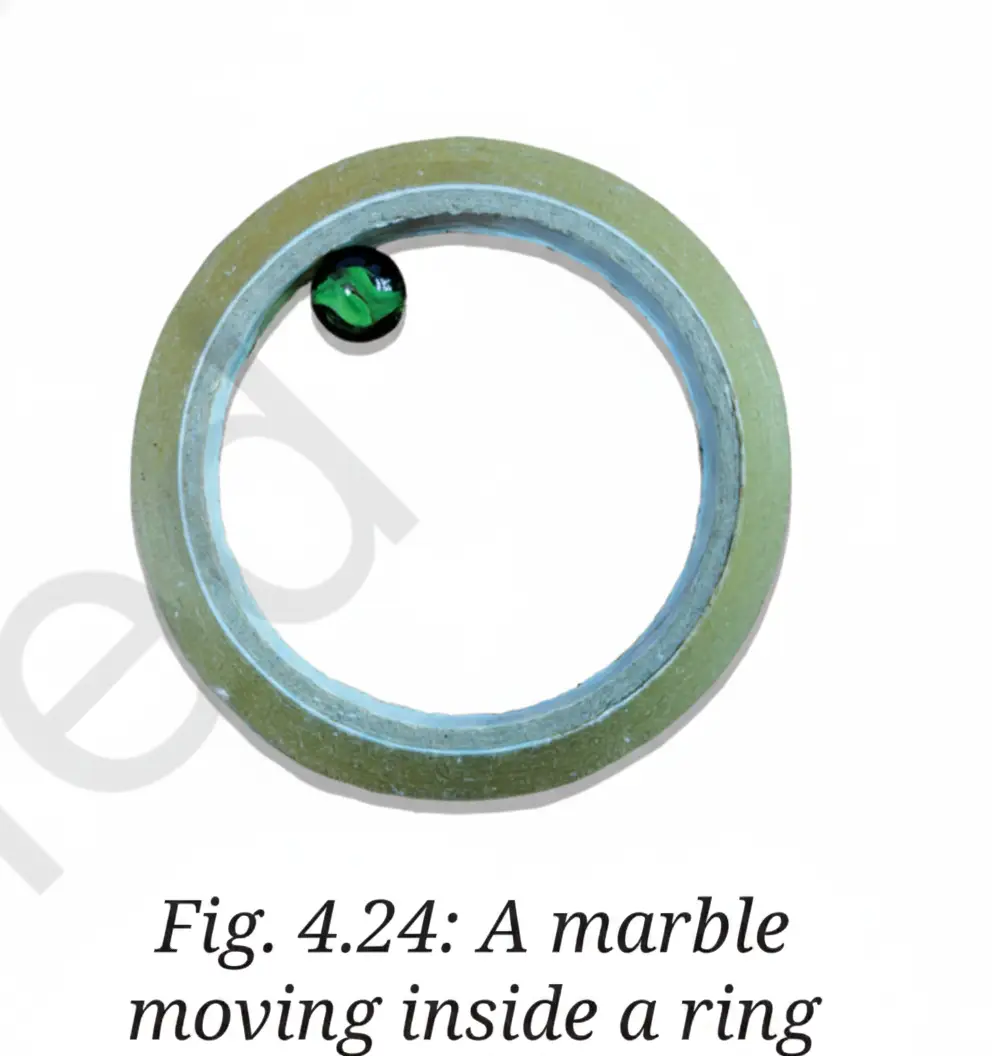
In an experiment, a marble is rolled inside a circular ring placed on a flat surface.
(a) Predict the path the marble will take if the ring is suddenly lifted while the marble is in motion.
(b) After performing the experiment, describe the observed motion of the marble once the ring is removed. Does it continue in a circular path or follow a different trajectory?
(c) Provide a reason for the observed behavior of the marble.
Show answer & explanation
Answer: (a) It will move in a straight line along the tangent to the ring at the point of release; (b) Observed: it does not continue in a circle but moves off in a straight tangential line; (c) In circular motion the velocity at any instant is along the tangent, and once the ring's inward push is removed the marble simply continues in that straight direction.
Explanation: While the marble moves inside the ring (Fig. 4.24), the wall of the ring keeps pushing it towards the centre, continuously changing the direction of its motion and keeping it on the circular path. At every instant, the velocity of a body in circular motion is directed along the tangent to the circle at that point. When the ring is suddenly lifted, this inward force disappears, so there is nothing left to bend the marble's path. The marble therefore leaves the circular path and moves in a straight line along the tangent at the point where it was when the ring was removed, which is exactly what is observed in the experiment.
Q14Kinematic Equationsmedium3 marks
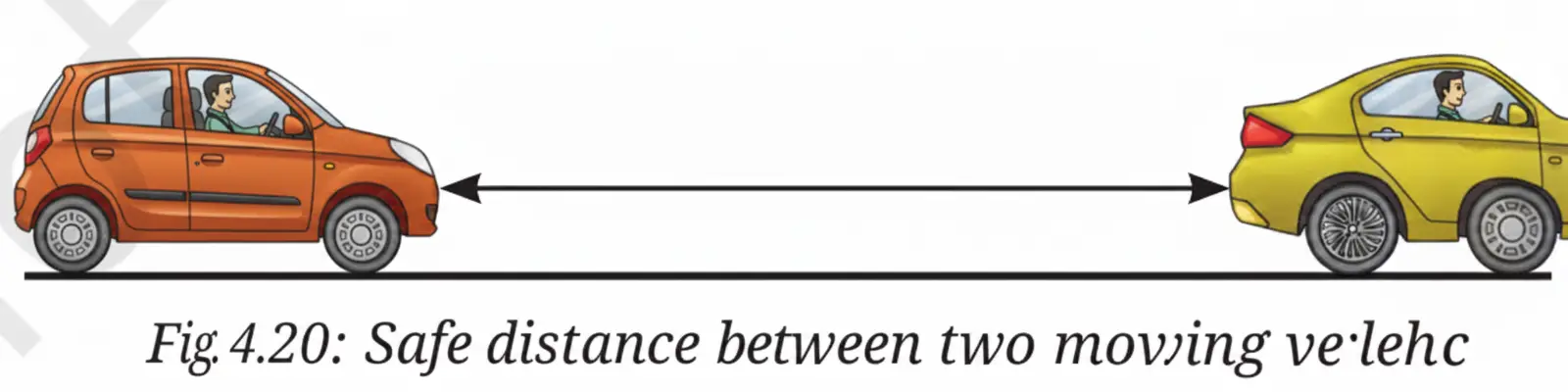
Based on the principles of motion, explain the importance of keeping a safe distance from the vehicle in front of you. How should this safe distance be adjusted based on your initial velocity? Refer to the provided diagram (Fig. 4.20).
Show answer & explanation
Answer: A moving vehicle cannot stop instantly - it travels a stopping distance s = u2/(2a) after braking, so a safe gap prevents collision if the front vehicle brakes suddenly; since stopping distance grows with the square of speed, the safe distance must be increased sharply at higher initial velocity (doubling the speed needs about four times the gap).
Explanation: When the vehicle ahead (Fig. 4.20) brakes suddenly, the driver behind first takes some reaction time (during which the car keeps moving at speed u) and then the brakes bring the car to rest with a retardation a. Using the equation of motion v2 = u2 - 2as with final velocity v = 0, the braking distance is s = u2/(2a). If the gap between the two vehicles is less than this stopping distance (reaction distance plus braking distance), a collision is unavoidable, which is why a safe distance must always be maintained. Because s depends on u2, the required distance rises very rapidly with speed: at double the initial velocity the braking distance becomes four times as large. Hence the faster you are driving, the much larger the safe distance you must keep from the vehicle in front.
Q15Velocity-time Graphshard3 marks
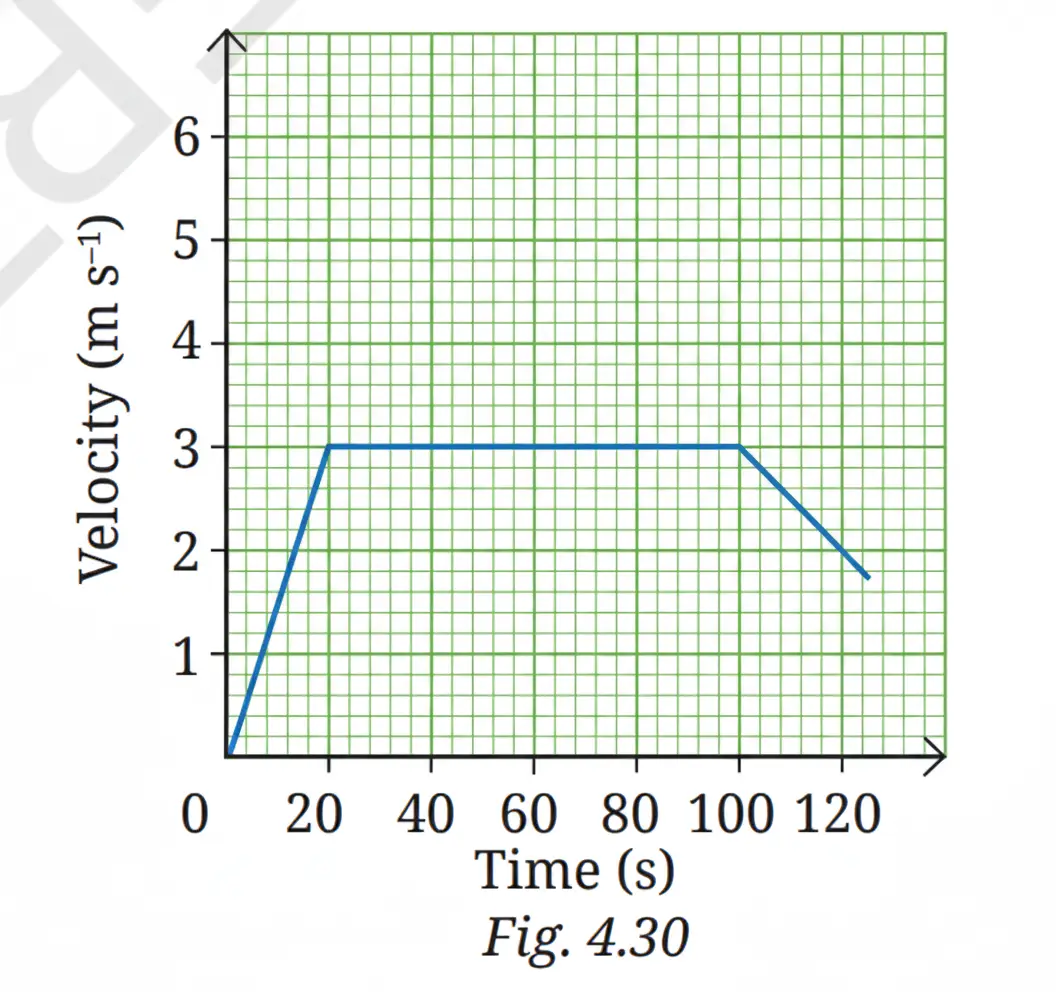
The velocity-time graph for a cyclist's motion from 0 to 120 s is shown in Fig. 4.30. Shade the areas on the graph (using different colors or patterns) that represent the displacement of the cyclist during the following intervals: (i) when the cyclist is moving with constant velocity, and (ii) when the velocity of the cyclist is decreasing. Additionally, calculate the total displacement and the average acceleration for the entire 120 s interval.
Show answer & explanation
Answer: (i) Shade the rectangle under the graph from t = 20 s to t = 100 s at v = 3 m/s (area 240 m); (ii) shade the trapezium from t = 100 s to t = 120 s (area 50 m); total displacement = 320 m; average acceleration = (2 - 0)/120 = 0.017 m/s2 (approximately 1/60 m/s2).
Explanation: From Fig. 4.30 the cyclist accelerates uniformly from 0 to 3 m/s during 0 to 20 s, moves at a constant 3 m/s from 20 s to 100 s, and then slows uniformly so that the velocity is 2 m/s at 120 s. The area under a velocity-time graph gives displacement. Constant-velocity part (shade as region i): rectangle = 3 x (100 - 20) = 240 m. Decreasing-velocity part (shade as region ii): trapezium = 1/2 x (3 + 2) x 20 = 50 m. The acceleration phase contributes a triangle = 1/2 x 20 x 3 = 30 m, so total displacement = 30 + 240 + 50 = 320 m. Average acceleration over the full interval = (final velocity - initial velocity)/time = (2 - 0)/120 = 0.017 m/s2.
Q16Average Speed & Velocityeasy2 marks
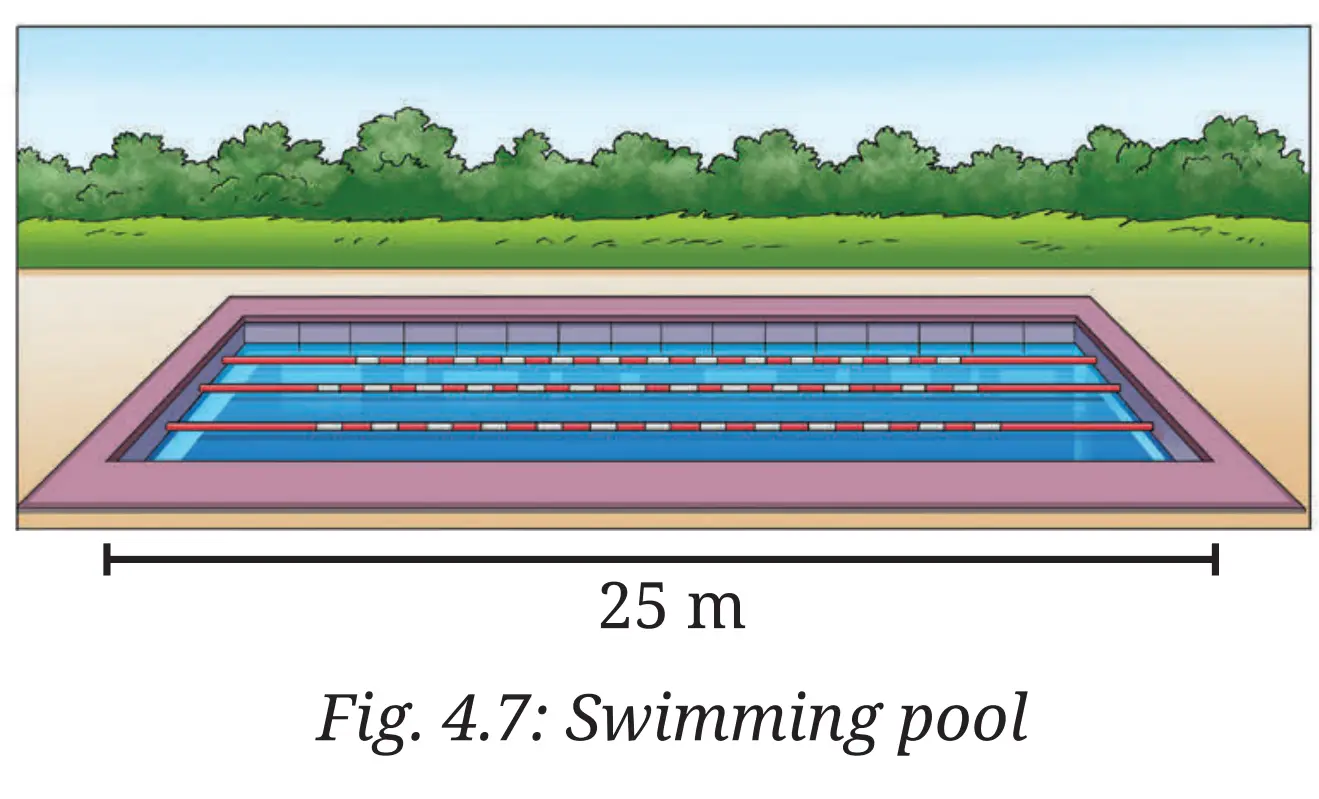
Sarang swims in a 25 m long pool. He swims from one end to the other and back to the starting point in 50 seconds. For this entire duration, calculate his average speed and his average velocity.
Show answer & explanation
Answer: Average speed = 1 m/s; average velocity = 0 m/s.
Explanation: Total distance covered = 25 m + 25 m = 50 m (one full length and back in the 25 m pool of Fig. 4.7). Average speed = total distance/total time = 50 m / 50 s = 1 m/s. Since Sarang returns to his starting point, his displacement for the whole trip is zero. Average velocity = displacement/total time = 0/50 = 0 m/s.
Q17Average Accelerationmedium2 marks
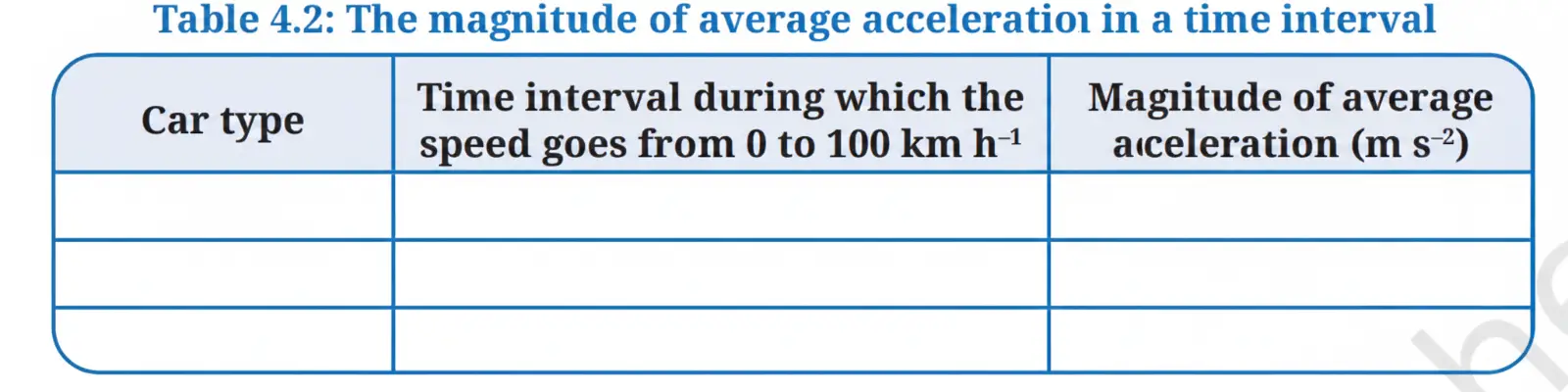
This activity consists of two parts. First, research the time required for various car models to accelerate from 0 km/h to 100 km/h. Record this information in a table as shown. Second, use the collected data to compute the magnitude of the average acceleration for each car.
Show answer & explanation
Answer: Average acceleration = 27.78/t m/s2 (since 100 km/h = 27.78 m/s); sample table: hatchback 15 s gives 1.85 m/s2, sedan 10 s gives 2.78 m/s2, sports car 5 s gives 5.56 m/s2.
Explanation: First convert the final speed: 100 km/h = 100 x 1000/3600 = 27.78 m/s. The magnitude of average acceleration = change in speed/time taken = (27.78 - 0)/t = 27.78/t m/s2, where t is the 0-100 km/h time found for each car. Filling Table 4.2 with typical researched values: a hatchback taking 15 s has a = 27.78/15 = 1.85 m/s2, a sedan taking 10 s has a = 27.78/10 = 2.78 m/s2, and a sports car taking 5 s has a = 27.78/5 = 5.56 m/s2. The shorter the 0-100 km/h time, the larger the average acceleration.
Q18Straight Line Motioneasy1 mark
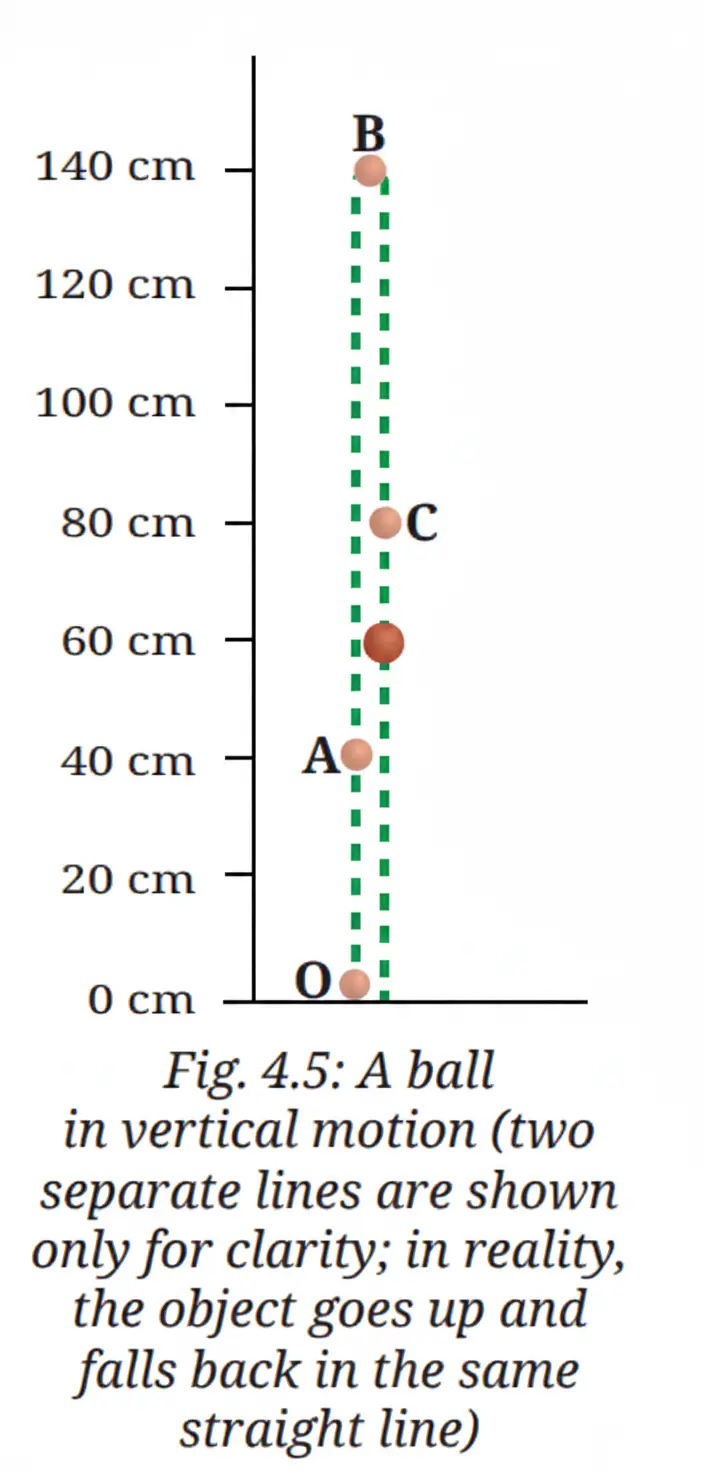
A ball is thrown vertically upwards from point O, reaches a maximum height at point B, and then falls back to O, as depicted in the figure. Can this entire motion be described as motion along a straight line?
Show answer & explanation
Answer: Yes - the entire motion is along a straight line (the same vertical line), only the direction of motion reverses at B.
Explanation: As Fig. 4.5 notes, the two dashed lines are drawn separately only for clarity; in reality the ball rises from O to B (140 cm) and falls back along the same vertical straight line. At the highest point B the direction of motion reverses, but the path itself never leaves that single vertical line. Motion along a straight line does not require the direction to stay the same, so the up-and-down journey is still one-dimensional, straight-line (rectilinear) motion.
Stuck anywhere in Chapter 4 (Describing Motion)? Vidya ma'am — EduLevel's AI teacher — teaches this chapter live, by voice, and solves your doubts till they click.