Exploration Class 9 Science Chapter 12: Patterns in Life: Diversity and Classification — NCERT Solutions
Chapter 12 of the new NCERT Class 9 Science textbook Exploration (2026-27) — Patterns in Life: Diversity and Classification. Below are 16 questions from this chapter with answers and step-by-step explanations, including 8 diagram-based questions with their figures. Try each one before revealing the answer — and if a concept doesn't click, Vidya ma'am teaches this exact chapter live in the EduLevel app.
What Chapter 12 covers
Biodiversity
India Hotspot
Biodiversity Evolved
Classify Organisms
Need Classification
Biological Systems
Five Kingdom
Kingdom Monera
Kingdom Protista
Kingdom Fungi
Kingdom Plantae
Kingdom Animalia
Adaptations Outcome
Scientific Naming
Fossils Evidence
Biodiversity Threat
Exploration Chapter 12 — solved questions
Attempt each question first, then open the answer to compare your method.
Q1Five Kingdomeasy2 marks
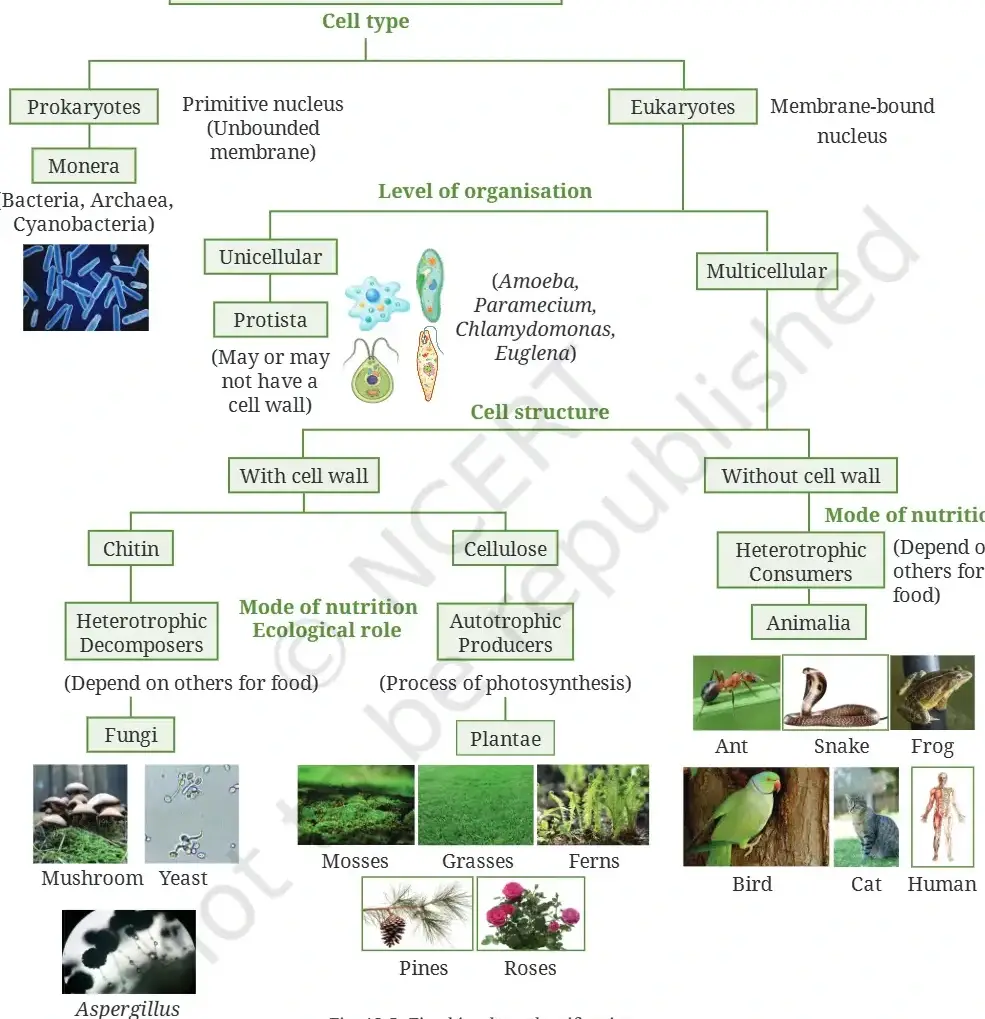
Based on the provided concept map (Fig. 12.5), list the criteria used for the five-kingdom classification of living organisms.
Show answer & explanation
Answer: Four criteria: (1) cell type, prokaryotic or eukaryotic; (2) level of organisation, unicellular or multicellular; (3) cell structure, whether a cell wall is present or absent and what it is made of (chitin or cellulose); (4) mode of nutrition and ecological role, autotrophic producer, heterotrophic decomposer or heterotrophic consumer.
Explanation: The concept map branches step by step, and every branching point is one criterion. The first split is cell type: prokaryotes, whose nucleus is primitive and not bound by a membrane, form Monera (bacteria, archaea, cyanobacteria), while the rest are eukaryotes with a membrane-bound nucleus. The eukaryotes are then split by level of organisation into unicellular forms, which make up Protista (Amoeba, Paramecium, Chlamydomonas, Euglena), and multicellular forms. The multicellular branch splits on cell structure, separating those with a cell wall from those without a cell wall (Animalia). Finally, mode of nutrition and ecological role separates the walled group into heterotrophic decomposers with a chitin wall (Fungi) and autotrophic producers with a cellulose wall that carry out photosynthesis (Plantae).
Q2Five Kingdommedium3 marks
Compare the classification criteria you derived from the concept map with the following specific criteria: cell type (prokaryote vs. eukaryote) and cell structure (presence or absence of a cell wall).
Show answer & explanation
Answer: Both appear in the concept map, but they are only two of its four criteria: cell type is the very first split (Monera versus all eukaryotes) while cell structure is applied much later (Fungi and Plantae have a cell wall, Animalia does not); on their own the two cannot place Protista or tell Fungi from Plantae, so level of organisation and mode of nutrition are needed as well.
Explanation: The map applies four criteria in a fixed order, and the two given here are the first and the third. Cell type is the broadest cut because the absence of a membrane-bound nucleus is a fundamental difference, so it removes the prokaryotes (Monera) in a single step. Cell structure, the presence or absence of a cell wall, is applied only within the multicellular eukaryotes, where it separates the walled Fungi and Plantae from the wall-less Animalia. These two criteria alone are not sufficient, however: Protista may or may not have a cell wall, so it is caught only by the level of organisation criterion (unicellular), and Fungi and Plantae both have a cell wall, so they are told apart only by the material of that wall (chitin versus cellulose) and by mode of nutrition (decomposer versus photosynthetic producer). So the two specific criteria agree with the map but are incomplete, since a workable classification needs all four criteria acting together.
Q3Biodiversity Threatmedium3 marks
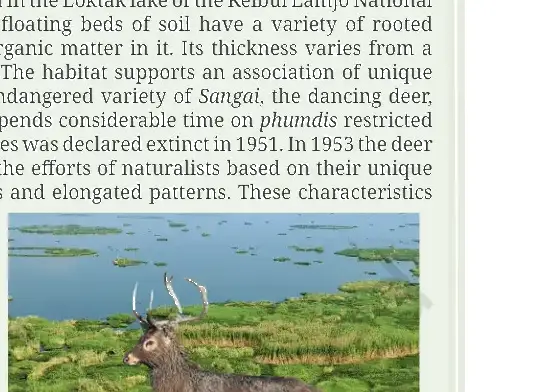
After reading about the endangered Sangai deer and its unique phumdis habitat, suggest practical measures that could be taken to conserve the deer and protect its environment.
Show answer & explanation
Answer: Restore the natural water-level cycle of Loktak lake so the phumdis stay thick, stop poaching and encroachment by patrolling and strict legal protection, keep Keibul Lamjao National Park free of pollution and invasive weeds, run captive breeding and establish a second wild population as insurance, monitor numbers regularly, and involve local people through awareness and alternative livelihoods.
Explanation: The Sangai is endemic to a single habitat, so conserving the deer means conserving the phumdis it lives on. Phumdis are floating mats of soil and vegetation that must sink low enough in the dry season to touch the lake bed and take up nutrients; when water levels are held artificially high the mats grow thin and can no longer bear the deer's weight, so restoring the natural cycle of water levels is the single most important measure. Because the whole population is confined to Keibul Lamjao National Park, one disease outbreak, fire or flood could wipe it out, which is why captive breeding and establishing a second population elsewhere act as insurance against extinction. Anti-poaching patrols and legal protection address direct killing, while controlling encroachment, fishing huts, pollution and invasive weeds protects the quality of the habitat itself. Local participation matters because conservation fails if the people who depend on the lake are given no alternative livelihood.
Q4Kingdom Animaliamedium3 marks
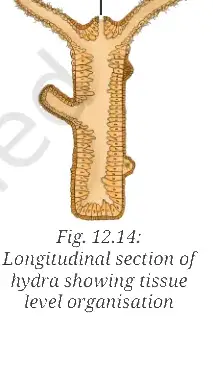
Cnidarians have a single body opening for both ingesting food and expelling waste. Propose the limitations that this type of body plan might present.
Show answer & explanation
Answer: Feeding and egestion cannot happen at the same time, so fresh food can be taken in only after wastes have been thrown out; food and waste mix in the same cavity; the gut cannot be divided into specialised regions for step-by-step digestion; and because digested food must reach every cell by diffusion, the body has to stay small and thin.
Explanation: Cnidarians such as hydra have a sac-like gastrovascular cavity with only one opening that works as both mouth and anus, which is an incomplete digestive tract. Since the same opening is used both ways, the animal must expel undigested remains before it can swallow its next meal, so feeding is interrupted rather than continuous and the rate of food intake is limited; incoming food also mixes with waste in the same cavity. A one-way tube can be divided into specialised regions such as stomach and intestine that work like an assembly line, each secreting its own enzymes and absorbing at its own stage, but a single-opening sac cannot, so digestion is slower and less efficient. Cnidarians are only at the tissue level of organisation and have no circulatory system, so digested food has to reach every cell by diffusion. That restricts them to a thin, small body and prevents the evolution of larger and more complex forms.
Q5Need Classificationmedium3 marks
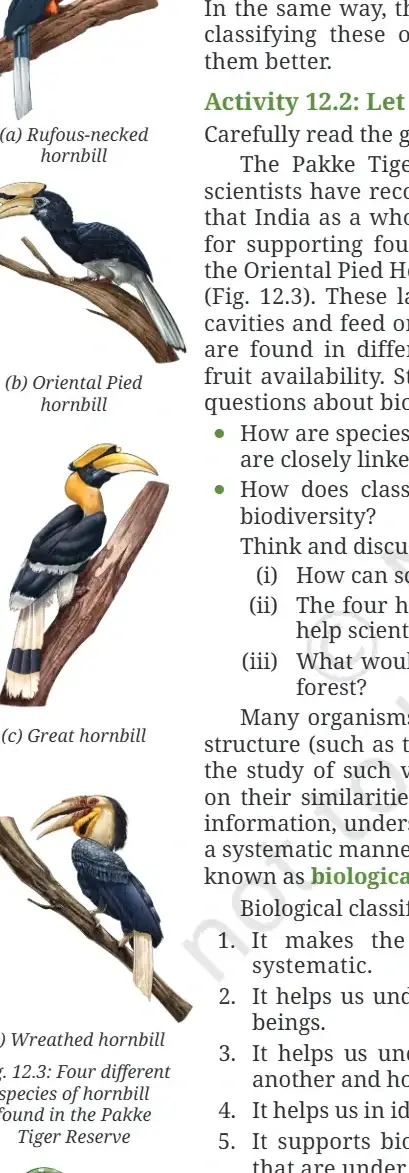
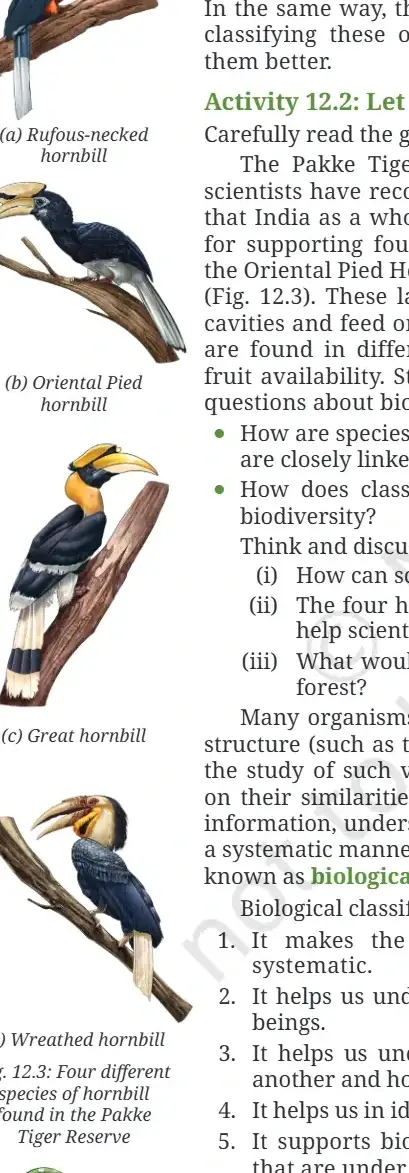
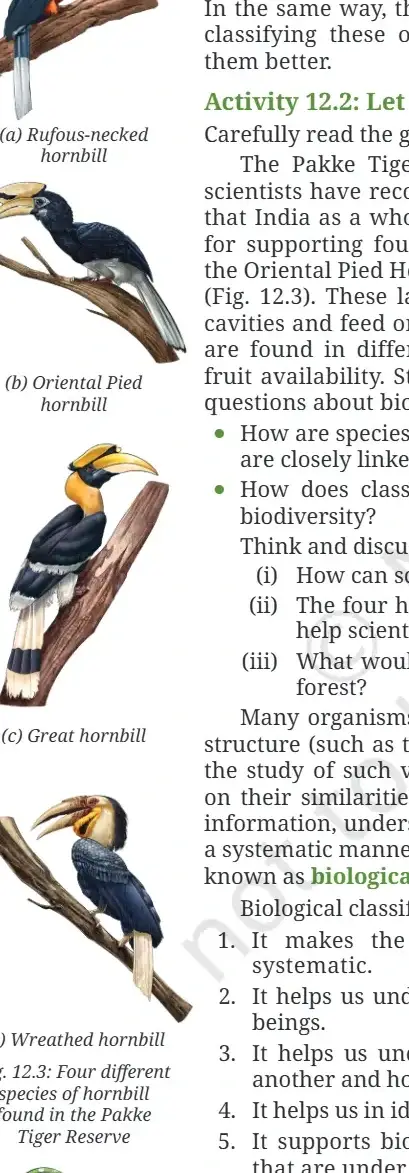
In what way does the classification of the four hornbill species contribute to our understanding of biodiversity?
Show answer & explanation
Answer: It shows that birds which look alike are really four separate species (Rufous-necked, Oriental Pied, Great and Wreathed hornbill), so it reveals how much diversity a single forest actually holds, gives each species a unique name for reliable records, shows how closely they are related, and lets the niche and the conservation needs of each species be studied separately.
Explanation: At a glance the four birds look like one kind of hornbill, so without classification the biodiversity of the Pakke Tiger Reserve would be badly undercounted. By comparing characteristics such as size, plumage and the shape of the bill and casque, scientists establish that these are four distinct species, which is a real measure of the species richness of that forest. Placing all four in the same family at the same time communicates that they share a common ancestor and a common body plan, so classification shows diversity and relatedness together. Each species then receives a unique scientific name, which lets sightings and records from anywhere in the world be pooled without confusion. Finally, once the species are separated, the habits, food and threats of each can be studied on their own, so a species that is endangered can be identified and given targeted protection instead of staying hidden inside a vague group.
Q6Need Classificationhard3 marks
Analyze the case study and discuss the following questions: (i) How do scientists manage to keep records of such a large number of species? (ii) The four hornbill species appear similar. What specific features help scientists distinguish between them? (iii) What would be the ecological impact if the large, old trees were to disappear from the forest?
Show answer & explanation
Answer: (i) By biological classification, a nested hierarchy from kingdom down to species plus a unique two-part scientific name for every species, maintained in catalogues, museum collections and databases. (ii) Body size, plumage colour and pattern, and above all the size, colour and shape of the bill and of the casque on top of it, along with calls, food and habitat. (iii) Hornbills would lose their nesting cavities so breeding would fail, seed dispersal would collapse and forest regeneration would slow, and many other cavity-nesting and canopy species would disappear, destabilising the whole ecosystem.
Explanation: (i) Millions of species cannot be remembered one by one, so scientists group them by shared characteristics into a nested hierarchy of kingdom, phylum, class, order, family, genus and species, and give each species a unique binomial scientific name, so records stay unambiguous and any newly found species can be slotted into the system. (ii) The four hornbills share the general hornbill body plan, so scientists rely on finer characters: the Great hornbill is very large with a bright yellow bill and a broad casque, the Rufous-necked hornbill has a rufous head and neck, the Oriental Pied hornbill is the smallest and is black and white with a black-and-white casque, and the Wreathed hornbill has ridges or wreaths at the base of its bill and a coloured throat pouch. (iii) Hornbills nest only in natural cavities that form in large, old trees, so if those trees vanish there are no nest sites, breeding stops and the population crashes. Hornbills are also major seed dispersers and are called the farmers of the forest, so their decline means fewer seeds are carried away from parent trees and forest regeneration slows down. Old trees are food sources and homes for many other birds, mammals, insects and epiphytes as well, so losing them removes habitat for a large part of the community and disturbs the balance of the whole forest.
Q7Need Classificationmedium3 marks
Based on the case study, how are species distributed within a forest? Identify which plants and animals are closely interconnected.
Show answer & explanation
Answer: Species are not spread evenly through a forest; each occupies the part where the resources it needs are available, which is why the four hornbill species are found in different areas depending on fruit availability. The hornbills and the large, old fruiting trees are the most closely interconnected, because the trees give fruit and nesting cavities while the hornbills disperse their seeds.
Explanation: A forest is not uniform, since light, moisture, canopy height and above all food differ from place to place, so each species settles where the conditions and resources suit it, that is, in its own niche. The case study shows this directly: the four hornbill species occur in different parts of the reserve according to where fruit is available, which also reduces competition between them and lets all four coexist in the same forest. The tightest link is between the hornbills and the large old trees, which supply the fruit they eat and the natural cavities in which they nest. In return the hornbills swallow the fruit and drop the seeds far from the parent tree, so new trees come up across the forest. Neither partner would do well without the other, and this mutual dependence explains why the distribution of the birds tracks the distribution of the trees.
Q8Classify Organismsmedium3 marks
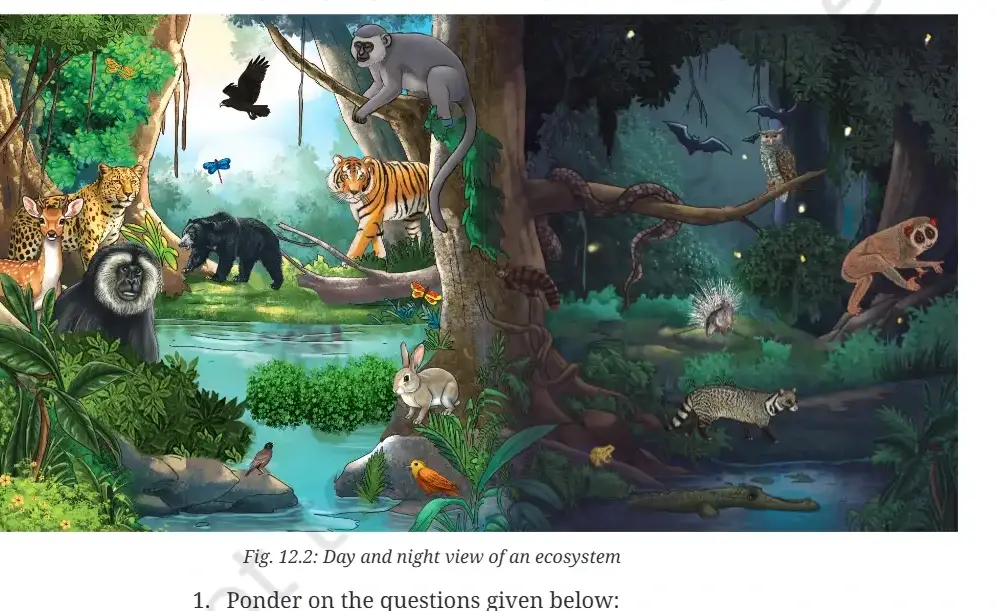
Based on the provided illustration of an ecosystem (Fig. 12.2), perform the following tasks:
1. List all the animals you can identify.
2. Describe the location of each identified animal within the scene.
3. Classify the animals based on their apparent time of activity:
(i) Diurnal (active during the day)
(ii) Nocturnal (active during the night)
(iii) Active during both day and night
4. Organize your observations into a table.
Show answer & explanation
Answer: Day (lit) side, diurnal: spotted deer, leopard, sloth bear, lion-tailed macaque, grey langur, crow, myna, a small orange-yellow bird, dragonfly and butterflies. Night (dark) side, nocturnal: owl, two bats, slow loris, porcupine, civet, snake coiled on a branch, frog, fireflies and a gharial in the stream. At the day-night boundary, active in both: tiger and rabbit.
Explanation: Figure 12.2 is one forest scene split down the middle, the left half lit as day and the right half dark as night, so where an animal is drawn tells you when it is active. On the bright day side the spotted deer, leopard and lion-tailed macaque are at the left among the trees and near the water, the sloth bear walks on the grassy bank, the grey langur sits high on a branch, a crow flies in the open sky, a dragonfly and butterflies are in the air, and a myna and a small orange-yellow bird perch on rocks at the water's edge, so all of these are diurnal. On the dark night side bats fly in the air, an owl perches on a branch with a snake coiled along the same branch, fireflies glow, a slow loris clings to a branch at the right, a porcupine and a civet move on the forest floor, a frog sits near the bank and a gharial lies in the stream, so all of these are nocturnal. The tiger and the rabbit are drawn near the middle, at the boundary of the two halves, which matches their real habit of being active by day as well as by night, mainly around dawn and dusk. Set out as a table with the columns Animal, Location in the scene and Time of activity, one row per animal, the pattern becomes clear: the same forest supports two different sets of animals in turn, so its space and food are shared across the 24-hour cycle instead of being competed for by everyone at once.
Q9Biodiversity Evolvedmedium2 marks
If a large number of organisms exhibit similar characteristics, is it possible that they have a shared ancestral origin?
Show answer & explanation
Answer: Yes. Characteristics shared by a large number of organisms usually mean they inherited those features from a common ancestor, which is why classification based on shared characteristics reflects evolutionary relationships; but similarity alone is not proof, since unrelated organisms living in similar conditions can independently develop similar features.
Explanation: Characteristics are passed from parents to offspring, so when many organisms share the same fundamental features, the simplest explanation is that they all inherited those features from one ancestral population from which they later diverged. This is exactly the reasoning behind biological classification: organisms grouped together because of shared characteristics generally turn out to share ancestry, so the groups reflect evolutionary relationships rather than mere convenience. The more fundamental the shared feature, such as being made of cells or using DNA as the genetic material, the older the common ancestor it points to. Similarity by itself is not conclusive, though, because organisms that are not closely related can evolve similar features when they live in similar environments, as with the streamlined shape of a fish and a dolphin. That is why scientists compare many characteristics together, and today also compare DNA, before concluding that organisms share an ancestral origin.
Q10Kingdom Animaliamedium3 marks
Sponges (Porifera) are sessile organisms with a body structure adapted for filtering water. Could they survive on land? Justify your answer.
Show answer & explanation
Answer: No. A sponge could not survive on land, because its entire body plan depends on a current of water flowing through its pores: without water it would have no way to capture food, no way to exchange gases, no way to remove waste, no support for its soft body, and it would quickly dry out.
Explanation: Poriferans are sessile filter feeders in which water is drawn in through many tiny pores called ostia, passes through canals lined by collar cells whose flagella drive the current and trap food particles, and leaves through a large opening called the osculum. All their essential functions ride on that water current, namely food capture, gas exchange by diffusion across the cells, and removal of waste, and not one of them can work in air. Sponges have no organs, no lungs or tracheae, no circulatory or excretory system and no waterproof covering, so on land their cells would lose water at once and die. Their soft body is also held up by the surrounding water and by a skeleton of spicules, so out of water it would collapse under its own weight, and being fixed in one place they could not move to find water either. Land animals need a moist respiratory surface protected inside the body, a way to conserve water and a skeleton that works against gravity, and the sponge body plan has none of these, which is why sponges are confined to aquatic, mostly marine, habitats.
Q11Biodiversity Threatmedium3 marks
Describe the potential effects of climate change on the biodiversity of an ecosystem.
Show answer & explanation
Answer: Rising temperature and changed rainfall shift or shrink habitats so species must migrate, adapt or die; the timing of flowering, breeding and migration falls out of step so food chains and interactions break; specialised and endemic species are lost first while pests and invasive species spread; and extreme events, rising sea level and warmer oceans destroy habitats such as coral reefs. The overall result is falling biodiversity and unstable ecosystems.
Explanation: Every species survives only within a certain range of temperature, moisture and other conditions, so when the climate changes faster than species can adapt they must shift their range, usually towards the poles or up mountains, or perish. Species that cannot move or have nowhere left to go, such as endemic species on mountain tops and islands or those tied to one habitat like the Sangai on its phumdis, are lost first, so specialists disappear while a few tolerant generalists spread. Climate change also disturbs timing: if flowering, insect emergence, breeding and migration shift by different amounts, pollinators and flowers or birds and their prey no longer match, and these broken interactions damage the whole food web. Warmer and altered conditions let pests, disease-carrying organisms and invasive species enter regions that once excluded them, adding further pressure on native species. On top of this, more frequent droughts, floods, cyclones and forest fires, together with melting ice, rising sea level and warmer, more acidic oceans that bleach coral reefs, destroy habitats outright, so ecosystems lose species, food chains shorten and the ecosystem becomes less stable and slower to recover.
Q12Biological Systemshard3 marks
Explain the reasons why studying genetics provides fundamental and detailed information about living organisms.
Show answer & explanation
Answer: Because genes are the underlying instructions for the whole organism: all life uses the same DNA code, so genetics explains structure, function, development, heredity and variation at their source, reveals relationships and shared ancestry even between organisms that look nothing alike, and supplies an enormous number of precise, comparable characters for identifying and classifying species.
Explanation: Visible features are outcomes, whereas the genetic material is the cause, since DNA carries the instructions that decide how an organism is built, how it works, how it develops from a single cell and what it passes to the next generation, so studying genes explains an organism at its most fundamental level instead of merely describing its surface. DNA is also universal, because essentially every living thing from bacteria to humans uses the same genetic material and the same code, which is itself strong evidence that all life shares a common origin and which gives one common yardstick that can be applied to every organism. Since DNA is a long sequence, it provides a huge number of characters to compare, far more than the handful of visible features, so it is detailed enough to separate two species that look almost identical, such as closely related hornbills, and to detect relationships between organisms whose appearance is completely different. It also cuts through misleading resemblance, because unrelated organisms that evolved similar forms in similar habitats can be told apart by their genes, which makes classification reflect true ancestry. Finally, genetics explains heredity and variation, that is, why offspring resemble their parents and yet differ from them, which is the basis of evolution, of plant and animal breeding and of understanding inherited disease.
Q13Biodiversitymedium3 marks
Explain the role of classifying organisms in comprehending the scope of biodiversity.
Show answer & explanation
Answer: Classification organises millions of species into a nested hierarchy on the basis of shared characteristics, so it makes the study of life systematic, reveals how many distinct kinds actually exist, fixes each with a unique name for unambiguous records, shows how organisms are related and how they evolved, allows any organism to be identified, and highlights the species that need conservation.
Explanation: Biodiversity is far too vast to grasp organism by organism, so without a system the sheer number of species remains a vague impression rather than real knowledge. Classification solves this by grouping organisms with shared characteristics into a nested hierarchy from kingdom down to species, so an enormous variety is reduced to a manageable number of groups that can be studied and compared, which makes the study systematic. It also measures the scope of diversity honestly, because careful comparison shows that organisms which look alike are often several distinct species, so the true richness is revealed instead of undercounted, and each species is fixed by a unique scientific name so that records everywhere refer to the same organism. Since the groups rest on characteristics inherited from common ancestors, the hierarchy also shows how organisms are related to one another and how life evolved, turning a bare list into a pattern that carries meaning. Finally, once species are distinguished and named, any organism can be identified and rare or threatened species can be recognised and protected, so classification is the tool that turns the overwhelming variety of life into something we can comprehend and conserve.
Q14Kingdom Protistamedium3 marks
Explain how a single-celled organism can carry out all its necessary life processes, while multicellular organisms, such as humans, require billions of specialized cells to perform similar functions.
Show answer & explanation
Answer: A single cell is microscopic, so its surface area is large compared with its volume and no point is far from the surface; materials move in, out and around by simple diffusion and organelles carry out each function, so one cell is enough. A large body has too small a surface-area-to-volume ratio for diffusion to serve its inner cells, so it uses division of labour instead, with billions of cells specialised into tissues, organs and organ systems.
Explanation: In a unicellular organism such as Amoeba or Paramecium the entire body is one cell, and every function is performed by organelles inside it: the cell membrane and contractile vacuole for exchange and water balance, food vacuoles for digestion, pseudopodia or cilia for movement and mitochondria for respiration. This works only because the cell is microscopic, so its surface area is very large in relation to its volume and no point inside lies far from the surface, which lets oxygen, food and wastes be exchanged with the surroundings and distributed by simple diffusion fast enough to keep it alive. As a body grows, volume increases as the cube of its size (length3) while surface increases only as the square (length2), so the surface-area-to-volume ratio falls sharply and diffusion becomes far too slow to supply cells deep inside; a human could never survive as one giant cell. Multicellular organisms therefore keep their cells small and increase their number instead, and those cells divide the work between them, so that similar cells form tissues, tissues form organs and organs form organ systems, each dedicated to one function, such as lungs for gas exchange and blood for transport. A specialised cell performs its own task far more efficiently than a general-purpose cell could, and this division of labour is what allows multicellular organisms to become large, complex and long-lived, so it is not that they need billions of cells to do the same job, but that size and complexity force a different and more efficient solution.
Q15Kingdom Animaliaeasy1 mark
Meena and Hari found an animal in their garden. Hari identified it as an insect, while Meena thought it was an earthworm. From the given options, select the one that definitively confirms the animal is an insect.
The animal has a bilaterally symmetrical body.
The animal's body possesses jointed legs.
The animal has a cylindrical body shape.
The animal's body shows little segmentation.
Show answer & explanation
Answer: The animal's body possesses jointed legs.
Explanation: The presence of jointed legs is the most defining characteristic of the phylum Arthropoda, to which insects belong. While both insects and earthworms can have bilateral symmetry, only insects have jointed appendages.
Q16Kingdom Animaliaeasy1 mark
Sponges exhibit one of the most basic body plans among animals. Their cells lack true tissues and organs. Which cellular feature listed below justifies their inclusion in the animal kingdom?
The absence of mitochondria.
The capacity for photosynthesis.
The presence of a cell membrane.
The absence of a cell wall.
Show answer & explanation
Answer: The absence of a cell wall.
Explanation: The absence of a rigid cell wall is a fundamental characteristic of animal cells, distinguishing them from plants, fungi, and bacteria. All other options are incorrect for classifying a sponge as an animal.
Stuck anywhere in Chapter 12 (Patterns in Life: Diversity and Classification)? Vidya ma'am — EduLevel's AI teacher — teaches this chapter live, by voice, and solves your doubts till they click.