Exploration Class 9 Science Chapter 6: How Forces Affect Motion — NCERT Solutions
Chapter 6 of the new NCERT Class 9 Science textbook Exploration (2026-27) — How Forces Affect Motion. Below are 22 questions from this chapter with answers and step-by-step explanations, including 8 diagram-based questions with their figures. Try each one before revealing the answer — and if a concept doesn't click, Vidya ma'am teaches this exact chapter live in the EduLevel app.
What Chapter 6 covers
The Concept of Force
Measuring Force
Balanced Unbalanced Forces
Force of Friction
Newton's First Law
Newton's Second Law
Newton's Third Law
Forces System Objects
Exploration Chapter 6 — solved questions
Attempt each question first, then open the answer to compare your method.
Q1Newton's Second Laweasy1 mark
A force acting on a body of mass 5 kg produces an acceleration of 2 m/s². What is the magnitude of the force?
2.5 N
10 N
7 N
3 N
Show answer & explanation
Answer: 10 N
Explanation: By Newton's second law, F = ma. Here m = 5 kg and a = 2 m/s², so F = 5 × 2 = 10 N.
Q2Newton's Second Laweasy1 mark
One newton (1 N) is the same as which of the following?
1 kg·m/s²
1 kg·m/s
1 kg·m²/s²
1 g·cm/s²
Show answer & explanation
Answer: 1 kg·m/s²
Explanation: From F = ma, one newton is the force that gives a mass of 1 kg an acceleration of 1 m/s². So 1 N = 1 kg × 1 m/s² = 1 kg·m/s². The unit kg·m/s (without the second squared) is the unit of momentum, not force.
Q3Newton's Second Laweasy1 mark
A football of mass 2 kg is moving with a velocity of 5 m/s. What is its momentum?
10 N
10 kg·m/s
2.5 kg·m/s
7 kg·m/s
Show answer & explanation
Answer: 10 kg·m/s
Explanation: Momentum = mass × velocity = 2 × 5 = 10 kg·m/s. Remember that the SI unit of momentum is kg·m/s, while the newton (N) is the unit of force, so 10 N is a unit mistake.
Q4Newton's Second Laweasy1 mark
The mass of a school bag is 10 kg. Taking g = 10 m/s², what is its weight?
10 N
100 kg
100 N
1 N
Show answer & explanation
Answer: 100 N
Explanation: Weight is the force with which the Earth pulls a body, so W = m × g. Here W = 10 × 10 = 100 N. Since weight is a force, it is measured in newtons (N), not in kg.
Q5Newton's Second Lawmedium2 marks
A car of mass 1000 kg starts from rest and reaches a velocity of 20 m/s in 10 s. What is the force applied by its engine?
2000 N
20000 N
200 N
100 N
Show answer & explanation
Answer: 2000 N
Explanation: Acceleration = change in velocity ÷ time = (20 − 0) ÷ 10 = 2 m/s². By Newton's second law, F = ma = 1000 × 2 = 2000 N.
Q6Newton's Second Lawmedium2 marks
A force of 60 N acts on a body of mass 12 kg. What acceleration does it produce?
720 m/s²
0.2 m/s²
48 m/s²
5 m/s²
Show answer & explanation
Answer: 5 m/s²
Explanation: From F = ma, acceleration a = F ÷ m = 60 ÷ 12 = 5 m/s². Multiplying 60 × 12 or dividing the other way round (12 ÷ 60) are common errors; acceleration is always force divided by mass.
Q7Newton's Second Lawmedium2 marks
A cricket ball of mass 0.15 kg moving at 20 m/s is caught by a fielder and brought to rest. What is the magnitude of the change in momentum of the ball?
3 kg·m/s
0.15 kg·m/s
20 kg·m/s
30 kg·m/s
Show answer & explanation
Answer: 3 kg·m/s
Explanation: Initial momentum = m × v = 0.15 × 20 = 3 kg·m/s. Final momentum = 0.15 × 0 = 0 kg·m/s because the ball comes to rest. So the change in momentum = 3 − 0 = 3 kg·m/s.
Q8Newton's Second Lawmedium2 marks
The momentum of a body increases from 30 kg·m/s to 60 kg·m/s in 5 s. What is the force acting on it?
30 N
6 N
12 N
18 N
Show answer & explanation
Answer: 6 N
Explanation: By Newton's second law, force = change in momentum ÷ time taken. Change in momentum = 60 − 30 = 30 kg·m/s. So F = 30 ÷ 5 = 6 N.
Q9Newton's Second Lawmedium2 marks
The mass of an object is 6 kg on the Earth. What will its mass be on the Moon, where gravity is about one-sixth of that on the Earth?
1 kg
6 kg
36 kg
10 N
Show answer & explanation
Answer: 6 kg
Explanation: Mass is the amount of matter in a body and does not change from place to place, so it stays 6 kg on the Moon. Only weight, which equals m × g, becomes about one-sixth on the Moon because g is smaller there. Dividing the mass by 6 confuses mass with weight.
Q10Newton's Second Lawhard3 marks
A force of 18 N gives a mass m1 an acceleration of 3 m/s² and a mass m2 an acceleration of 6 m/s². What acceleration will the same force produce if m1 and m2 are tied together?
9 m/s²
4.5 m/s²
2 m/s²
3 m/s²
Show answer & explanation
Answer: 2 m/s²
Explanation: From m = F ÷ a, m1 = 18 ÷ 3 = 6 kg and m2 = 18 ÷ 6 = 3 kg. When tied together, the total mass = 6 + 3 = 9 kg. So acceleration = F ÷ total mass = 18 ÷ 9 = 2 m/s². Averaging the two accelerations to get 4.5 m/s² is wrong because it is the masses that add up, not the accelerations.
Q11Newton's Second Lawhard3 marks
A vehicle of mass 800 kg moving at 20 m/s is brought to rest in 4 s by applying brakes. What is the magnitude of the braking force?
16000 N
4000 N
200 N
1000 N
Show answer & explanation
Answer: 4000 N
Explanation: The velocity changes by 20 − 0 = 20 m/s in 4 s, so the retardation = 20 ÷ 4 = 5 m/s². Braking force F = ma = 800 × 5 = 4000 N. Multiplying mass directly by velocity (800 × 20 = 16000) gives momentum in kg·m/s, not force.
Q12Newton's Second Lawhard3 marks
A bullet of mass 20 g is fired from a gun with a velocity of 400 m/s. What is the momentum of the bullet?
8000 kg·m/s
8 kg·m/s
20 kg·m/s
0.8 kg·m/s
Show answer & explanation
Answer: 8 kg·m/s
Explanation: First convert the mass into SI units: 20 g = 20 ÷ 1000 = 0.02 kg. Momentum p = m × v = 0.02 × 400 = 8 kg·m/s. Forgetting to convert grams into kilograms gives the wrong answer 8000 kg·m/s.
Q13Newton's Third Laweasy2 marks
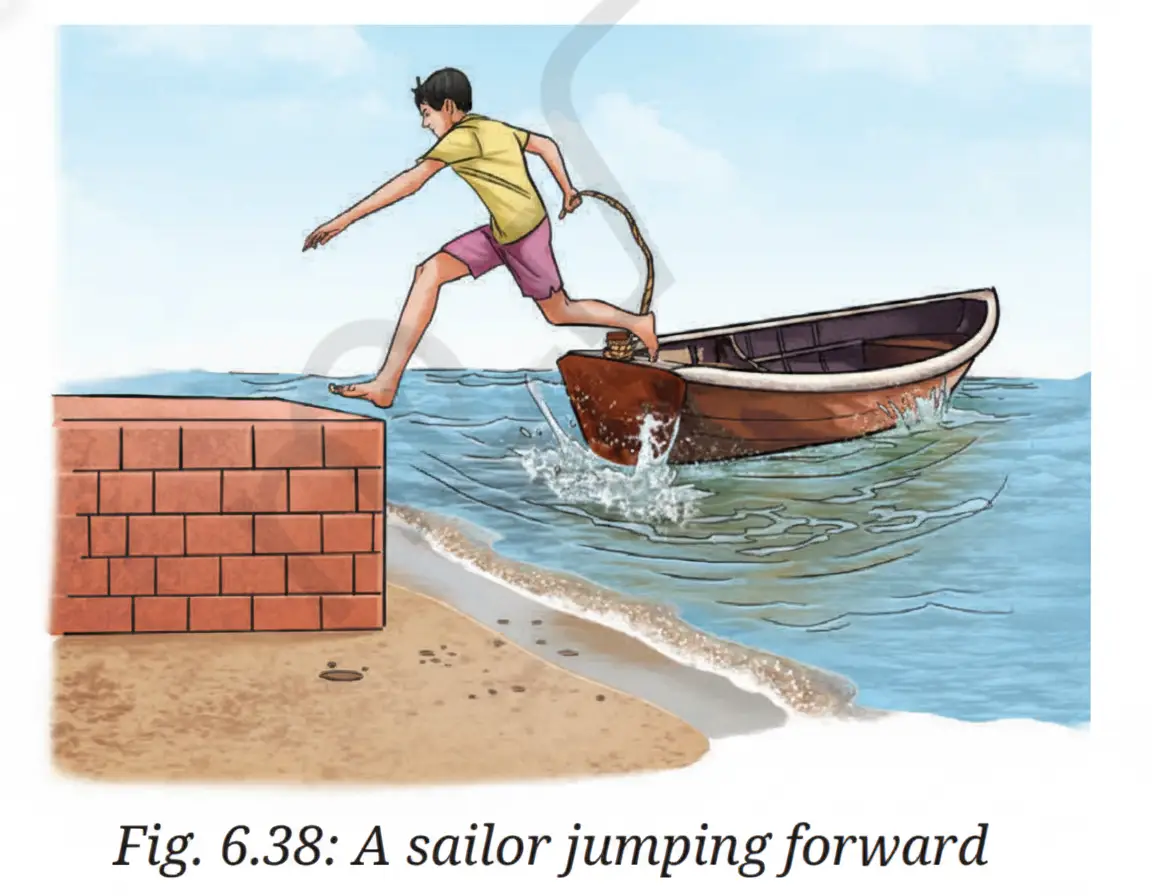
A sailor jumps out from a small boat towards the shore as shown in the figure. Does the boat move as a result? If it does, specify the direction and explain why.
Show answer & explanation
Answer: Yes - the boat moves backward, away from the shore, because the sailor's feet push the boat in the direction opposite to his jump (Newton's third law).
Explanation: While jumping, the sailor pushes the boat backward with his feet; this is the action force. By Newton's third law, the boat exerts an equal and opposite reaction force on the sailor, which carries him forward towards the shore. The action force acting on the boat makes the boat move in the opposite direction, i.e. backward, away from the shore. The same result follows from conservation of momentum: the total momentum was initially zero, so when the sailor gains forward momentum, the boat gains an equal momentum backward.
Q14Balanced Unbalanced Forceseasy3 marks
A block resting on a table is acted upon by two forces of 10 N and 6 N. For each of the three cases illustrated in the accompanying figure, calculate the magnitude of the net force on the block and state its direction.
Show answer & explanation
Answer: (a) 16 N in the direction of the two applied forces; (b) 4 N towards the right, in the direction of the 10 N force; (c) 4 N towards the left, in the direction of the 10 N force.
Explanation: Forces acting along the same straight line add up when they point the same way and subtract when they point opposite ways. In case (a) both forces act in the same direction, so the net force is 10 + 6 = 16 N in the direction in which the forces are applied. In case (b) the 10 N force acts towards the right and the 6 N force towards the left, so the net force is 10 - 6 = 4 N towards the right, along the 10 N force. In case (c) the directions are interchanged, so the net force is again 10 - 6 = 4 N, but now towards the left, along the 10 N force.
Q15Measuring Forcemedium3 marks
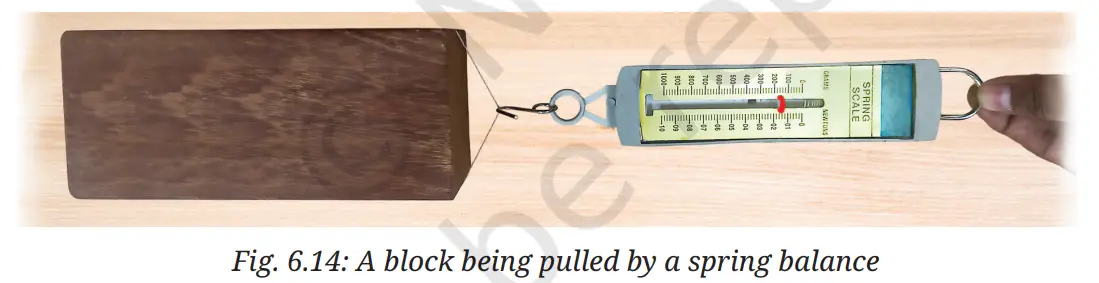
A wooden block is pulled by a spring balance on a horizontal surface, as shown in the figure. The force is gradually increased until the block just begins to move. (i) What does the reading on the spring balance represent at this exact moment? (ii) If the block were pulled at a constant velocity, what would be the net force acting on it? (iii) Explain how the spring balance reading relates to the magnitude of the force of friction.
Show answer & explanation
Answer: (i) The maximum (limiting) static friction force; (ii) zero net force; (iii) since the applied pull just balances friction, the spring balance reading equals the magnitude of the friction force.
Explanation: (i) The block just begins to move when the applied pull barely overcomes the maximum static friction, so at that exact moment the spring balance reading equals the limiting (maximum static) friction force. (ii) At constant velocity the acceleration is zero, so by Newton's first and second laws (F = ma with a = 0) the net force on the block is zero. (iii) Whether the block is on the verge of moving or sliding uniformly, the pulling force and the friction force balance each other; hence the spring balance reading gives the magnitude of friction - the limiting static friction at the instant of slipping and the sliding friction during uniform motion.
Q16Balanced Unbalanced Forcesmedium2 marks
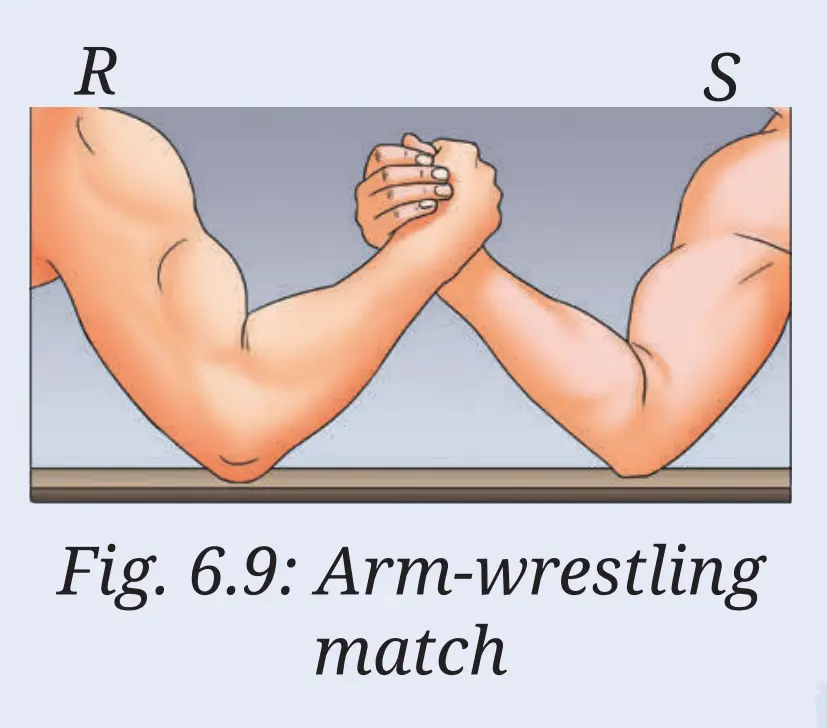
In an arm-wrestling match between players R and S, their arms begin to tilt forward. At this moment, are the forces applied by the players balanced? If they are not balanced, identify which player is applying the greater force.
Show answer & explanation
Answer: No, the forces are not balanced at that moment — player S is applying the greater force, because the forward tilt means R's hand is the one being driven down.
Explanation: As long as the clasped hands stay still, the two players' forces are equal and opposite, so they are balanced. The instant the arms begin to tilt, that state of rest changes, and a change of motion can only happen under an unbalanced net force, so at this instant the forces are not balanced. In arm-wrestling both elbows stay planted on the table, so the joined hands cannot swing sideways towards R or towards S; they can only tip towards you or away from you, which is why the question describes the tilt as being to the front, out of the page. A player is losing when the back of his own hand is being driven down towards the table, and in the figure it is R's hand that faces you - you are looking at the back of R's hand, with R's fingers curled over S's fist. So a tilt to the front means R's hand is the one being pushed down: R is giving way, and therefore S exerted the larger force.
Q17Balanced Unbalanced Forceseasy2 marks
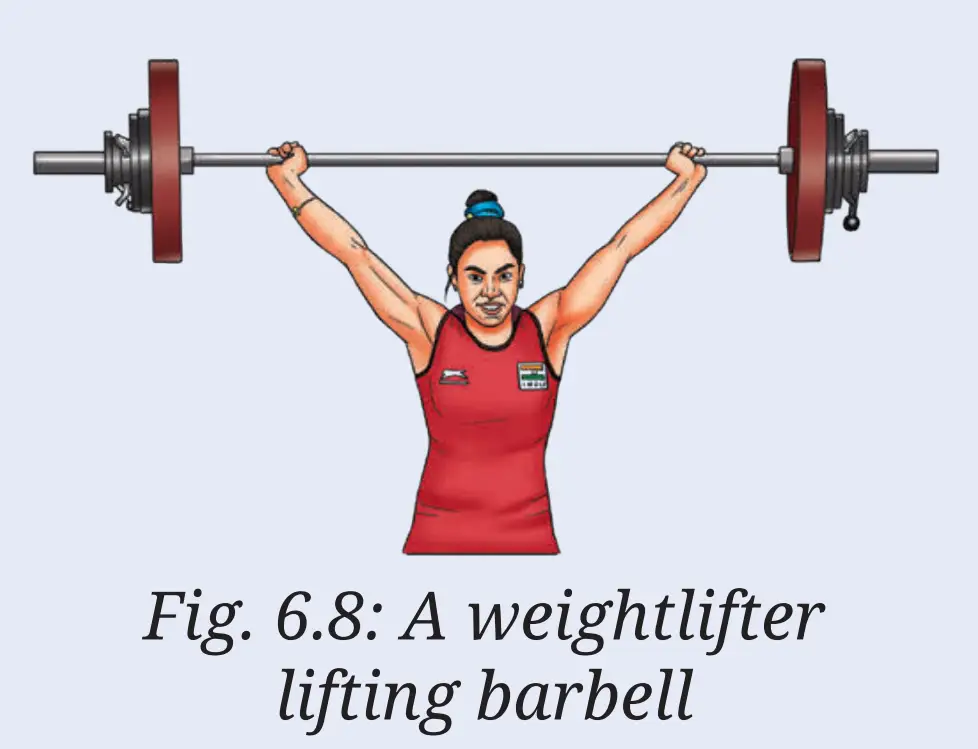
Consider a weightlifter holding a barbell stationary as shown in the corresponding figure. Identify two forces acting on the barbell. State whether these forces are balanced or unbalanced when the barbell is held steady.
Show answer & explanation
Answer: The weight of the barbell (gravity) acting downward and the upward force applied by the weightlifter's hands; the two forces are balanced (net force zero).
Explanation: Two forces act on the stationary barbell: the force of gravity, i.e. the weight of the barbell, pulling it vertically downward, and the upward muscular force applied by the weightlifter's hands supporting it. Since the barbell is held steady, its state of motion is not changing, so the net force on it must be zero. Therefore the two forces are equal in magnitude, opposite in direction, and balanced.
Q18Newton's Third Laweasy2 marks
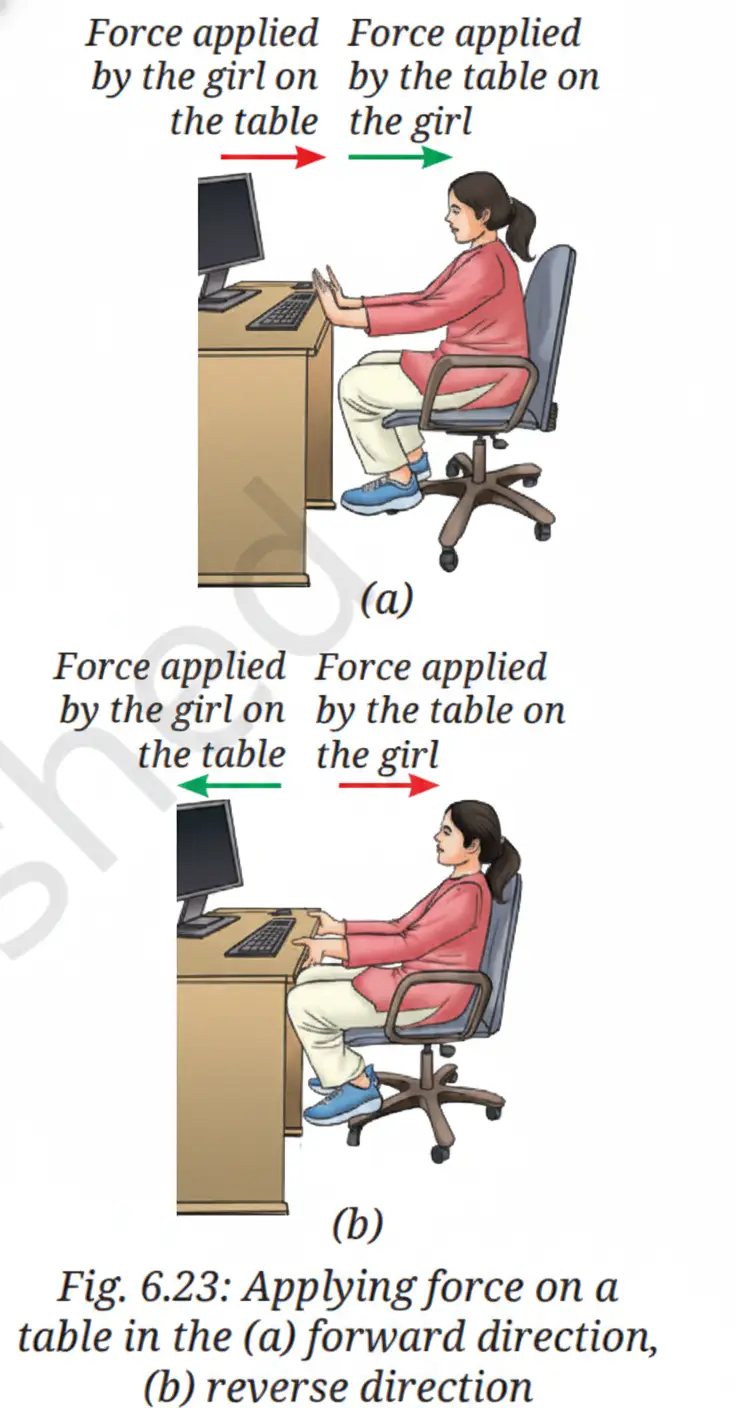
While sitting on a chair with wheels, you push a large table away from you. What happens to you and the chair? In which direction do you move?
Show answer & explanation
Answer: You and the chair roll backward, away from the table - opposite to the direction of your push - due to the table's equal and opposite reaction force (Newton's third law).
Explanation: When you push the table, you exert a force on it directed away from you; this is the action force. By Newton's third law, the table simultaneously exerts an equal and opposite reaction force on you, directed away from the table. Because the chair is on wheels and friction is very small, this reaction force is unbalanced and sets you and the chair in motion. You therefore roll backward, away from the table, in the direction opposite to your push, as the arrows in the figure show.
Q19Balanced Unbalanced Forcesmedium2 marks
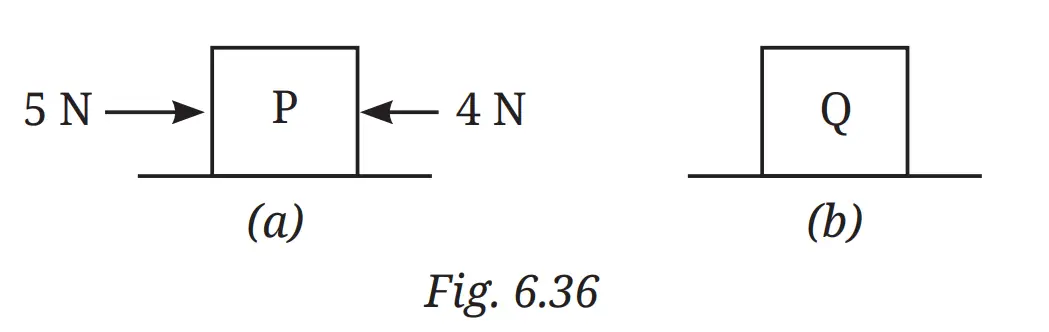
Two blocks, P and Q, are on a smooth horizontal surface as shown in the figure. Two forces of 4 N and 5 N act on block P in opposite directions. Block Q is observed to be moving with a constant velocity. Which of the following statements is correct?
P experiences a net force and Q does not experience a net force.
P does not experience a net force and Q experiences a net force.
Both P and Q experience a net force.
Neither P nor Q experiences a net force.
Show answer & explanation
Answer: P experiences a net force and Q does not experience a net force.
Explanation: Block P has unbalanced forces (5N > 4N), so it has a net force. Block Q moves at a constant velocity, which means its acceleration is zero, and therefore the net force on it is zero according to Newton's first law.
Q20Newton's Second Laweasy1 mark
When a net force is applied to an object, we observe that the object accelerates. Which statement correctly describes this acceleration?
opposite to the direction of force, with acceleration proportional to the force acting on the object.
opposite to the direction of force, with acceleration proportional to the mass of the object.
in the direction of force, with acceleration inversely proportional to the force acting on the object.
in the direction of force, with acceleration proportional to the force acting on the object.
Show answer & explanation
Answer: in the direction of force, with acceleration proportional to the force acting on the object.
Explanation: Newton's Second Law states that acceleration is directly proportional to the net force (F=ma) and in the same direction as the force.
Q21Newton's Third Lawmedium2 marks
A hand cart loaded with vegetables collides with an identical but empty hand cart. Which statement accurately describes the forces during the collision?
the loaded cart exerts a force of larger magnitude on the empty cart.
the empty cart exerts a force of larger magnitude on the loaded cart.
neither cart exerts a force on the other.
the loaded cart and the empty cart, both exert an equal magnitude of force on each other.
Show answer & explanation
Answer: the loaded cart and the empty cart, both exert an equal magnitude of force on each other.
Explanation: According to Newton's Third Law, for every action, there is an equal and opposite reaction. The forces the carts exert on each other are an action-reaction pair and must be equal in magnitude.
Q22Newton's Second Lawmedium2 marks
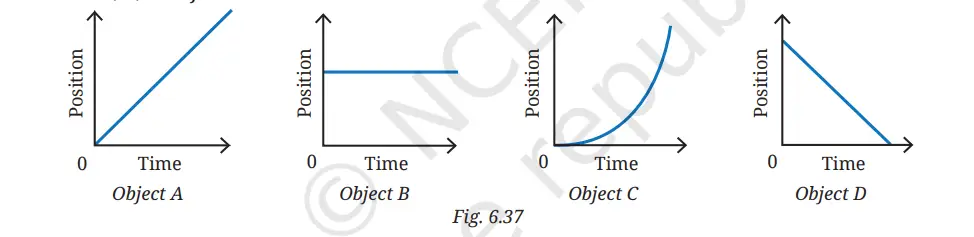
The position-time graphs for four objects (A, B, C, and D) moving along a straight line are provided. On which of these objects is a net force acting?
Object A
Object B
Object C
Object D
Show answer & explanation
Answer: Object C
Explanation: A net force causes acceleration. The slope of a position-time graph represents velocity. Graph C is a curve, indicating that its slope (velocity) is changing, which means the object is accelerating.
Stuck anywhere in Chapter 6 (How Forces Affect Motion)? Vidya ma'am — EduLevel's AI teacher — teaches this chapter live, by voice, and solves your doubts till they click.