Exploration Class 9 Science Chapter 3: Tissues in Action — NCERT Solutions
Chapter 3 of the new NCERT Class 9 Science textbook Exploration (2026-27) — Tissues in Action. Below are 14 questions from this chapter with answers and step-by-step explanations, including 6 diagram-based questions with their figures. Try each one before revealing the answer — and if a concept doesn't click, Vidya ma'am teaches this exact chapter live in the EduLevel app.
What Chapter 3 covers
Plant vs Animal Tissues
Plant Growth
Apical meristem
Lateral meristem
Intercalary meristem
Permanent tissues
Animal Tissues
Epithelial tissues
Connective tissues
Muscular tissues
Nervous tissues
Musculoskeletal System
Types of Joints
Skeletal System
Exploration Chapter 3 — solved questions
Attempt each question first, then open the answer to compare your method.
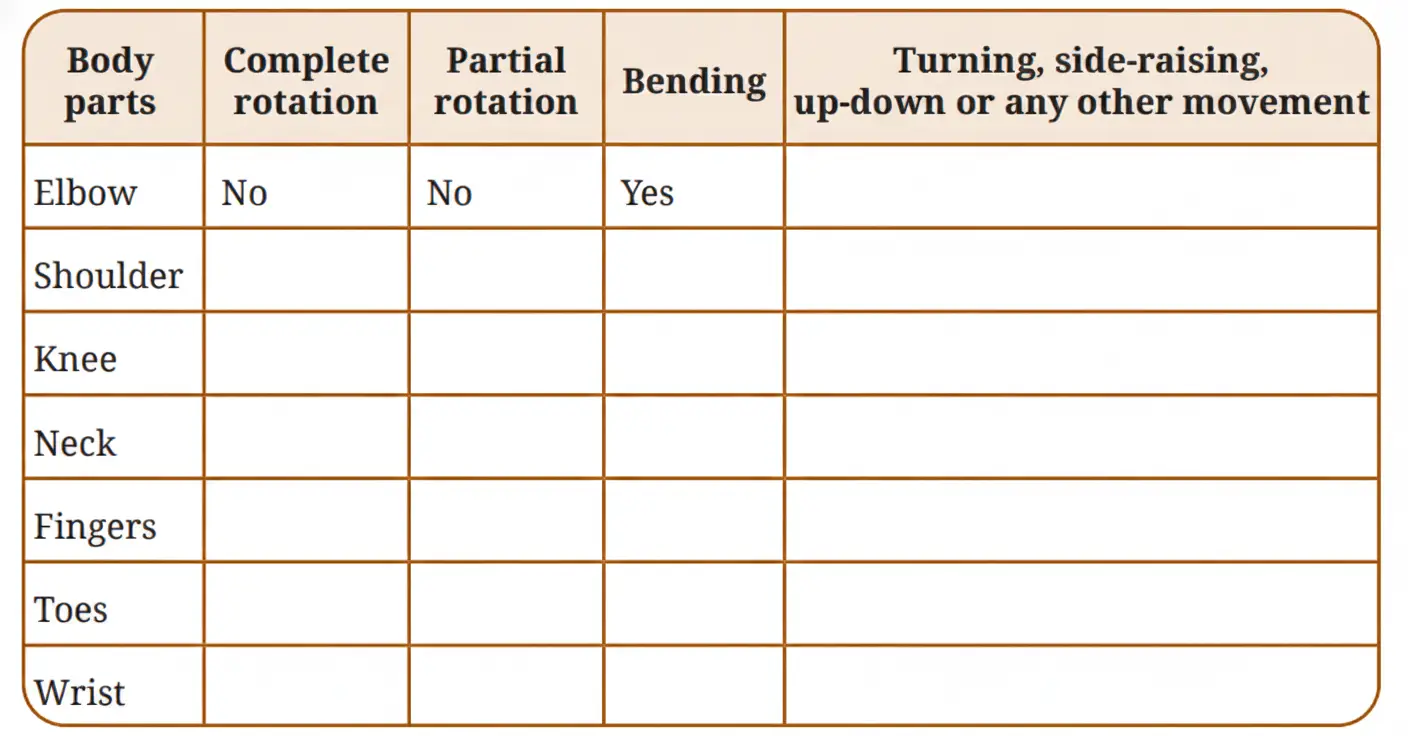
Q1Types of Jointsmedium3 marks
Observe the range of movements possible for different parts of your body. Complete the provided table to indicate whether each body part can perform complete rotation, partial rotation, or bending. Based on your observations, explain what is responsible for causing the bones to move at the joints.
Show answer & explanation
Answer: Shoulder: complete rotation yes (moves in all directions); Elbow, Knee, Fingers and Toes: bending only, no rotation; Neck: partial rotation (turning side to side) and bending (nodding up and down); Wrist: partial rotation and bending. The bones are moved at the joints by muscles - skeletal (voluntary) muscles are attached to the bones by tendons, and when a muscle contracts it pulls the bone.
Explanation: The kind of movement a joint allows depends on its structure: the ball and socket joint of the shoulder lets the bone rotate in almost all directions, the hinge joints of the elbow, knee, fingers and toes allow bending in only one plane, the pivot joint of the neck lets the head turn from side to side and nod, and the gliding joint of the wrist permits bending and limited turning. The joint, however, only permits a movement; it does not produce it. Movement is produced by muscles - skeletal muscle is joined to bone by tough tendons, and when the muscle contracts it shortens and pulls the bone along with it. Since a muscle can only pull and never push, muscles are arranged in antagonistic pairs such as the biceps and triceps at the elbow: one contracts to bend the joint while the other relaxes, and the reverse action straightens it.
Q2Lateral meristemmedium2 marks
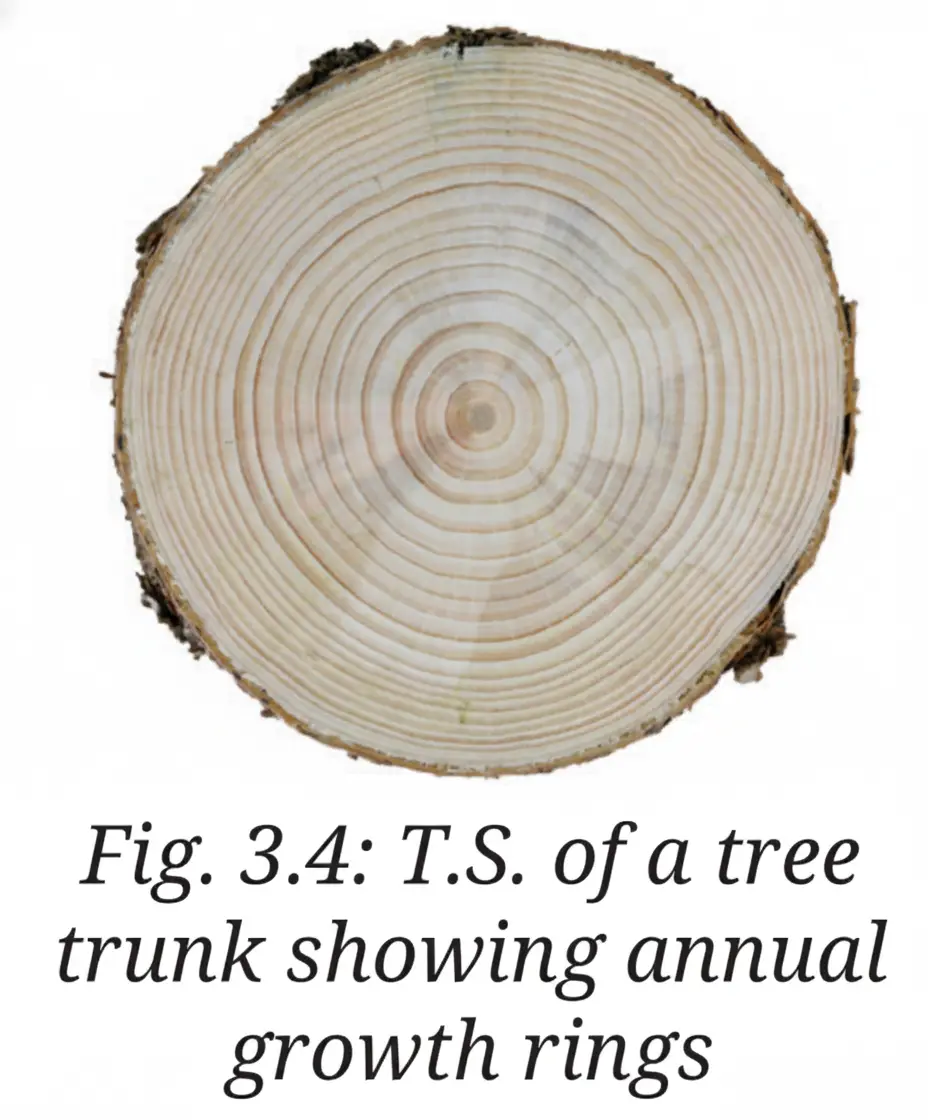
Explain how plants increase their diameter or girth. Identify the specific tissue responsible for this secondary growth.
Show answer & explanation
Answer: Plants increase their girth by secondary growth: the lateral meristem (cambium) - a ring of actively dividing cells running along the sides of the stem and root - keeps adding new secondary xylem towards the inside and new secondary phloem towards the outside, so the stem thickens. The tissue responsible is the lateral meristem (cambium).
Explanation: Growth in thickness is called secondary growth, and it is brought about by the lateral meristem, also called cambium, which runs lengthwise along the sides of the stem and root as a thin ring of small, thin-walled, actively dividing cells. These cells divide again and again and add new cells on both sides - secondary xylem (wood) towards the centre and secondary phloem towards the outside - so the diameter of the stem keeps increasing year after year. The cambium is more active in the favourable growing season, when it forms wide, large cells that appear as light-coloured wood, and less active in the unfavourable season, when it forms narrow, darker cells. This alternation produces the light and dark bands seen in the figure as annual growth rings, and counting these rings gives the approximate age of the tree.
Q3Plant Growthmedium3 marks
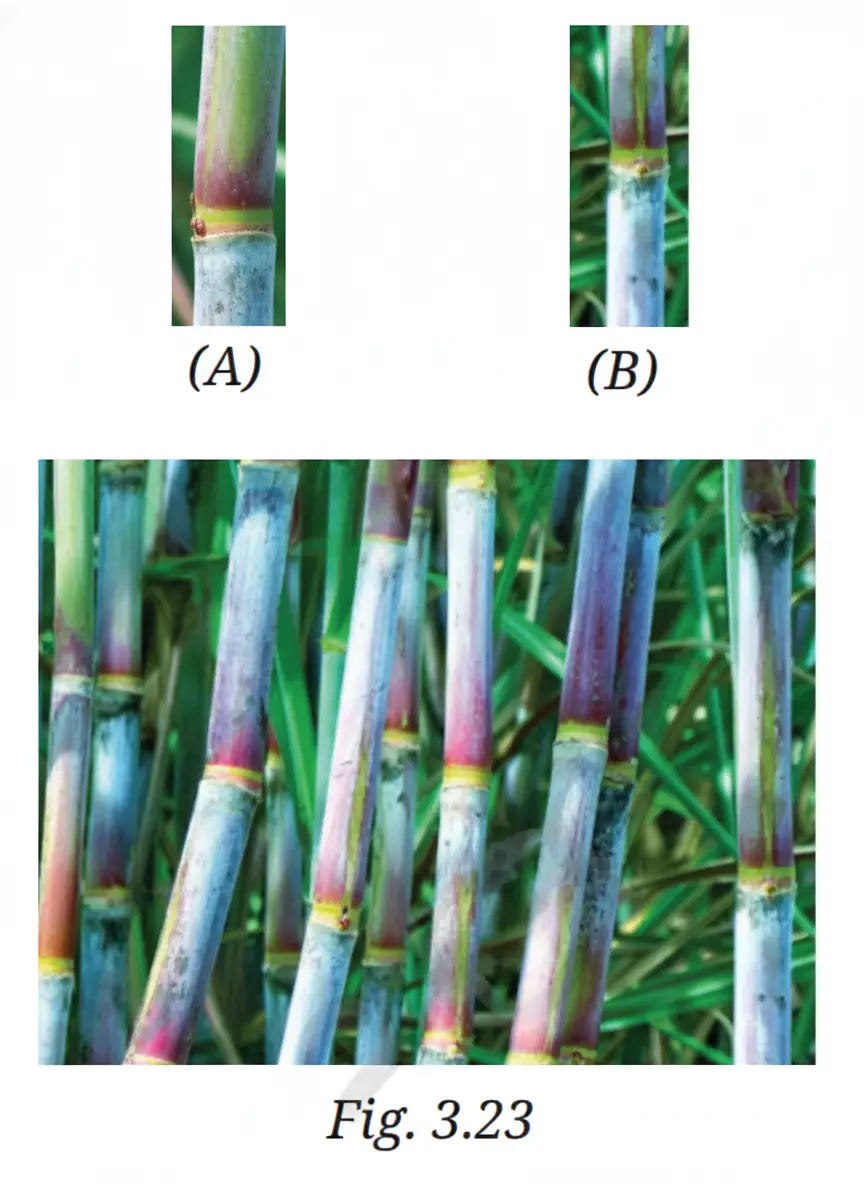
Sohan conducted an experiment on sugarcane regeneration using two types of cuttings, 'A' and 'B', as shown in the figure. After several weeks, the 'B' cuttings sprouted into new plants, but the 'A' cuttings did not. Based on this observation, answer the following: (i) Why were the 'B' cuttings able to grow while the 'A' cuttings were not? (ii) What was the key difference between cutting 'B' and cutting 'A'? (iii) What observation or measurement could be used to confirm the effect of this difference? (iv) To ensure a fair comparison, what experimental parameters should be kept constant for both types of cuttings?
Show answer & explanation
Answer: (i) The 'B' cuttings carried a node with a healthy bud whose meristematic cells could divide and grow into a new shoot and roots, whereas the 'A' cuttings had no such bud and their permanent cells cannot divide to form a new plant. (ii) The key difference was the presence of a node bearing a live bud (meristematic tissue) in 'B' and its absence in 'A'. (iii) Record the percentage of cuttings that sprout in each set, and the number and length of new shoots and roots per cutting, after a fixed number of days. (iv) Keep constant: the same sugarcane variety, the same length and thickness of cutting, the same soil, planting depth, water, light and temperature, the same number of cuttings and the same period of observation.
Explanation: A sugarcane stem is made mostly of permanent tissue, whose cells have lost the power to divide, so a plain internode piece cannot by itself produce a new plant. At each node, however, there is a bud (the eye) that contains meristematic tissue - small, thin-walled cells with dense cytoplasm that divide continuously. When such a cutting is planted, the dividing cells of the bud give rise to a new shoot and roots arise at the node, so only the cuttings carrying a bud sprout. This is why sugarcane is propagated from stem pieces called setts, each of which must carry at least one node with a healthy bud. For the comparison to be fair, only the presence of the bud should differ between the two sets, because if any other condition also changed, the difference in sprouting could not be attributed to the bud.
Q4Permanent tissuesmedium3 marks
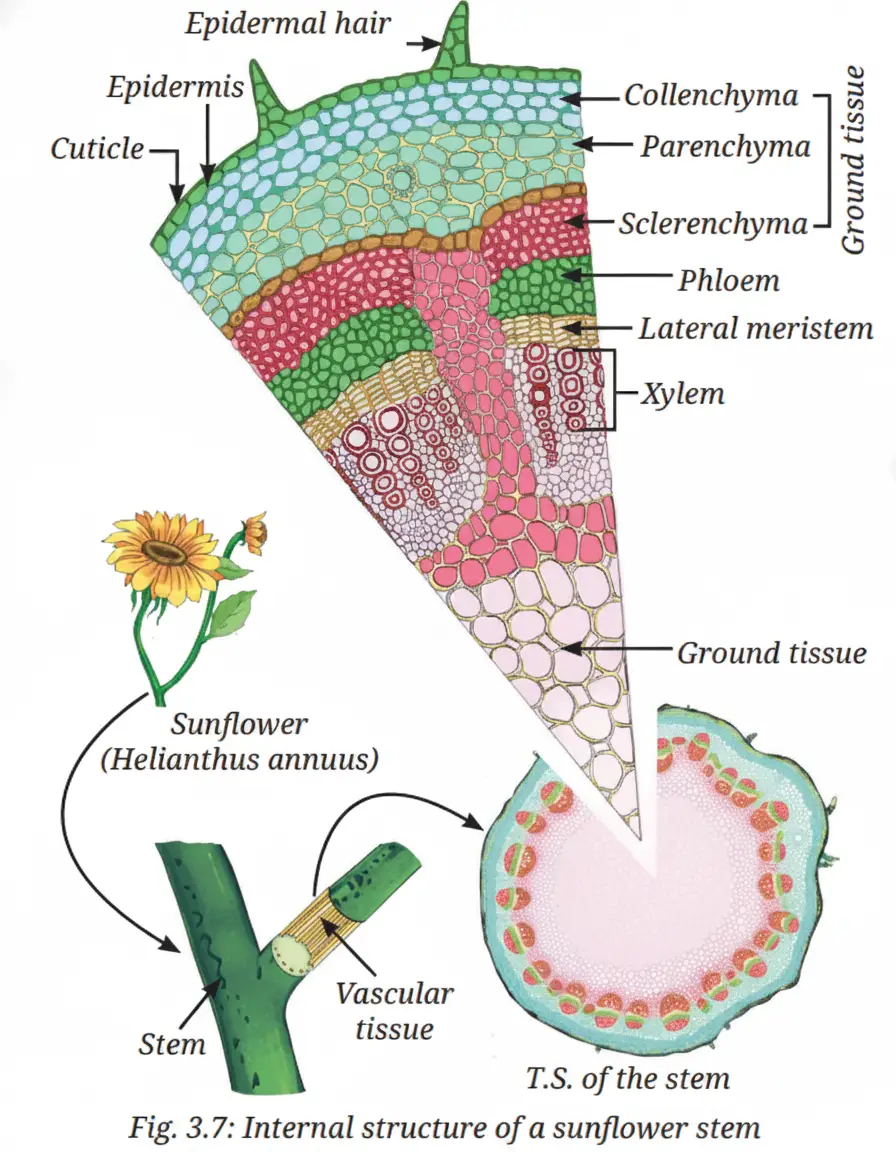
Examine the transverse section (T.S.) of a sunflower stem as depicted in the provided diagram. Based on your observation, address the following points: (i) Are all the cells uniform in shape and size? (ii) How many distinct types of tissues can you distinguish? (iii) What are the noticeable differences between these tissues?
Show answer & explanation
Answer: (i) No - the cells are not uniform; they differ in shape, size and wall thickness. (ii) About seven distinct tissues can be made out: epidermis, collenchyma, parenchyma, sclerenchyma, phloem, lateral meristem (cambium) and xylem. (iii) They differ in cell shape and size, in wall thickness (thin in parenchyma, thickened at the corners in collenchyma, thick and lignified in sclerenchyma and xylem), in being living or dead, in having or lacking intercellular spaces, and in their position and function in the stem.
Explanation: A tissue is a group of cells of similar structure that work together at a common job, and a stem contains several such tissues, so its cells cannot all be alike. The outermost single layer of flat, closely packed cells is the epidermis, covered by a waxy cuticle and bearing epidermal hairs; it protects the stem and checks water loss. Below it lies the ground tissue, made of collenchyma (living cells thickened at their corners, giving flexibility to the young stem), parenchyma (living, thin-walled cells with intercellular spaces that store food) and sclerenchyma (dead cells with thick lignified walls that make the stem hard and strong). Further in are the vascular bundles arranged in a ring, in which xylem (largely dead cells with thick lignified walls and wide lumens) carries water and minerals upward and phloem carries food, with a narrow band of lateral meristem (cambium) between them whose small, actively dividing cells add new xylem and phloem. The differences in cell shape, in wall thickness and in whether the cells are living or dead all correspond to the different functions each tissue performs.
Q5Connective tissueseasy2 marks
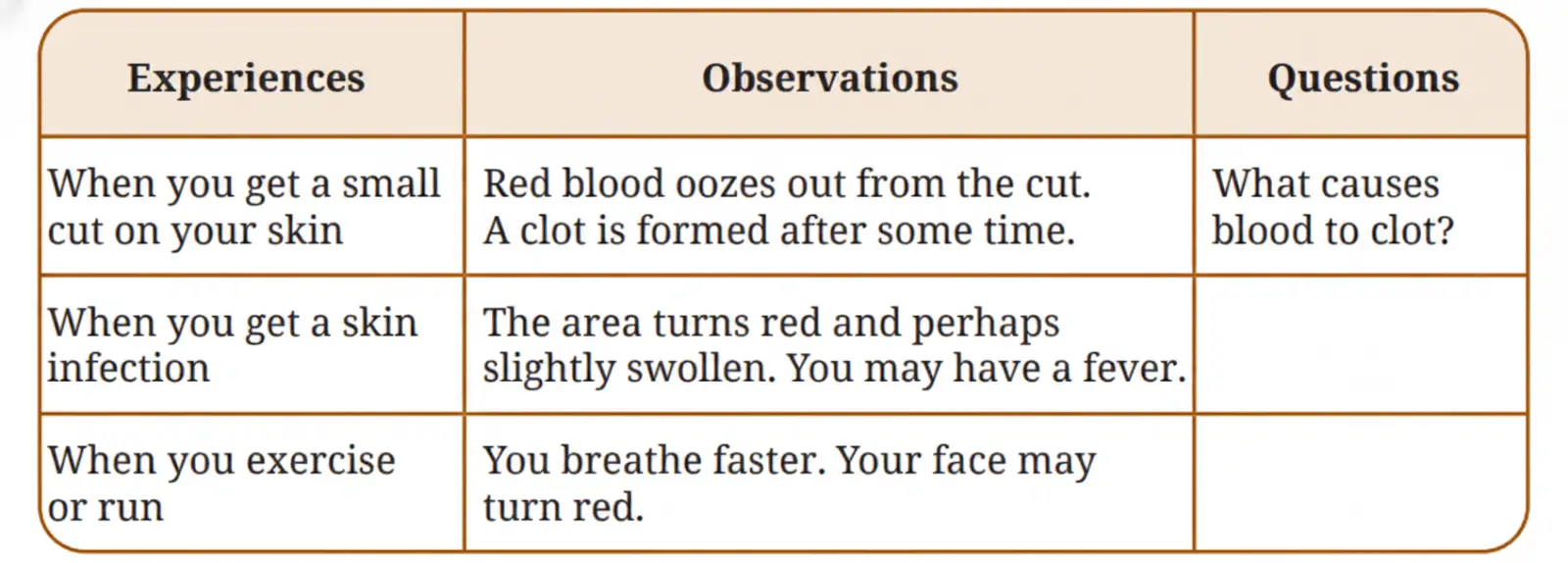
With reference to the provided table of everyday experiences, what is the biological process that causes blood to clot?
Show answer & explanation
Answer: Blood clotting (coagulation) - platelets collect at the cut and release clotting factors that convert the soluble plasma protein fibrinogen into insoluble threads of fibrin, which form a mesh that traps blood cells and seals the wound.
Explanation: Blood is a fluid connective tissue whose matrix is the liquid plasma, in which red blood cells, white blood cells and platelets float. When a blood vessel is cut, red blood oozes out and the platelets (thrombocytes) gather at the injured spot and release chemicals called clotting factors. Together with calcium and other factors present in the plasma, these convert the soluble plasma protein fibrinogen into long, insoluble threads of fibrin. The fibrin threads form a net across the wound that traps blood cells, and this mass dries and hardens into a clot. The clot plugs the cut, stops further loss of blood and prevents germs from entering the body.
Q6Apical meristemmedium3 marks
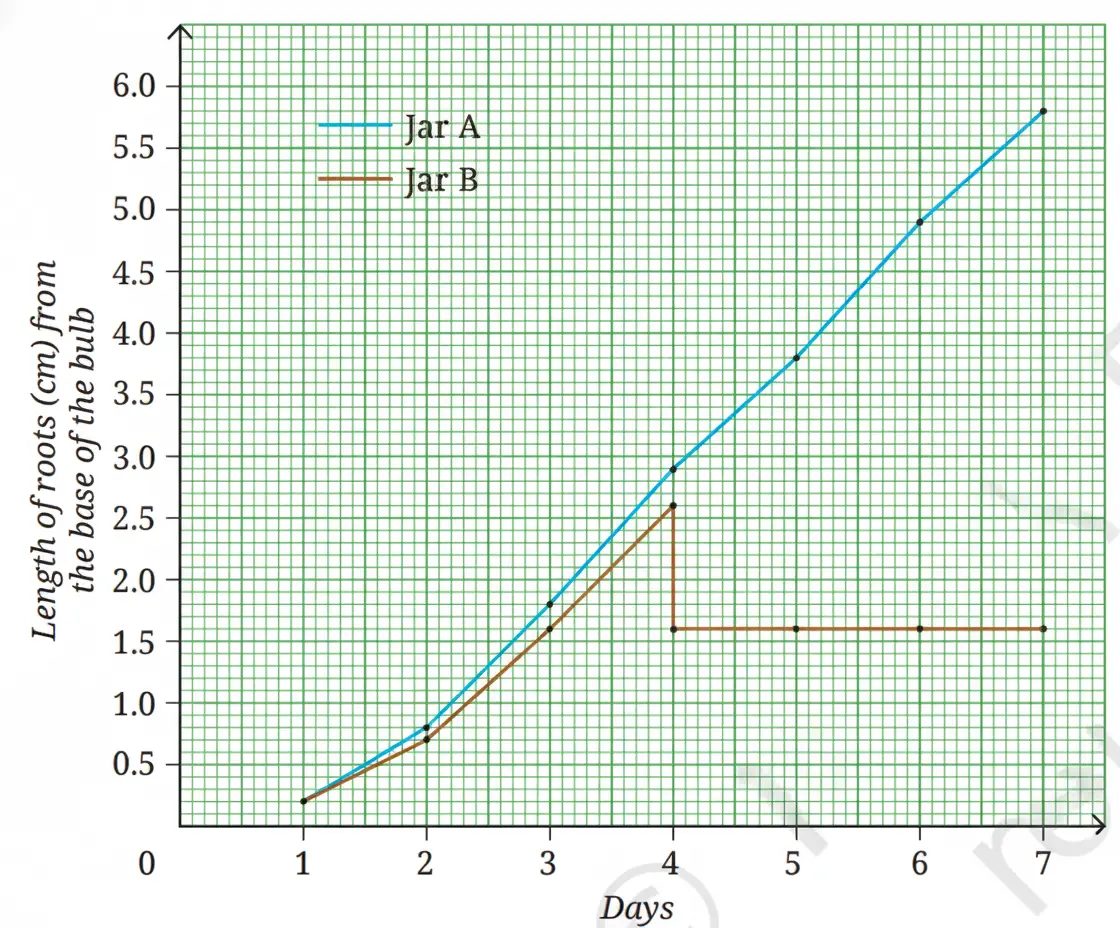
Analyze the provided graph which show the length of onion roots over seven days for two different setups (Jar A and Jar B). Compare the growth trend in Jar A with that in Jar B. Based on this comparison, what can you infer about the location of growth in plant roots?
Show answer & explanation
Answer: The Jar A roots grew steadily on all seven days (about 0.25 cm on day 1 rising to about 5.8 cm on day 7), while the Jar B roots grew at the same rate only up to day 4 (about 2.6 cm), then dropped by 1 cm to 1.6 cm when their tips were cut and stayed at 1.6 cm on days 5, 6 and 7 - showing that a root grows in length only at its tip, where the apical meristem is present.
Explanation: Up to day 4 the two curves almost coincide, so the roots in both jars were growing at the same rate to begin with. The sudden vertical fall of exactly 1 cm in the Jar B line on day 4 marks the point where about 1 cm of the root tips was cut off, and after that the Jar B line stays perfectly flat at 1.6 cm while Jar A keeps climbing to about 5.8 cm. Since removing the tip was the only change made to Jar B, and growth stopped completely after it, the region that makes a root longer must be the tip itself. The tip carries the apical meristem, a group of small, thin-walled, actively dividing cells with dense cytoplasm that keep producing new cells; these new cells then enlarge and increase the length of the root. Once the tip is cut off the meristem is gone, so no new cells are formed and the root can no longer grow in length.
Q7Epithelial tissuesmedium1 mark
For the following Assertion (A) and Reason (R), select the correct option.
Assertion (A): The epithelium in the lungs is highly adapted for gas exchange.
Reason (R): This is because the lung epithelium is composed of many layers of tall cells, which slows down the process of diffusion.
Both (A) and (R) are true, and (R) is the correct explanation of (A).
Both (A) and (R) are true, but (R) is not the correct explanation of (A).
(A) is true, but (R) is false.
(A) is false, but (R) is true.
Show answer & explanation
Answer: (A) is true, but (R) is false.
Explanation: The assertion is true; lung epithelium is specialized for gas exchange. The reason is false; it is made of a single layer of very thin, flat (squamous) cells to minimize diffusion distance, not multiple layers of tall cells.
Q8Epithelial tissueseasy1 mark
What is the primary reason that the epithelial lining of internal organs in animals is typically very thin, consisting of just one or a few layers of cells?
To facilitate efficient food storage.
To offer maximum mechanical strength.
To permit the rapid exchange of substances.
To minimize friction between surfaces.
Show answer & explanation
Answer: To permit the rapid exchange of substances.
Explanation: A thin epithelial layer, such as in the alveoli of the lungs or the lining of blood capillaries, provides a short diffusion path, allowing for the efficient and rapid exchange of gases, nutrients, and waste products.
Q9Muscular tissuesmedium1 mark
For the following Assertion (A) and Reason (R), select the correct option.
Assertion (A): Cardiac muscle tissue is capable of sustained, continuous contraction without experiencing fatigue.
Reason (R): This is due to the presence of a large number of mitochondria and a rich blood supply in cardiac muscle cells.
Both (A) and (R) are true, and (R) is the correct explanation of (A).
Both (A) and (R) are true, but (R) is not the correct explanation of (A).
(A) is true, but (R) is false.
(A) is false, but (R) is true.
Show answer & explanation
Answer: Both (A) and (R) are true, and (R) is the correct explanation of (A).
Explanation: The assertion is true; cardiac muscle works continuously. The reason is also true and correctly explains the assertion. The high number of mitochondria provides constant ATP for energy, and the rich blood supply ensures a steady flow of oxygen and nutrients.
Q10Plant Growtheasy1 mark
Meristematic tissues are characterized by continuous cell division. Which of the following cellular features enables this property?
They possess thick protective walls.
They have large nutrient-storing vacuoles.
They feature thin walls, dense cytoplasm, and a large, prominent nucleus.
They are composed of functionally specialized, differentiated cells.
Show answer & explanation
Answer: They feature thin walls, dense cytoplasm, and a large, prominent nucleus.
Explanation: Meristematic cells are metabolically active with dense cytoplasm, a large nucleus for controlling cell division, and thin walls to allow for growth. They lack large vacuoles which would otherwise hinder rapid division.
Q11Types of Jointseasy1 mark
Identify the type of joint that is primarily responsible for the bending motion of the knees and ankles.
Ball and socket
Hinge
Pivot
Saddle
Show answer & explanation
Answer: Hinge
Explanation: The knee and ankle joints are primarily hinge joints, which allow for movement in one plane, such as flexion and extension (bending and straightening).
Q12Connective tissuesmedium1 mark
For the following Assertion (A) and Reason (R), select the correct option.
Assertion (A): Tendons are structures that connect one bone to another, facilitating movement at the joints.
Reason (R): Tendons are composed of a strong connective tissue designed to transfer the force of muscle contraction to the bone.
Both (A) and (R) are true, and (R) is the correct explanation of (A).
Both (A) and (R) are true, but (R) is not the correct explanation of (A).
(A) is true, but (R) is false.
(A) is false, but (R) is true.
Show answer & explanation
Answer: (A) is false, but (R) is true.
Explanation: The assertion is false; tendons connect muscle to bone, while ligaments connect bone to bone. The reason is a true statement describing the composition and function of tendons.
Q13Types of Jointsmedium1 mark
For the following Assertion (A) and Reason (R), select the correct option.
Assertion (A): Movement in a hinge joint is restricted to a single plane.
Reason (R): This is because the ends of the bones in a hinge joint are shaped to permit sliding movements in every direction.
Both (A) and (R) are true, and (R) is the correct explanation of (A).
Both (A) and (R) are true, but (R) is not the correct explanation of (A).
(A) is true, but (R) is false.
(A) is false, but (R) is true.
Show answer & explanation
Answer: (A) is true, but (R) is false.
Explanation: The assertion is true; hinge joints like the elbow or knee allow movement primarily in one plane (flexion/extension). The reason is false; the specific shape of bones in a hinge joint is what restricts movement to one plane, unlike gliding joints which allow sliding in multiple directions.
Q14Permanent tissueseasy1 mark
A plant is showing symptoms of being unable to move sugars from its leaves to its roots. Which of the following tissues is likely damaged or not functioning correctly?
Xylem
Phloem
Epidermis
Sclerenchyma
Show answer & explanation
Answer: Phloem
Explanation: Phloem is the vascular tissue responsible for translocation, which is the transport of soluble organic compounds (food, primarily sucrose) from the leaves to other parts of the plant like the roots.
Stuck anywhere in Chapter 3 (Tissues in Action)? Vidya ma'am — EduLevel's AI teacher — teaches this chapter live, by voice, and solves your doubts till they click.