Exploration Class 9 Science Chapter 13: Earth as a System: Energy, Matter, and Life — NCERT Solutions
Chapter 13 of the new NCERT Class 9 Science textbook Exploration (2026-27) — Earth as a System: Energy, Matter, and Life. Below are 16 questions from this chapter with answers and step-by-step explanations, including 3 diagram-based questions with their figures. Try each one before revealing the answer — and if a concept doesn't click, Vidya ma'am teaches this exact chapter live in the EduLevel app.
What Chapter 13 covers
Earth Spheres
Uneven Heating
Uneven Heating
Solar Radiation
Planetary winds
Biogeochemical Cycles
Water cycle
Human Impact
Exploration Chapter 13 — solved questions
Attempt each question first, then open the answer to compare your method.
Q1Solar Radiationhard3 marks
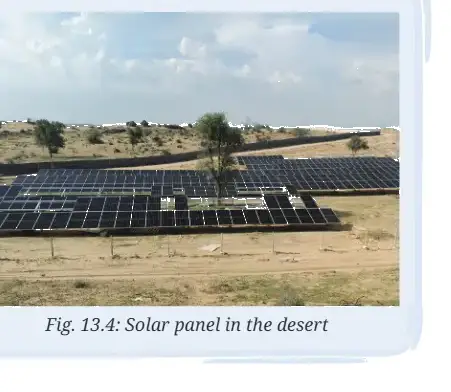
Estimate the surface area of the Earth that needs to be covered with solar panels to meet the entire electricity demand of your country today. To perform this estimation, find the necessary data online, assume a value for insolation on the Earth's surface, and consider an efficiency for the conversion of solar energy to electricity. Compare your result with the area of a large desert, like the Thar desert, to see if it's a feasible solution.
Show answer & explanation
Answer: About 4,000-6,000 km2 (roughly 5,000 km2) of panels is enough - only about 2-3% of the Thar desert's ~2,00,000 km2, so it is feasible in terms of land.
Explanation: Take India's yearly electricity demand as about 1.6 x 10¹² kWh. Assume the ground receives roughly 5 kWh per m2 each day, which is about 1,825 kWh per m2 in a year, and take a panel efficiency of about 15-20%, giving nearly 300 kWh of electricity per m2 per year. Dividing the total demand by this output gives an area of roughly 5,000 km2. Since the Thar desert covers about 2,00,000 km2, the panels would need only a few percent of it, so covering part of a desert with solar panels is a feasible way to meet the demand.
Q2Solar Radiationmedium2 marks
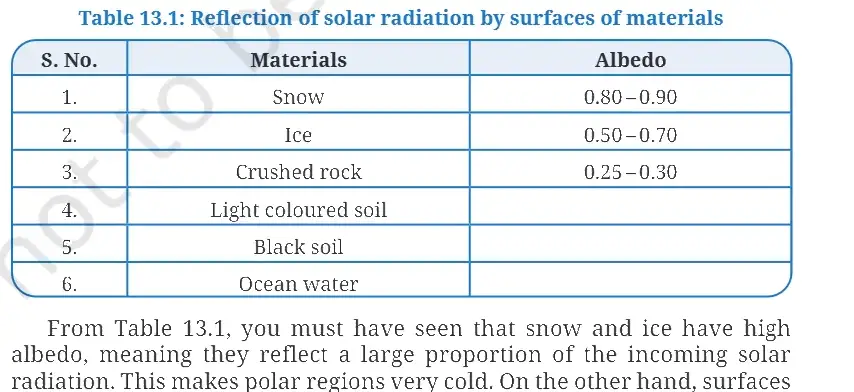
Using reliable sources such as websites and books, find the information required to complete Table 13.1 regarding the albedo of different materials.
Show answer & explanation
Answer: Light coloured soil approx 0.30-0.40; Black soil approx 0.05-0.15; Ocean water approx 0.05-0.10.
Explanation: Albedo is the fraction of incoming solar radiation that a surface reflects. Light, pale surfaces reflect more and so have a higher albedo, while dark surfaces absorb most of the sunlight and have a low albedo. Light-coloured soil is fairly reflective (about 0.30-0.40), black soil is dark and absorbs most radiation (about 0.05-0.15), and deep ocean water also absorbs most of the light falling on it, giving a low albedo (about 0.05-0.10). This is why dark surfaces heat up far more than light ones under the same Sun.
Q3Earth Sphereseasy2 marks
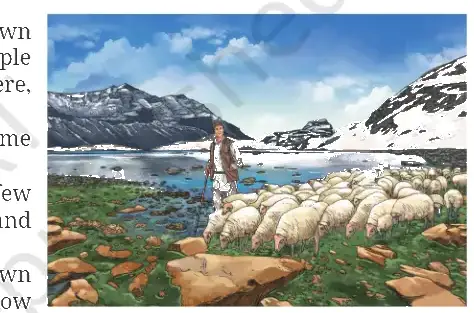
Using the provided diagram (Fig. 13.1) of the Earth's surface, locate and identify one distinct example for each of the following spheres: geosphere, hydrosphere, cryosphere, atmosphere, and biosphere.
Show answer & explanation
Answer: Geosphere - the rocks and mountains; Hydrosphere - the lake water; Cryosphere - the snow on the mountain peaks; Atmosphere - the sky/air; Biosphere - the shepherd, sheep and grass (living things).
Explanation: The Earth is made of interacting spheres. The geosphere is the solid rock and soil, seen as the boulders and mountains; the hydrosphere is all the liquid water, seen as the lake; the cryosphere is the frozen water, seen as the snow and ice on the peaks; the atmosphere is the envelope of gases, seen as the sky and clouds; and the biosphere is all living organisms, seen as the shepherd, his sheep and the grass. The single scene shows all five spheres meeting in one place, showing how closely they interact.
Q4Uneven Heatingmedium2 marks
Explain the benefits of a cool mountain breeze for agricultural activities, specifically for crops and soil.
Show answer & explanation
Answer: The cool breeze lowers the temperature, which cuts down evaporation from the soil and transpiration from plants, keeping soil moist and crops healthy while reducing heat stress and some pests.
Explanation: A cool mountain breeze reduces the air temperature around the fields. cooler air slows down the loss of water by evaporation from the soil surface and by transpiration from leaves, so the soil stays moist for longer and the plants do not wilt or suffer heat stress. The lower temperature also reduces the activity of many pests and can help set fruit and grain, so the moderated microclimate is favourable for healthy crop growth.
Q5Earth Spheresmedium3 marks
If a significant area of forest is removed, describe the possible consequences for the flow of a river located within that region.
Show answer & explanation
Answer: River flow becomes irregular - flash floods and heavy silt during rains, and reduced or dried-up flow in the dry season - because runoff and erosion rise while infiltration and groundwater recharge fall.
Explanation: Trees and their roots intercept rain and hold the soil, letting water soak in and slowly recharge groundwater that keeps a river flowing all year. When the forest is cleared, rain hits the bare ground and runs off quickly instead of soaking in, so during the monsoon the river swells rapidly and may flood, carrying large amounts of eroded soil that silt up the channel. In the dry season there is little stored groundwater to feed the river, so its flow drops sharply or it may even dry up. This shows how the biosphere, geosphere and hydrosphere are linked.
Q6Solar Radiationeasy2 marks
Calculate the amount of solar energy that a 1 m² area would receive in one hour, assuming the insolation at the Earth's surface is 1 kWm⁻².
Show answer & explanation
Answer: 1 kWh (= 3.6 x 10⁶ J = 3.6 MJ).
Explanation: Energy equals power multiplied by time. The insolation of 1 kW per m2 falling on an area of 1 m2 gives a power of 1 kW, and over a time of 1 hour the energy received is 1 kW x 1 h = 1 kilowatt-hour (kWh). Converting to joules, 1 kWh = 1000 W x 3600 s = 3.6 x 10⁶ J, i.e. 3.6 MJ.
Q7Human Impactmedium2 marks
Using the simulation at the provided web address (https://phet.colorado.edu/en/simulations/greenhouse-effect), analyze the relationship between the concentration of greenhouse gases and the planet's surface temperature.
Show answer & explanation
Answer: The relationship is direct - as the greenhouse gas concentration rises, the surface temperature rises; lowering the concentration cools the surface.
Explanation: The Earth's surface, warmed by sunlight, gives off heat as long-wave infrared radiation. Greenhouse gases absorb some of this outgoing radiation and re-emit part of it back towards the surface. In the simulation, increasing the greenhouse gas concentration traps more infrared radiation, so less heat escapes to space and the surface temperature settles at a higher value; reducing the concentration lets more heat escape and the surface cools. So higher greenhouse gas concentration means a warmer planet - a direct relationship.
Q8Biogeochemical Cycleshard3 marks
Based on the information that carbon constitutes about 49% of the dry weight of organisms and 71% of global carbon is in oceans, comment on the significance of the atmosphere holding only about 1% of the total global carbon.
Show answer & explanation
Answer: Though tiny, the atmospheric carbon pool is the most active link of the carbon cycle, so even small additions (e.g. burning fossil fuels) cause large percentage changes in CO2 that strongly affect the greenhouse effect and climate.
Explanation: The atmosphere holds only about 1% of global carbon, yet it is the pool through which carbon constantly moves between the other spheres - plants take CO2 from the air in photosynthesis, and respiration, decay and burning return it. Because this reservoir is so small compared with the oceans and living matter, adding even a modest amount of carbon (for example by burning fossil fuels) changes its concentration by a large percentage. Since atmospheric CO2 controls the greenhouse effect, this small but sensitive pool has an outsized influence on global temperature and climate, and is easily disturbed by human activity.
Q9Planetary windshard3 marks
Imagine two Earth-sized planets, both with atmospheres. One is completely covered by oceans, and the other is entirely land. Given that the Sun heats the equator more intensely than the poles, compare the likely wind patterns on these two hypothetical planets to the wind systems on our Earth, which has both land and sea.
Show answer & explanation
Answer: All three have global equator-to-pole winds from uneven heating; the ocean planet's winds are steady and uniform, the land planet's are extreme and variable, while Earth adds monsoons and land/sea breezes because land and sea heat differently.
Explanation: On any of these planets the Sun heats the equator more than the poles, so warm air rises at the equator and sinks near the poles, setting up large-scale planetary winds. On the all-ocean planet the water heats and cools slowly and evenly, so the winds are steady, regular and humid with few local contrasts. On the all-land planet the surface heats and cools quickly, giving big day-night and seasonal temperature swings and therefore strong, variable, dry winds. Earth has both land and sea, so on top of the planetary winds their different heating rates create extra wind systems such as monsoons and land and sea breezes.
Q10Uneven Heatingmedium3 marks
Describe the changes that occur to warm equatorial surface water as it moves towards the poles, and explain the effect of this water movement on the regions it travels to.
Show answer & explanation
Answer: As the warm current flows poleward it loses heat, cools, becomes denser and saltier and finally sinks; on the way it warms the coasts and regions it passes, giving them a milder, wetter climate.
Explanation: Water near the equator is heated strongly by the Sun and moves poleward as a warm surface current. As it travels it gives up heat to the cooler air, so it gradually cools; evaporation makes it saltier, and the cooling and higher salinity make it denser until it eventually sinks at high latitudes, driving the ocean's thermohaline circulation. Along the way it carries and releases equatorial heat to the regions it passes, keeping their coasts warmer and often wetter than they would otherwise be. In this way ocean currents redistribute heat from the equator towards the poles and moderate climates.
Q11Earth Sphereshard3 marks
Describe how an increase in the concentration of atmospheric carbon dioxide could impact plankton populations in the ocean.
Show answer & explanation
Answer: More CO2 dissolves in the sea: it can boost photosynthesising phytoplankton, but it also makes the water acidic (ocean acidification), which dissolves and weakens the shells of many plankton and reduces their numbers.
Explanation: When atmospheric carbon dioxide rises, more of it dissolves into the ocean. On one hand, phytoplankton use CO2 for photosynthesis, so extra CO2 can help some of them grow faster. On the other hand, dissolved CO2 forms carbonic acid and lowers the water's pH, a process called ocean acidification. Acidic water dissolves and weakens the calcium carbonate shells and skeletons of shell-forming plankton, so their populations fall. Since plankton form the base of the ocean food chain, such changes can disturb the whole marine ecosystem.
Q12Solar Radiationmedium2 marks
Describe the mechanism by which heat is lost from the Earth's surface. What is the importance of this process?
Show answer & explanation
Answer: The Sun-warmed surface loses heat by radiating it as long-wave (infrared) radiation towards the atmosphere and space; this outgoing radiation balances the incoming sunlight and keeps Earth's temperature stable and fit for life.
Explanation: Sunlight warms the Earth's surface, and the warm surface then gives off this energy as long-wave infrared (heat) radiation directed to the atmosphere and out to space. This outgoing radiation is the main way the planet loses the heat it gains from the Sun. The process is important because it balances the incoming solar radiation, so the Earth neither keeps heating up nor cools down without limit, keeping the average temperature steady and within the range that supports life.
Q13Human Impactmedium3 marks
Explain the ways in which human activities contribute to the rise in greenhouse gas concentrations in the atmosphere. Additionally, suggest actions you could take personally to lower greenhouse gas emissions.
Show answer & explanation
Answer: Burning fossil fuels, deforestation, livestock and paddy farming, industry and waste all raise greenhouse gases; personally one can save electricity, walk/cycle or use public transport, plant trees, and reduce, reuse and recycle.
Explanation: Human activities add greenhouse gases mainly by burning fossil fuels (coal, petrol, diesel) for electricity, transport and industry, which releases carbon dioxide; by cutting down forests, which removes trees that absorb CO2; by rearing cattle and growing paddy, which release methane; and by industries, cement making and rotting waste in landfills. To reduce my own emissions I can switch off unused lights and appliances and use energy-efficient LED devices, walk, cycle or take public transport instead of private vehicles, plant and protect trees, and follow reduce-reuse-recycle to cut waste. Choosing renewable energy and avoiding the burning of rubbish also help.
Q14Biogeochemical Cyclesmedium3 marks
Describe the consequences for plants and animals on Earth if the biogeochemical cycles were to be disrupted and cease functioning. Provide a few examples to support your explanation.
Show answer & explanation
Answer: Nutrients would stop being recycled, so life would collapse - e.g. no CO2 recycling stops photosynthesis and starves the food chain, a broken nitrogen cycle halts protein and plant growth, and a stalled water cycle brings drought.
Explanation: Biogeochemical cycles such as the carbon, nitrogen, oxygen and water cycles continuously recycle nutrients between the living and non-living parts of the Earth, so organisms get a fresh supply of the materials they need. If they stopped, these materials would get locked up and could not be reused. For example, if the carbon cycle stopped, plants would run out of CO2 for photosynthesis, so they and the animals depending on them would die; if the nitrogen cycle stopped, plants could not make proteins and would fail to grow; and if the water cycle stopped, there would be no rain or fresh water, causing drought. Dead matter would also not decompose to return nutrients to the soil, so food chains would collapse and life on Earth could not survive.
Q15Uneven Heatingmedium1 mark
Identify the primary mechanism responsible for the warming of the Earth.
Carbon dioxide in the atmosphere directly absorbs solar radiation and releases it as heat.
Small particles in the atmosphere absorb incoming sunlight, which directly heats the planet.
The Earth's surface absorbs sunlight, then re-radiates this energy as heat, which is trapped by greenhouse gases.
The planet is warmed solely by sunlight that is reflected off clouds.
Show answer & explanation
Answer: The Earth's surface absorbs sunlight, then re-radiates this energy as heat, which is trapped by greenhouse gases.
Explanation: The greenhouse effect, the main driver of Earth's warming, involves solar radiation being absorbed by the surface and then re-emitted as infrared radiation, which is then trapped by atmospheric greenhouse gases.
Q16Biogeochemical Cycleseasy1 mark
Select the option that best describes the function of biogeochemical cycles within an ecosystem.
To supply food directly to every organism.
To recycle key nutrients between living and non-living parts of the environment.
To generate new chemical elements for organisms to use.
To eliminate pollutants and harmful substances from an organism.
Show answer & explanation
Answer: To recycle key nutrients between living and non-living parts of the environment.
Explanation: Biogeochemical cycles are the pathways by which essential elements like carbon and nitrogen are circulated between the biotic (living) and abiotic (non-living) components of an ecosystem, ensuring their continuous availability.
Stuck anywhere in Chapter 13 (Earth as a System: Energy, Matter, and Life)? Vidya ma'am — EduLevel's AI teacher — teaches this chapter live, by voice, and solves your doubts till they click.