Exploration Class 9 Science Chapter 8: Journey Inside the Atom — NCERT Solutions
Chapter 8 of the new NCERT Class 9 Science textbook Exploration (2026-27) — Journey Inside the Atom. Below are 20 questions from this chapter with answers and step-by-step explanations, including 5 diagram-based questions with their figures. Try each one before revealing the answer — and if a concept doesn't click, Vidya ma'am teaches this exact chapter live in the EduLevel app.
What Chapter 8 covers
Roots of Atomic Theory
Historical Journey
Thomson's Model
Gold Foil Experiment
Rutherford's Model
Bohr's Model
Discovery of Neutron
Symbols of Elements
Atomic Number
Mass Number
Electron Distribution
Valency
Isotopes
Average Atomic Mass
Isobars
Exploration Chapter 8 — solved questions
Attempt each question first, then open the answer to compare your method.
Q1Valencyeasy1 mark
The valency of an element is determined by the number of electrons present in its:
Innermost shell
Nucleus
Outermost shell
Second shell
Show answer & explanation
Answer: Outermost shell
Explanation: The electrons in the outermost shell, called valence electrons, decide how an atom combines with other atoms. Therefore, the valency of an element is determined by the number of electrons in its outermost shell.
Q2Valencyeasy1 mark
What is the valency of hydrogen?
1
2
3
0
Show answer & explanation
Answer: 1
Explanation: A hydrogen atom has only one electron in its outermost shell and needs one more electron to become stable. Since it can combine with one other atom, the valency of hydrogen is 1.
Q3Valencyeasy1 mark
What is the valency of oxygen?
1
2
3
6
Show answer & explanation
Answer: 2
Explanation: An oxygen atom has 6 electrons in its outermost shell and needs 2 more to complete its octet of 8. Since it needs 2 electrons, the valency of oxygen is 2.
Q4Valencyeasy1 mark
An atom has the electron distribution 2, 8, 8. What is its valency?
0
8
2
18
Show answer & explanation
Answer: 0
Explanation: An atom with the arrangement 2, 8, 8 has 8 electrons in its outermost shell, which is a completely filled, stable arrangement. Valency is the number of electrons an atom gains, loses or shares to reach such a stable outermost shell, so an atom that already has one needs to do nothing - its valency is 0. Atoms like this are largely unreactive for exactly that reason.
Q5Valencymedium1 mark
The electronic configuration of chlorine (atomic number 17) is 2, 8, 7. What is its valency?
7
1
2
3
Show answer & explanation
Answer: 1
Explanation: Chlorine has 7 electrons in its outermost shell and needs only 1 more to complete its octet of 8. Since it needs 1 electron, the valency of chlorine is 1.
Q6Valencymedium1 mark
An element X has the electronic configuration 2, 8, 3. What is the valency of X?
3
5
8
2
Show answer & explanation
Answer: 3
Explanation: Element X has 3 electrons in its outermost shell. It loses these 3 electrons to achieve a stable configuration, so its valency is 3. This element is aluminium.
Q7Valencymedium1 mark
What is the correct chemical formula of magnesium chloride?
MgCl
MgCl₂
Mg₂Cl
Mg₂Cl₃
Show answer & explanation
Answer: MgCl₂
Explanation: Magnesium has a valency of 2 and chlorine has a valency of 1. To balance the valencies, one magnesium atom combines with two chlorine atoms, giving the formula MgCl₂.
Q8Valencymedium1 mark
Nitrogen has 5 electrons in its outermost shell. What is its valency?
5
2
3
1
Show answer & explanation
Answer: 3
Explanation: Although nitrogen has 5 electrons in its outermost shell, it needs 3 more electrons to complete its octet of 8. Since gaining 3 electrons is easier than losing 5, its valency is 3 (8 − 5 = 3).
Q9Valencymedium1 mark
Which of the following pairs of elements will combine in a 1:1 ratio to form a compound?
Magnesium and chlorine
Sodium and chlorine
Aluminium and oxygen
Magnesium and nitrogen
Show answer & explanation
Answer: Sodium and chlorine
Explanation: Sodium has a valency of 1 and chlorine also has a valency of 1. Since both have the same valency, they combine in a 1:1 ratio to form NaCl (sodium chloride).
Q10Valencyhard1 mark
The formula of aluminium oxide is Al₂O₃. The valencies of aluminium and oxygen are respectively:
2 and 3
3 and 2
3 and 3
1 and 2
Show answer & explanation
Answer: 3 and 2
Explanation: Aluminium has a valency of 3 and oxygen has a valency of 2. By the criss-cross method, the valency of aluminium (3) becomes the subscript of oxygen and the valency of oxygen (2) becomes the subscript of aluminium, giving Al₂O₃.
Q11Valencyhard1 mark
Both sodium (Na) and magnesium (Mg) lose electrons to become stable. Why does magnesium have a higher valency than sodium?
Because magnesium has more shells than sodium
Because magnesium has 2 electrons in its outermost shell while sodium has only 1
Because magnesium is heavier than sodium
Because sodium gains electrons while magnesium loses them
Show answer & explanation
Answer: Because magnesium has 2 electrons in its outermost shell while sodium has only 1
Explanation: Sodium (2, 8, 1) has 1 electron in its outermost shell to lose, giving it a valency of 1. Magnesium (2, 8, 2) has 2 outer electrons to lose, giving it a valency of 2. Losing a greater number of outer electrons gives magnesium the higher valency.
Q12Valencyhard1 mark
Two elements P (electronic configuration 2, 8, 2) and Q (electronic configuration 2, 8, 7) combine to form a compound. What is its formula?
PQ
PQ₂
P₂Q
P₂Q₇
Show answer & explanation
Answer: PQ₂
Explanation: P has 2 electrons in its outermost shell, so its valency is 2. Q has 7 outer electrons and needs 1 more, so its valency is 1. Balancing the valencies 2 and 1 by the criss-cross method gives the formula PQ₂.
Q13Atomic Numbereasy2 marks
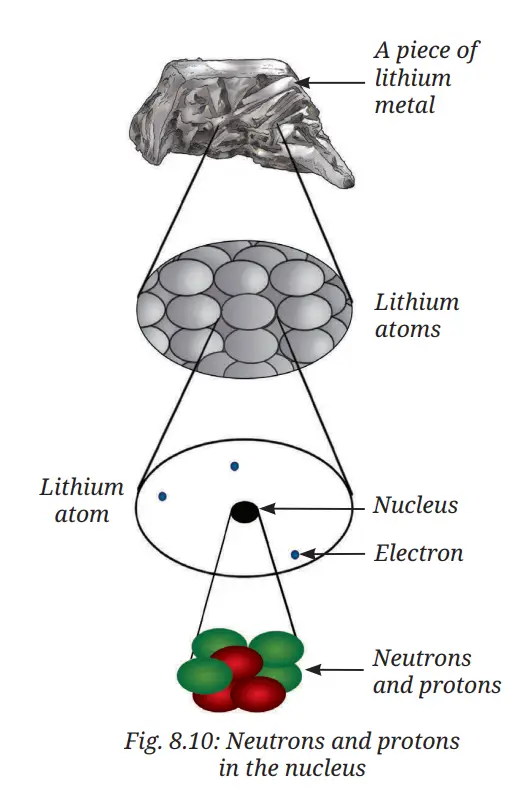
Based on the principle that atomic number uniquely identifies an element, examine the provided diagram of a lithium atom (Fig. 8.10). Determine the number of protons and neutrons within its nucleus and state its atomic number.
Explanation: In Fig. 8.10 the lithium atom is shown with 3 electrons around the nucleus, and since an atom is electrically neutral, the number of protons must equal the number of electrons, so there are 3 protons. The magnified nucleus shows a cluster of 7 particles: 3 protons and 4 neutrons (this is lithium-7, the common isotope). The atomic number is defined as the number of protons in the nucleus, so Z = 3, and this number uniquely identifies the element as lithium. Its mass number would be 3 + 4 = 7.
Q14Isobarsmedium3 marks
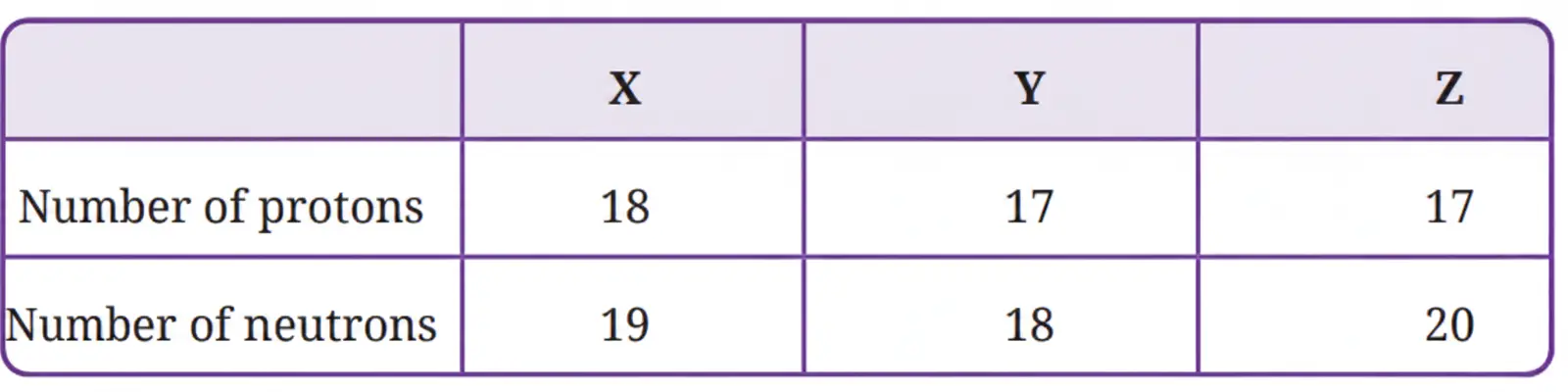
The table provided shows the composition of the nuclei for three atomic species: X, Y, and Z. Based on this data, describe the relationship between the following pairs:
(i) Y and Z
(ii) Z and X
Show answer & explanation
Answer: (i) Y and Z are isotopes (same atomic number 17, mass numbers 35 and 37); (ii) Z and X are isobars (same mass number 37, different atomic numbers 17 and 18).
Explanation: From the table: X has 18 protons and 19 neutrons, Y has 17 protons and 18 neutrons, Z has 17 protons and 20 neutrons. Y and Z have the same number of protons (17), so they are atoms of the same element, but their neutron numbers differ, giving mass numbers 17 + 18 = 35 and 17 + 20 = 37; atoms with the same atomic number but different mass numbers are isotopes. Z and X have different atomic numbers (17 and 18), so they are different elements, but their mass numbers are equal: 17 + 20 = 37 and 18 + 19 = 37. Atoms of different elements with the same mass number are called isobars.
Q15Gold Foil Experimenthard3 marks
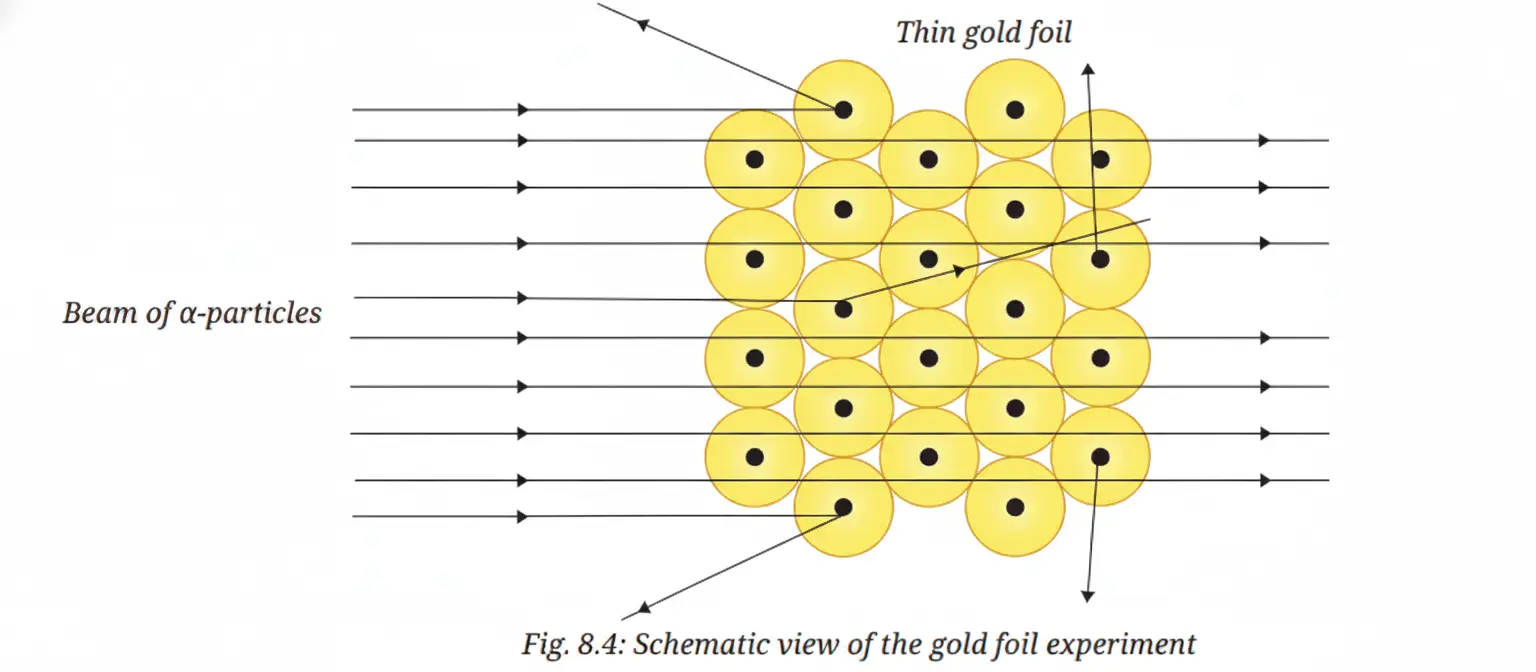
By observing Fig. 8.4 of the gold foil experiment, predict the observations you would expect if the gold foil used in the experiment were made thicker. Also, draw a simple diagram to illustrate the expected observations. Compare a thin foil versus a thick foil and explain how the thickness affects the chances of an alpha particle hitting a nucleus.
Show answer & explanation
Answer: With a thicker foil, more alpha particles would be deflected and bounced back and fewer would pass straight through; a very thick foil could even stop the particles. Thin foil = few atomic layers = most alphas pass undeflected; thick foil = many layers of atoms = a much higher chance of an alpha coming close to or hitting a nucleus.
Explanation: In Fig. 8.4 the foil is only a few atom-layers thick, and since an atom is mostly empty space with a tiny positive nucleus at the centre, most alpha particles pass straight through, a few deflect at small angles, and very few bounce back. Making the foil thicker adds many more layers of gold atoms in the path of each alpha particle, so the probability that a particle passes close to some nucleus, and hence gets repelled by its positive charge, increases with every extra layer. Therefore the number of deflected particles and the number rebounding towards the source would increase, while the fraction passing straight through would decrease; an extremely thick foil would absorb or stop most alpha particles altogether. The diagram should show the same beam entering a foil drawn with many rows of atoms, with more arrows bent at large angles and more arrows turned back than in the thin-foil figure.
Q16Isotopeseasy1 mark
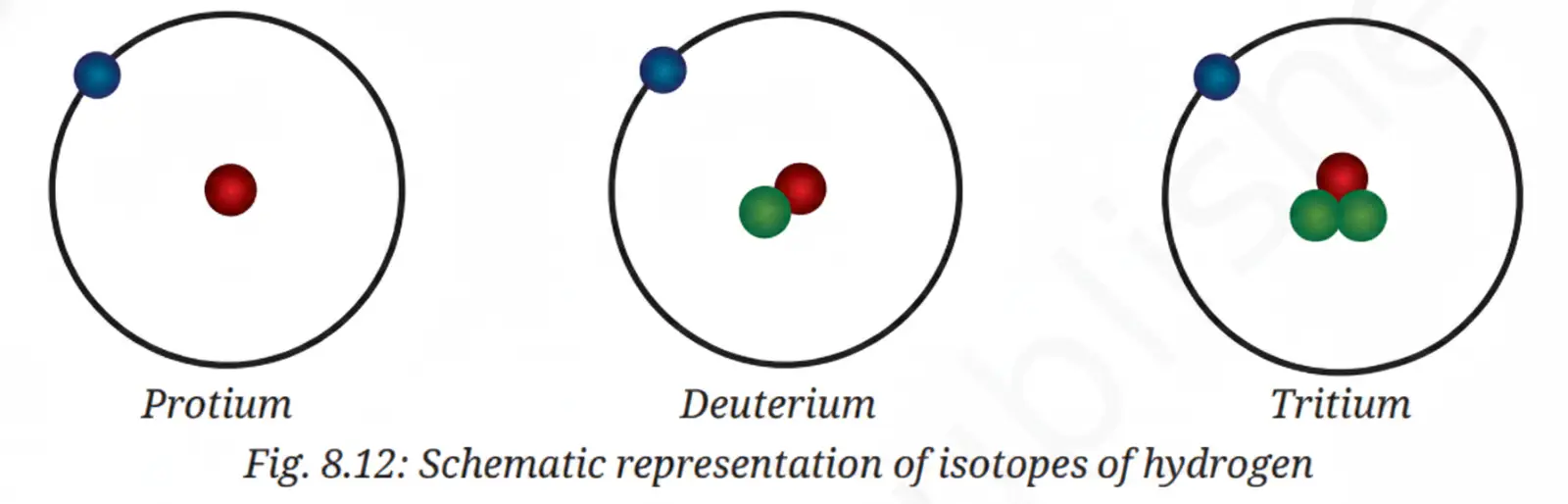
Hydrogen has three isotopes: protium (¹H), deuterium (²H), and tritium (³H). Each has one proton. Deuterium has one neutron, and tritium has two neutrons. Determine the number of electrons present in each of these hydrogen isotopes.
Show answer & explanation
Answer: Each isotope (protium, deuterium and tritium) has exactly 1 electron.
Explanation: An atom is electrically neutral, so the number of electrons always equals the number of protons. All three isotopes of hydrogen have the same atomic number, 1, meaning each has exactly one proton, as Fig. 8.12 shows. The extra neutrons in deuterium and tritium carry no charge, so they change only the mass number, not the electron count. Hence protium, deuterium and tritium each have 1 electron, which is why isotopes of an element show the same chemical behaviour.
Q17Discovery of Neutronmedium3 marks
Conduct research to find out more information about the Dhruva reactor located at the Bhabha Atomic Research Centre (BARC), as shown in the accompanying image.
Show answer & explanation
Answer: Dhruva is India's largest indigenously designed and built research reactor, located at BARC, Trombay (Mumbai); it became operational in 1985, has a thermal power of 100 MW, uses natural uranium fuel with heavy water as moderator and coolant, and serves as a major source of neutrons for research and for producing radioisotopes used in medicine, agriculture and industry.
Explanation: The image (Fig. 8.8) shows the Bhabha Atomic Research Centre at Trombay, Mumbai, India's premier nuclear research facility named after Dr. Homi Jehangir Bhabha. Dhruva, which attained criticality on 8 August 1985, is a landmark of Indian science because it was designed and built entirely by Indian scientists and engineers. It is a 100 MW (thermal) research reactor that uses natural uranium as fuel and heavy water (D2O) as both moderator and coolant; the moderator slows down neutrons so they can sustain the fission chain reaction. Its intense neutron beams are used for research in physics and materials science and for making radioisotopes that serve medicine (diagnosis and cancer treatment), agriculture and industry. It is not used for generating electricity; its purpose is research and isotope production.
Q18Electron Distributioneasy2 marks
Hydrogen's electron distribution is shown in Fig. 8.11. A helium atom has two protons and two electrons. Describe how these two electrons would be arranged in the atomic shells of the helium atom.
Show answer & explanation
Answer: Both electrons of helium occupy the first shell (K shell); its electronic configuration is 2, and the K shell is completely filled.
Explanation: Electrons fill shells starting from the one closest to the nucleus, and the maximum number a shell can hold is 2n2. For the first shell (K shell, n = 1), the capacity is 2 x 12 = 2 electrons. Helium has only 2 electrons, so both fit into the K shell and no other shell is needed, giving the configuration 2. As Fig. 8.11 shows, hydrogen has 1 electron in the K shell while helium has its K shell completely filled; this filled shell makes helium chemically stable (unreactive), with a valency of zero.
Q19Rutherford's Modelmedium1 mark
Consider the following statements. Assertion (A): Rutherford concluded that most of an atom's mass is concentrated in a small central region called the nucleus. Reason (R): According to Thomson's model, electrons are embedded in a uniformly distributed positive charge sphere. Choose the correct option:
(i) Both A and R are true, and R is the correct explanation of A.
(ii) Both A and R are true, but R is not the correct explanation of A.
(iii) A is true, but R is false.
(iv) A is false, but R is true.
Both A and R are true, and R is the correct explanation of A.
Both A and R are true, but R is not the correct explanation of A.
A is true, but R is false.
A is false, but R is true.
Show answer & explanation
Answer: Both A and R are true, but R is not the correct explanation of A.
Explanation: Assertion (A) correctly states Rutherford's conclusion from the gold foil experiment. Reason (R) correctly describes Thomson's model. However, R does not explain A; Rutherford's conclusion was a refutation of Thomson's model, not a consequence of it.
Q20Roots of Atomic Theorymedium1 mark
Consider the following statements:
Assertion (A): The discovery of subatomic particles was crucial for understanding the structure of the atom.
Reason (R): In a neutral atom, the number of electrons is equal to the number of protons.
Choose the correct option:
Both A and R are true, and R is the correct explanation of A.
Both A and R are true, but R is not the correct explanation of A.
A is true, but R is false.
A is false, but R is true.
Show answer & explanation
Answer: Both A and R are true, but R is not the correct explanation of A.
Explanation: Assertion (A) is true because discovering protons, neutrons, and electrons allowed scientists to build models of the atom. Reason (R) is also true for a neutral atom. However, R is just one property of an atom, not the full explanation for why discovering these particles was important for understanding atomic structure. The discovery itself, not just the number equality, was key.
Stuck anywhere in Chapter 8 (Journey Inside the Atom)? Vidya ma'am — EduLevel's AI teacher — teaches this chapter live, by voice, and solves your doubts till they click.