Exploration Class 9 Science Chapter 2: Cell: The Building Block of Life — NCERT Solutions
Chapter 2 of the new NCERT Class 9 Science textbook Exploration (2026-27) — Cell: The Building Block of Life. Below are 20 questions from this chapter with answers and step-by-step explanations, including 5 diagram-based questions with their figures. Try each one before revealing the answer — and if a concept doesn't click, Vidya ma'am teaches this exact chapter live in the EduLevel app.
What Chapter 2 covers
How to Study Cells
Structure of Cell
Cell Membrane
Cell Wall
Cell Interior
Cell Division
Exploration Chapter 2 — solved questions
Attempt each question first, then open the answer to compare your method.
Q1Structure of Celleasy1 mark
Which organelle is known as the powerhouse of the cell?
Nucleus
Mitochondria
Ribosome
Golgi apparatus
Show answer & explanation
Answer: Mitochondria
Explanation: Mitochondria release energy in the form of ATP through cellular respiration. Because they generate most of the energy the cell needs for its activities, they are called the powerhouse of the cell.
Q2Structure of Celleasy1 mark
Which structure controls all the activities of a cell and contains its genetic material?
Cell membrane
Cytoplasm
Nucleus
Vacuole
Show answer & explanation
Answer: Nucleus
Explanation: The nucleus contains the DNA, which is the genetic material of the cell. It directs and controls all the activities of the cell, so it acts as the control centre of the cell.
Q3Structure of Celleasy1 mark
Which cell organelle is the site of protein synthesis?
Ribosomes
Lysosomes
Plastids
Vacuoles
Show answer & explanation
Answer: Ribosomes
Explanation: Ribosomes are tiny organelles where amino acids are joined together to build proteins. Because they manufacture proteins, they are often called the protein factories of the cell.
Q4Structure of Celleasy1 mark
Which of the following is present in a plant cell but absent in an animal cell?
Cell membrane
Cell wall
Nucleus
Cytoplasm
Show answer & explanation
Answer: Cell wall
Explanation: A rigid cell wall made of cellulose surrounds the cell membrane in plant cells and gives them shape and support. Animal cells do not have a cell wall, so this feature is unique to plant cells.
Q5Structure of Cellmedium1 mark
Which organelle contains digestive enzymes and is often called the suicidal bag of the cell?
Golgi apparatus
Lysosome
Ribosome
Mitochondrion
Show answer & explanation
Answer: Lysosome
Explanation: Lysosomes are the cell's clean-up system: they hold powerful digestive enzymes that break down worn-out cell parts and other waste, keeping the cell tidy. The nickname comes from what happens if a cell is badly damaged - the lysosomes can release their enzymes and digest the cell itself. Note that your textbook simply calls lysosomes the clean-up system rather than using the nickname, so use that phrasing in an exam.
Q6Structure of Cellmedium1 mark
What is the main function of the Golgi apparatus in a cell?
Releasing energy from food
Storing, modifying and packaging materials
Controlling cell division
Trapping sunlight for photosynthesis
Show answer & explanation
Answer: Storing, modifying and packaging materials
Explanation: The Golgi apparatus receives materials made in the endoplasmic reticulum, then modifies, packages and dispatches them to different parts of the cell or outside it. It works like the packaging and dispatch unit of the cell.
Q7Structure of Cellmedium1 mark
A single large central vacuole that occupies most of the cell space is a characteristic feature of:
Animal cells
Bacterial cells only
Mature plant cells
Red blood cells
Show answer & explanation
Answer: Mature plant cells
Explanation: Mature plant cells usually have one large central vacuole that takes up most of the space inside the cell, pushing the other contents against the cell wall. It stores water, salts and other substances, and by staying full of water it maintains a pressure that keeps the cell firm - which is what holds a non-woody plant upright. Animal cells have vacuoles too, but small ones. When a plant loses water these vacuoles lose pressure and the plant wilts.
Q8Structure of Cellmedium1 mark
Which statement correctly describes a difference between the cell membrane and the cell wall?
The cell membrane is rigid while the cell wall is flexible
The cell membrane is selectively permeable while the cell wall lets water and dissolved minerals through
The cell wall is found only in animal cells
The cell membrane is made of cellulose
Show answer & explanation
Answer: The cell membrane is selectively permeable while the cell wall lets water and dissolved minerals through
Explanation: The cell membrane is selectively permeable: it controls which substances move into and out of the cell, and every cell has one. The cell wall sits outside it in plant cells, is made mainly of cellulose and is rigid, so it gives the cell shape and protects it while letting water and some dissolved minerals pass through. So the membrane is the layer that decides what gets in, and the wall is the layer that provides structure.
Q9Structure of Cellmedium1 mark
Ribosomes may attach to the surface of which organelle, giving it a rough appearance under the microscope?
Smooth endoplasmic reticulum
Rough endoplasmic reticulum
Golgi apparatus
Lysosome
Show answer & explanation
Answer: Rough endoplasmic reticulum
Explanation: When ribosomes attach to the surface of the endoplasmic reticulum, it looks rough and is called the rough endoplasmic reticulum. It helps in the synthesis and transport of proteins made by these ribosomes.
Q10Structure of Cellhard1 mark
Both mitochondria and chloroplasts have their own DNA. Which statement best describes a key functional difference between them?
Mitochondria trap solar energy while chloroplasts release energy
Chloroplasts make food using sunlight while mitochondria release energy from that food
Both release energy but neither makes food
Mitochondria make proteins while chloroplasts store water
Show answer & explanation
Answer: Chloroplasts make food using sunlight while mitochondria release energy from that food
Explanation: Chloroplasts carry out photosynthesis, using sunlight to make food such as glucose. Mitochondria then break down this food during respiration to release energy as ATP. So chloroplasts store energy in food and mitochondria release it.
Q11Structure of Cellhard1 mark
A cell viewed under a microscope has no cell wall, no plastids, many small vacuoles and a well-defined nucleus. This cell is most likely a(n):
Bacterial cell
Plant cell
Animal cell
Fungal cell
Show answer & explanation
Answer: Animal cell
Explanation: The absence of a cell wall and plastids rules out plant, bacterial and fungal cells, which all have cell walls. A well-defined membrane-bound nucleus along with many small vacuoles is typical of an animal cell.
Q12Structure of Cellhard1 mark
When placed in a concentrated salt solution, a plant cell loses water but does not completely collapse, unlike an animal cell. Why?
Because the plant cell has a nucleus
Because the rigid cell wall maintains the cell's shape even when the membrane shrinks
Because plant cells do not contain any water
Because the cell membrane of plants is completely impermeable
Show answer & explanation
Answer: Because the rigid cell wall maintains the cell's shape even when the membrane shrinks
Explanation: In a concentrated solution there is more solute outside the cell than inside, so water moves out of the cell by osmosis. The contents shrink and pull away from the cell wall, leaving a widening gap between the inner contents and the outer boundary. The cell does not collapse because the rigid cellulose wall holds its shape even after the contents have shrunk. Your textbook explains this through osmosis without giving the process a special name, so describe what happens rather than naming it.
Q13Cell Interiormedium3 marks
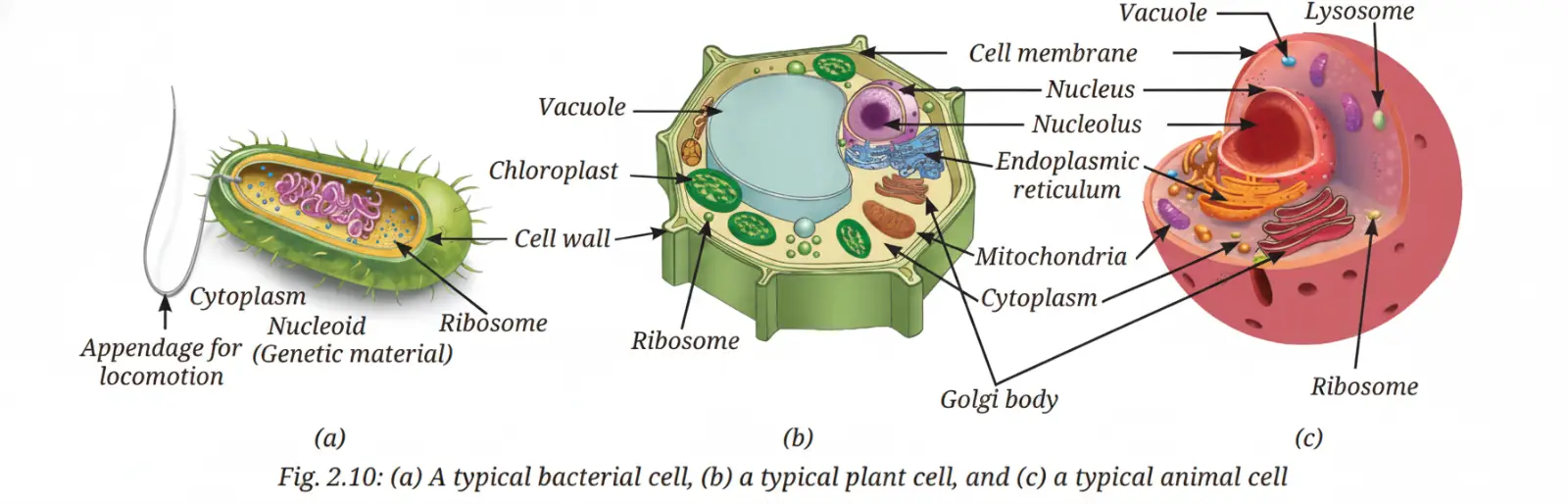
Examine the provided diagrams of a bacterial cell, a plant cell, and an animal cell in Fig. 2.10. Identify the structures present in each cell type and compare them.
Show answer & explanation
Answer: Common to all three: cell membrane, cytoplasm, ribosomes and genetic material. Bacterial cell (prokaryotic): cell wall and a nucleoid (genetic material with no membrane around it), no well-defined nucleus, no membrane-bound organelles, and an appendage for locomotion. Plant cell (eukaryotic): cell wall outside the cell membrane, well-defined nucleus with nucleolus, chloroplasts, a large vacuole, endoplasmic reticulum, Golgi body and mitochondria. Animal cell (eukaryotic): cell membrane but no cell wall, well-defined nucleus with nucleolus, lysosomes, a small vacuole, endoplasmic reticulum, Golgi body and mitochondria, but no chloroplast.
Explanation: A bacterial cell lacks a well-defined nucleus and membrane-bound organelles; its genetic material lies free in the cytoplasm as a nucleoid, so it is a prokaryotic cell and most of its cellular activities take place directly in the cytoplasm. Plant and animal cells both have a well-defined nucleus, that is, genetic material enclosed by a membrane, along with several membrane-bound organelles such as endoplasmic reticulum, Golgi body and mitochondria, so both are eukaryotic cells. Comparing the two eukaryotic cells, the plant cell has an extra rigid cell wall outside its cell membrane, chloroplasts for making food and a large vacuole, while the animal cell has none of these but does show lysosomes. The cell membrane, cytoplasm, ribosomes and genetic material are seen in all three types, showing that these are the basic requirements of any living cell.
Q14Cell Wallmedium3 marks
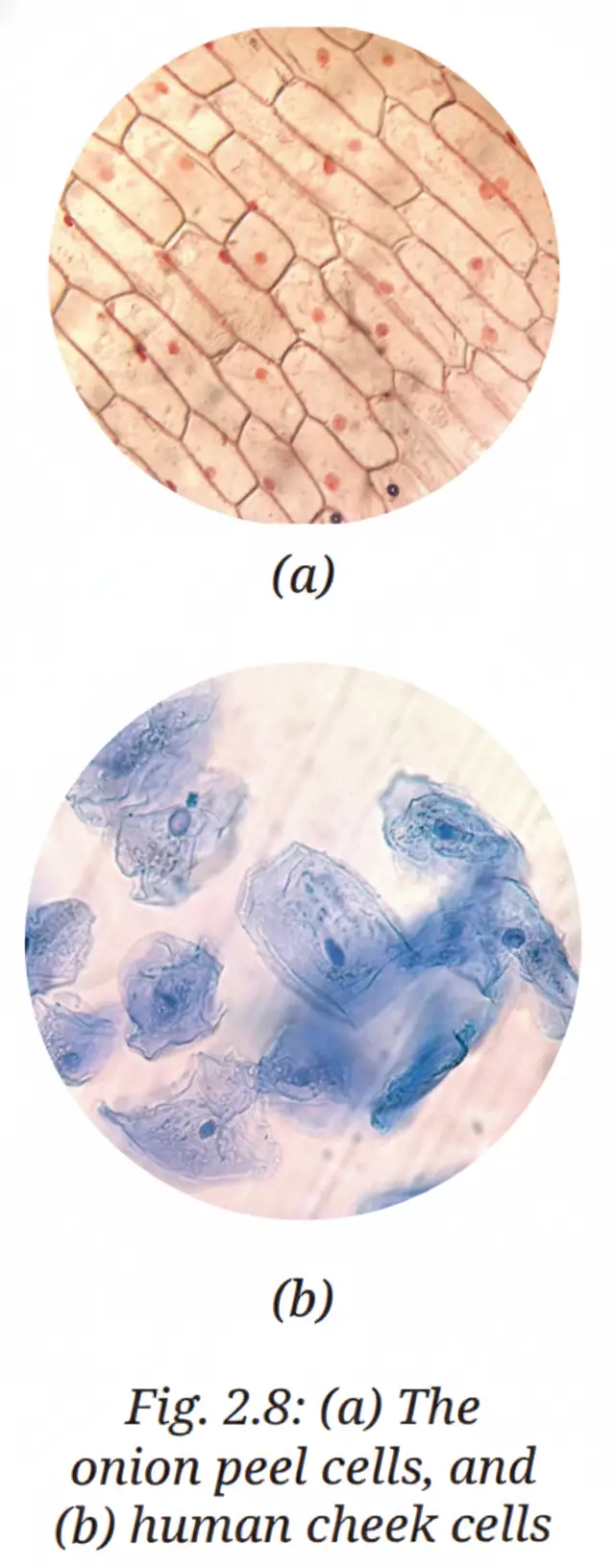
Based on the microscopic observation of temporary mounts of an onion peel and human cheek cells, address the following:
(i) Compare the shape and arrangement of the onion peel cells with those of the human cheek cells.
(ii) Provide a reason for the structural differences observed between the two types of cells.
(iii) Predict and describe the changes that would be seen if a 20 per cent sugar solution is applied to fresh slides of a Rhoeo leaf peel and human cheek cells, and they are observed after thirty minutes.
Show answer & explanation
Answer: (i) Onion peel cells are box-shaped with distinct boundaries and are arranged regularly and compactly like bricks in a wall, whereas cheek cells are rounded, irregular in shape and irregularly arranged. (ii) Onion peel cells are plant cells and have a rigid cell wall outside the cell membrane that fixes their shape and keeps them in a regular arrangement, while cheek cells are animal cells with only a flexible cell membrane and no cell wall, so they have no definite shape. (iii) Both lose water by osmosis: in the Rhoeo leaf peel cells the outer boundary stays the same but the inner content shrinks and the space between the inner and outer boundaries increases, while the cheek cells shrink considerably as a whole.
Explanation: The cell wall of a plant cell is made mainly of cellulose and is rigid, so it gives the onion peel and Rhoeo cells a fixed box-like shape and holds them packed in an orderly arrangement. Cheek cells are animal cells that have only the thin, flexible cell membrane and no cell wall, so they change shape easily and appear irregular and scattered. A 20 per cent sugar solution is more concentrated than the cell sap, so water moves out of the cells through the selectively permeable cell membrane by osmosis. In the Rhoeo cell the rigid cell wall keeps the outer boundary unchanged, so only the cell membrane and the inner content pull away and shrink, leaving a widening space between the shrunken content and the cell wall. The cheek cell has no cell wall to maintain its shape, so on losing water the whole cell shrinks.
Q15Cell Membranemedium3 marks
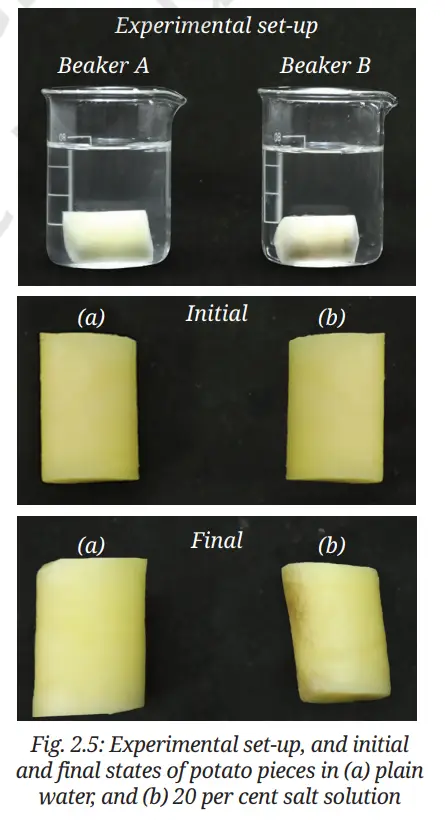
An experiment is set up using two potato pieces of roughly equal size. One is placed in Beaker A containing plain water, and the other in Beaker B containing a 20 per cent salt or sugar solution. After an hour, the initial and final weights are compared. What observations can be made regarding the change in size and weight for the potato pieces in both beakers?
Show answer & explanation
Answer: Beaker A (plain water): the potato piece swells, so its size increases and its final weight is more than its initial weight. Beaker B (20 per cent salt or sugar solution): the potato piece shrinks, so its size decreases and its final weight is less than its initial weight.
Explanation: The cell membrane of the potato cells is selectively permeable, which means it allows water to move in and out of the cell but not the salt or sugar molecules. Through such a membrane water moves from an area with more water and less solute, that is a dilute solution, to an area with less water and more solute, that is a concentrated solution; this movement of water is called osmosis. In Beaker A the plain water is more dilute than the cell sap of the potato cells, so water enters the cells and the piece swells and gains weight. In Beaker B the 20 per cent solution is more concentrated than the cell sap, so water moves out of the cells and the piece shrinks and loses weight.
Q16Cell Membranemedium3 marks
Describe the effect on a cell when it is placed into salt or sugar solutions of different concentrations, specifically isotonic, hypotonic, and hypertonic solutions.
Show answer & explanation
Answer: Isotonic solution (solute concentration of the extracellular medium = that of the intracellular medium): water enters and leaves at the same rate, so there is no net movement of water and the cell remains unchanged. Hypotonic solution (solute concentration outside < inside): water enters the cell by osmosis and the cell swells. Hypertonic solution (solute concentration outside > inside): water moves out of the cell by osmosis and the cell shrinks.
Explanation: The cell membrane is selectively permeable, so water can cross it but the dissolved salt or sugar cannot; water therefore moves by osmosis from the side having more water and less solute towards the side having less water and more solute. In an isotonic solution the solute concentrations of the extracellular and intracellular media are equal, so water moves both ways at the same rate and there is no net gain or loss, leaving the cell unchanged in size. In a hypotonic solution the surrounding medium is more dilute than the cell contents, so water moves into the cell and it swells. In a hypertonic solution the surrounding medium is more concentrated than the cell contents, so water moves out and the cell shrinks. A plant cell placed in a hypertonic solution keeps its outer shape because of its rigid cell wall, and only its inner content pulls away from the wall.
Q17Cell Divisionmedium2 marks
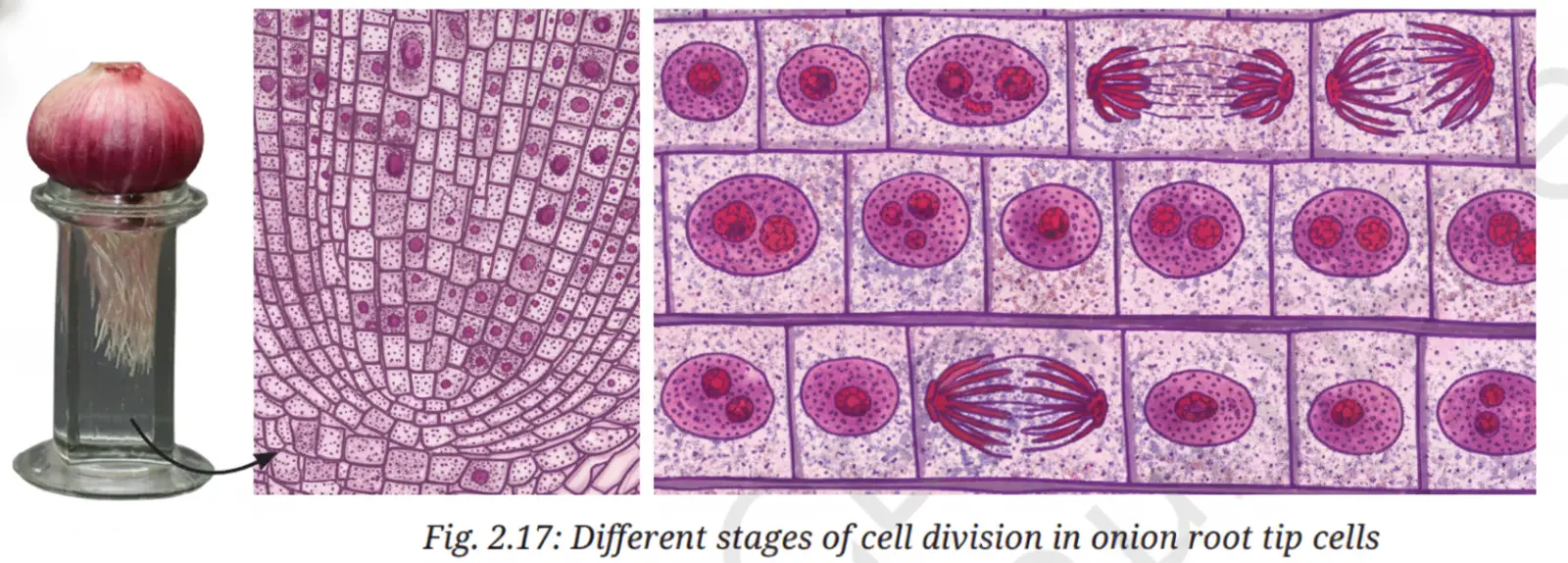
The provided image displays various stages of cell division in the cells of an onion root tip. Determine which of these stages occurs first in the sequence of cell division.
Show answer & explanation
Answer: The stage that comes first is the one in which the cell still has an intact, well-defined nucleus whose genetic material has condensed into distinct thread-like chromosomes, with no spindle fibres formed yet; the cells showing spindle fibres with chromosomes in the middle, then chromosomes pulled to opposite ends, and finally two daughter nuclei, come later.
Explanation: The cells at the growing tip of an onion root divide continuously, so a single slide catches different cells at different stages of cell division, which is why they show different structures. The earliest stage is recognised by the nucleus still being whole and enclosed, with the genetic material inside it just thickening into visible thread-like chromosomes, because nothing has yet been separated or pulled apart. After this the nuclear boundary disappears and spindle fibres appear and arrange the chromosomes in the middle of the cell, the chromosomes are then pulled towards opposite ends of the cell, and finally two separate daughter nuclei are formed and the cell divides into two. So the correct sequence is: intact nucleus with condensed chromosomes, then chromosomes in the middle with spindle fibres, then chromosomes at opposite ends, and then two daughter nuclei. The detailed names of these stages are studied in higher grades.
Q18Structure of Celleasy1 mark
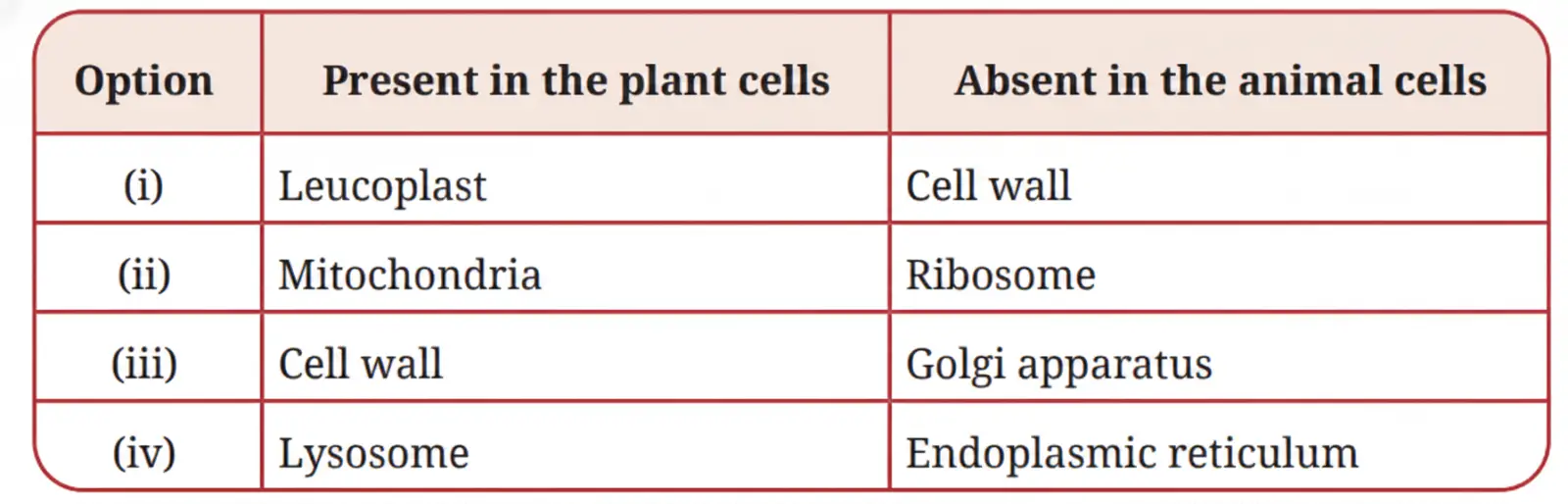
From the table provided, which option correctly identifies a pair of organelles that are present in plant cells but absent in animal cells?
Leucoplast, Cell wall
Mitochondria, Ribosome
Cell wall, Golgi apparatus
Lysosome, Endoplasmic reticulum
Show answer & explanation
Answer: Leucoplast, Cell wall
Explanation: Leucoplasts are colourless plastids that store food material such as starch, oils and proteins, and plastids of every kind are found only in plant cells and never in animal cells. The cell wall is an additional rigid covering, made mainly of cellulose, that lies outside the cell membrane in plant cells and gives them a fixed shape and support, whereas an animal cell has only a cell membrane. In the other options, mitochondria, ribosomes, Golgi apparatus, lysosomes and endoplasmic reticulum are all present in animal cells too, so those pairs do not fit the given categories. Hence only the pair leucoplast and cell wall is present in plant cells and absent in animal cells.
Q19Cell Membranemedium2 marks
Two identical animal cells are studied. Cell X is submerged in pure water, and Cell Y is submerged in a concentrated salt solution. After a period, it is noted that Cell X has swollen, and Cell Y has shrunk. Which of the following statements correctly explains these observations?
(i) Salt molecules entered Cell Y, making it shrink.
(ii) Water entered Cell X, and more water left Cell Y than salt entered it.
(iii) Water moved into Cell X and out of Cell Y via the cell membrane.
(iv) The movement of solute particles caused osmosis in both cells.
Salt molecules entered Cell Y, making it shrink.
Water entered Cell X, and more water left Cell Y than salt entered it.
Water moved into Cell X and out of Cell Y via the cell membrane.
The movement of solute particles caused osmosis in both cells.
Show answer & explanation
Answer: Water moved into Cell X and out of Cell Y via the cell membrane.
Explanation: Cell X is in a hypotonic solution (pure water), so water enters the cell, causing it to swell. Cell Y is in a hypertonic solution (concentrated salt), so water moves out of the cell, causing it to shrink. This movement of water across a semi-permeable membrane is osmosis.
Q20Cell Interioreasy1 mark
Which of the following pairs of cell organelles both contain their own DNA?
Chloroplasts, Ribosomes
Mitochondria, Nucleus
Golgi bodies, Ribosomes
Nucleus, Lysosomes
Show answer & explanation
Answer: Mitochondria, Nucleus
Explanation: The nucleus contains the cell's primary genome. Mitochondria and chloroplasts are unique organelles that contain their own small, circular DNA, supporting the endosymbiotic theory.
Stuck anywhere in Chapter 2 (Cell: The Building Block of Life)? Vidya ma'am — EduLevel's AI teacher — teaches this chapter live, by voice, and solves your doubts till they click.